

Oil, Natural Gas, and the Strait of Hormuz
Oil Price Update (+0.59%)
As of March 22, 2026, Brent crude settled at $107.04/bbl, a daily gain of +$0.63 (+0.59%). Since February 26, Brent has risen +51.30% from its pre-war close of $70.75.
LNG Market Update (-0.35%)
As of March 22, 2026, Cheniere Energy Inc. (LNG) closed at $280.89, a daily change of -$0.98 (-0.35%). Since February 26, the stock has gained +20.81% from its pre-war close of $232.51.
Strait of Hormuz Status (CRITICAL)
The maritime threat environment across the Arabian Gulf, Strait of Hormuz (SoH), and Gulf of Oman remains CRITICAL. Commercial traffic through the SoH is extremely limited, with current observed transit at just 1 vessel per day, compared to a historical average of approximately 138 vessels per day.
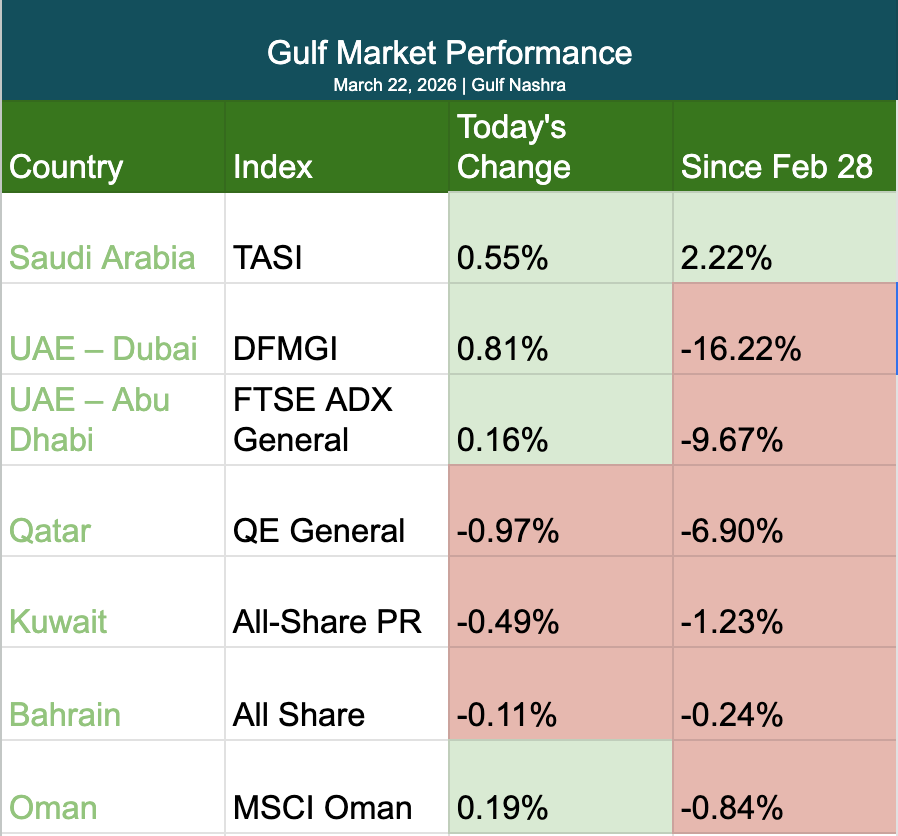
Stock Markets
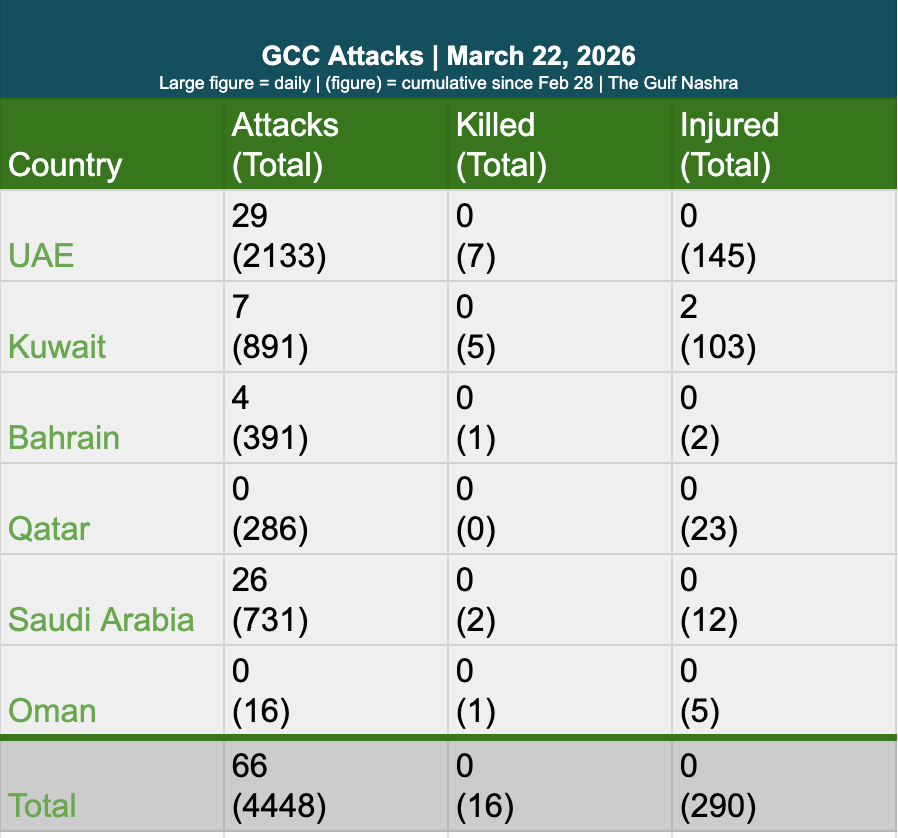
Attacks Summary
States’ Updates
“The Gulf countries may retaliate if Iran attacks continue, Turkey says.” Middle East Eye, March 21, 2026.
🇸🇦 Saudi Arabia
“Turkey, Saudi Arabia, Egypt and Pakistan meet as Ankara pushes for a security pact.” Middle East Eye, March 21, 2026.
“MBS, al-Sisi warn Iranian attacks on Gulf threaten regional stability.” Alarabiya, March 21, 2026.
“Aramco CEO Withdraws From Houston Event to Deal With War.” Bloomberg, March 22, 2026.
“Saudi Arabia orders Iranian military attache, four embassy staff to leave.” Reuters, March 21, 2026.
🇦🇪 UAE
“Explosion reported near tanker off UAE's Sharjah coast.” Middle East Eye, March 22, 2026.
🇰🇼 Kuwait
“Drone attack sparks fire at Kuwait Mina Al-Ahmadi refinery, units shut.” Middle East Eye, March 22, 2026.
🇶🇦 Qatar
“Seven killed in Qatar helicopter crash.” Alarabiya, March 22, 2026.
🇧🇭 Bahrain
“Patriot missile involved in Bahrain blast likely US-operated, analysis finds.” Reuters, March 22, 2026.
Public Debates
Gulf commentary today converges around a single escalation axis: Donald Trump 48-hour ultimatum to Iran—linking the opening of the Strait of Hormuz to threats of destroying Iranian energy infrastructure—and Tehran’s counter-signals that any such strike would trigger reciprocal attacks across the region. What emerges is not a conventional crisis cycle, but a transition toward coercive rule-setting, where energy systems themselves become the central lever of pressure. As Ebtisam Alkitbi framed it, this is “not an ordinary threat, but a strategic warning,” reflecting a shift from crisis management to the imposition of new rules by force—rules that could either compel calibrated Iranian retreat or push the Gulf into an open-ended escalation redefining security and energy equations simultaneously.
From Saudi voices, the dominant reading interprets the ultimatum as regime-level coercion rather than tactical signaling. Jamal Al Tamimi described it as a “clear declaration” of intent to bring down the Iranian system, noting that control over the Strait remains Tehran’s most critical deterrent tool—one it cannot afford to lose. At the operational level, Faisal Alhamad outlined a spectrum of US options, from forcing compliance to targeting dual-use energy infrastructure, highlighting a key constraint: a full blackout scenario, while feasible, risks consolidating domestic Iranian support around the regime—an outcome Washington likely seeks to avoid. Meanwhile, Hamdan Alshehri emphasized internal resilience narratives, arguing that Gulf security rests not only on capability but on preparedness and continuity after decades of confronting Iranian asymmetric behavior.
In the UAE, the framing sharpens into binary strategic outcomes. Dhahi Khalfan reduced the moment to two options for Tehran: compliance or collapse. This reflects a broader Emirati analytical line that sees the ultimatum as a forced decision point rather than a negotiable phase. The underlying assumption is that the cost of defiance has been deliberately raised to existential levels, narrowing Iran’s maneuvering space and compressing timelines for response.
Omani and Qatari commentary, however, foreground the regional spillover risks embedded in this logic. Yahya Al Wahibi pointed to explicit Iranian signaling that any strike on electricity or desalination infrastructure would be mirrored across the Gulf, reinforcing a doctrine of symmetrical retaliation. Saeed Jadad went further, warning that such an exchange would collapse Gulf neutrality entirely, triggering full-scale military engagement supported by allied powers. From Qatar, Khaled Al Kuwari and Al Qatari framed the escalation as indirectly targeting Gulf states themselves, arguing that Washington is fully aware that striking Iran’s energy sector would inevitably draw retaliation against regional infrastructure—effectively widening the war’s scope by design rather than accident.
Across Kuwait and Bahrain, the endpoint of this trajectory is articulated with clarity: escalation beyond infrastructure targeting would mark the definitive end of restraint. Meshal Alnami observed early signs of partial Iranian compliance in maritime signaling, but questioned whether this would satisfy US demands or invite further pressure. Abdulaziz Al-Buainain concluded that any Iranian strike on Gulf energy or water systems would transform the conflict from managed confrontation into total mobilization aimed at decisive defeat. Taken together, Gulf discourse today reflects a shared recognition that the current moment is not about deterrence signaling alone, but about crossing a threshold—where energy infrastructure becomes both the trigger and the battlefield of a potentially system-wide regional war.
Selected Gulf Opinions
“Trump and his backward team—especially his disastrous Secretary of Defense Pete Hegseth—whose mindset is no different from that of Mullah Omar, Osama bin Laden, Ayman al-Zawahiri, Abu Musab al-Zarqawi, Khomeini, Itamar Ben-Gvir, and Bezalel Smotrich. Anyone who thinks in a theocratic way has brought nothing to human societies but bloodshed and destruction—something both history and our present reality, which we see with our own eyes, clearly demonstrate.”
Anwar Al Rasheed, X, (Kuwait), March 22, 2026.
“I would not rule out the possibility that many units within the Islamic Revolutionary Guard Corps are led by operatives acting as Mossad agents, carrying out strikes on Gulf targets in ways that serve Israeli objectives. We recall the extent of Israeli infiltration into Iranian officials, to the point that the head of the committee tasked with countering Mossad was himself revealed to be a Mossad agent.”
Khaled Al Kuwari, X, (Qatar), March 22, 2026.
“The Omani foreign minister is the only Arab official to describe the American war as illegitimate and US policy as compromised and subject to Israeli dominance; this position reflects a model of Omani self-confidence, independent decision-making, and refusal to submit to the dictates of bullying powers.”
Zakaria Almuharami, X, (Oman), March 19, 2026.
“While it launches thousands of missiles and drones against all Gulf states, it maintains a deceptive diplomatic tone through its president and foreign minister, claiming it targets what it considers American facilities. This is false, as airports, civilian neighborhoods, and economic sites have been struck. At the same time, Tehran appears to be preparing to recalibrate its relations for the post-war phase once the conflict ends.”
Abdulrahman Al-Rashed, Asharq Al-Awsat, (Saudi Arabia), March 18, 2026.