

Oil, Natural Gas, and the Strait of Hormuz
Oil Price: +41.5%
As of the US market close on March 9, 2026, West Texas Intermediate (WTI) crude oil settled at $94.77 per barrel. The session was marked by extreme volatility; prices skyrocketed nearly 18% intraday to a peak of $119.43 following the intensification of the Hormuz blockade, before retracing after G7 leaders signaled a potential massive Strategic Petroleum Reserve (SPR) release. The net daily increase was 4.26%, with a total rise of 41.5% since February 27. Investing.com, March 9, 2026.
LNG Price: +51.3%
As of the close on March 9, 2026, the Japan-Korea Marker (JKM) LNG futures settled at $16.23 per mmBtu, a 3.31% daily increase. Global benchmarks remain at multi-year highs as the market prices in the indefinite halt of Qatari exports. Since the pre-war baseline of $10.72, the JKM has surged by 51.3%. Investing.com, March 9, 2026.
Strait of Hormuz Status: Critical Blockade
UKMTO and the Joint Maritime Information Center (JMIC) report that commercial transit has collapsed to near-zero levels. Advisory #2026 (March 9) maintains a “CRITICAL” threat level. Only one confirmed commercial transit was recorded in the last 24 hours. International insurers have effectively suspended “War Risk” coverage, and severe GPS/AIS interference is reported throughout the waterway. UKMTO
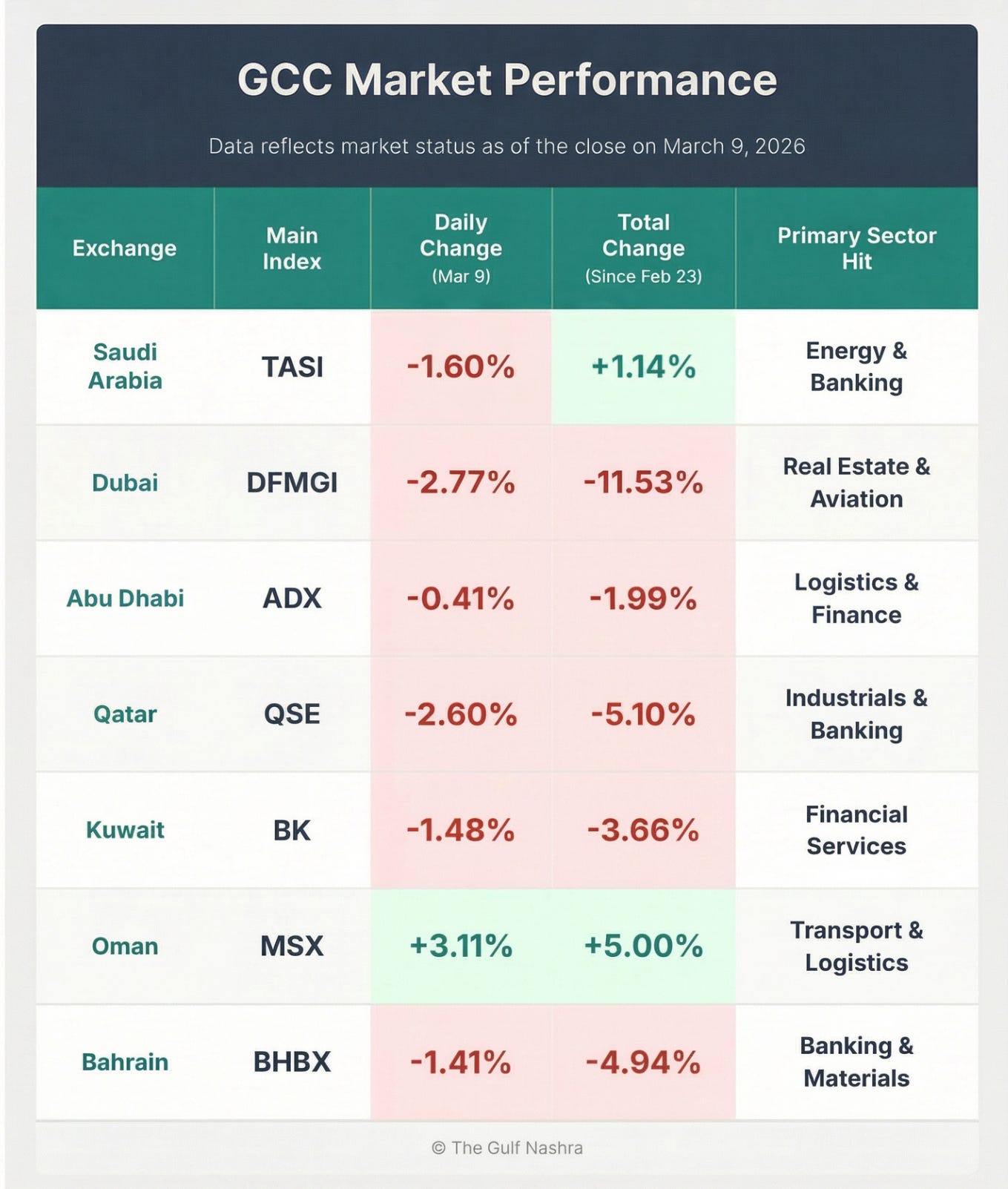
Stock Markets
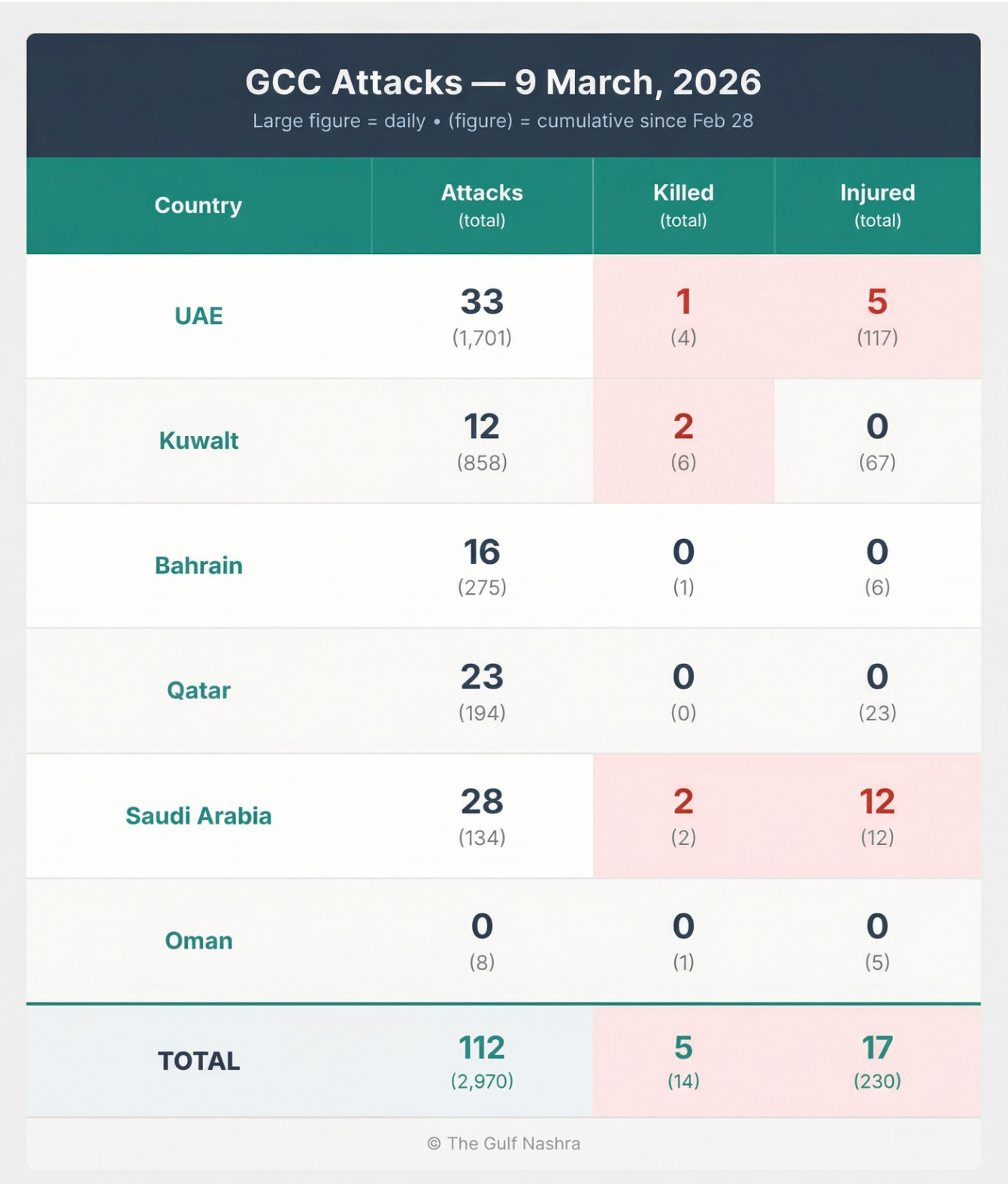
Attacks Summary
States’ Updates
🇸🇦 Saudi Arabia
“Lindsey Graham threatens Saudi Arabia if they do not join war on Iran.” Middle East Monitor, March 9, 2026.
“Saudi Arabia Starts Oil Cuts as It Races to Reroute Exports.” Bloomberg, March 9, 2026.
“Saudi Arabia intercepts 3 drones targeting Shaybah oilfield.” Middle East Monitor, March 9, 2026.
🇦🇪 UAE
“UAE officials deny Israeli reports of strike inside Iran.” Middle East Monitor, March 8, 2026.
“UAE ‘will not partake in any attacks’ on Iran: ambassador.” France 24, March 9, 2026.
“South Korea president says can’t stop US forces from redeploying weapons.” Reuters, March 9, 2026.
“UAE military helicopter crashes due to technical glitch, 2 dead.” Dubai Eye 103.8, March 9, 2026.
🇶🇦 Qatar
“Qatar’s emir warns Trump of ‘serious consequences’ from war with Iran.” Middle East Monitor, March 9, 2026.
“Qatar arrests 313 people for sharing footage, ‘misleading information’ amid attacks by Iran.” Dawn, March 9, 2026.
🇴🇲 Oman
“Oman’s sultan congratulates Iran’s new supreme leader.” Middle East Eye, March 9, 2026.
“Oman’s Muscat airport receives private jets amid reports on limits.” Reuters, March 9, 2026.
🇰🇼 Kuwait
“Kuwait’s Emir Slams Iran Over Its Attacks on the Region.” WSJ, March 9, 2026.
“Kuwait mourns two officials killed as Iran war rages.” Reuters, March 9, 2026.
🇧🇭 Bahrain
“One Dead in Iranian Attack on Bahraini Residential Building, Bahrain Says.” WSJ, March 9, 2026.
“Bapco declares force majeure as Iran sets Bahrain’s only refinery ablaze.” Euro News, March 9, 2026.
Public Opinion
A tweet by Lindsey Graham calling on Saudi Arabia to join the war against Iran drew sharp criticism from Gulf commentators. At the same time, the Israeli newspaper Yedioth Ahronoth reported unverified claims that the United Arab Emirates had carried out a strike on a desalination plant inside Iran, which Israeli officials interpreted as a possible signal of the UAE entry into the war. Against this backdrop, Gulf commentators increasingly focused on rejecting what they see as growing Western pressure on Gulf states to become directly involved in the war.
In response, Emirati commentator Abdulkhaleq Abdullah stated that, aside from the fact that the report was “not true,” the UAE would “never target civilian infrastructure.” Mohammed Al Hammadi expressed similar skepticism, asking how such a serious claim could be published without confirmation or an official statement from the UAE. Meanwhile, Saudi analyst Hesham Alghannam suggested that the episode reflects the need for “a reassessment of alliances and agreements,” indirectly pointing to the evolving relationship between Israel and the UAE. Moreover, Omani commentator Zakaria Al Muharami expressed hope that the United Arab Emirates would “close the Israeli embassy, expel the Zionist ambassador, and cut all forms of normalization with this treacherous entity that denies its crimes and shifts the blame onto the people of the Gulf, thereby exposing them to the dangers of reckless retaliation and destruction.”
Regarding Senator Graham remarks, Gulf commentators broadly expressed solidarity with the Saudi position. Although he later deleted the tweet, Emirati businessman Khalaf Ahmad Al Habtoor responded sharply, stating: “We say it clearly: we will not enter this war to serve the interests of others, nor will we sacrifice our sons in a conflict that could have been avoided through diplomacy and political solutions. We value the lives of our people and do not treat them as ‘collateral damage,’ as some others do.” From Kuwait, Mohammed Al Moqatei accused the senator of “playing the role of a devil in inflaming religious conflict and mocking Arabs and Muslims with blatant arrogance.” He further urged Donald Trump to “sideline extremists within his administration and act with rational judgment, similar to European leaders, to keep the region away from the quagmire of war.” Meanwhile, Bahraini commentator Abdulla Aljenaid remarked that “there is a big difference between diplomacy and thuglomacy.”
Saudi commentators, for their part, responded particularly forcefully to Graham remarks. Abdullah Mashat noted that the strong Saudi and broader Arab reaction reflected a growing awareness among Gulf publics of attempts to drag the region into the war. Salman bin Hithlain wrote that “Americans bear the consequences of everything, so do not warn us about consequences if you are the one who started the war.” Abdulatif Al Shaikh added that “major international relations are built on mutual respect and strategic trust, not on the language of ultimatums and threats.” Mohammed Al Bishi argued that when Saudi Arabia was fighting Iran backed Houthis in Yemen and facing drone and missile attacks on its territory, the United States failed to provide the expected support to its ally. Abdulaziz Altwaijri similarly argued that the war ultimately serves Israeli interests and therefore does not align with Saudi Arabia priorities. Finally, Saudi-American academic Nora Al Doaiji offered a technical critique of Graham’s message, concluding that “everything here is wrong: the message, the logic, the tone, the format — absolutely all of it.”
More Gulf Opinions
“The sympathy of Donald Trump toward Israel has become excessive, repulsive, and unbecoming of a country like the United States.”
Abdul Ghaffar Hussain, X, (UAE), March 9, 2026.
“During this war, the United Arab Emirates, Qatar, Kuwait, and Bahrain proved themselves to be the spearhead of the Gulf and at the forefront of its defense in action, not merely in words. As the saying goes, no one can scratch your skin like your own nail. No one can any longer underestimate countries such as Qatar, Bahrain, and Kuwait, for despite their small size, these states have demonstrated remarkable strength and courage through a determined and impressive defense of their homelands.”
Obaid Khalfan, X, (UAE), March 9, 2026.
“Who would have believed that a war in the twenty-first century would revive narratives of religious wars? In the conflict between Iran, Israel, and the United States, religious discourse appears through the statements of politicians. Ancient history remains present in the background and in the language used. In an age of technology and artificial intelligence, the world sometimes still moves with an ancient mindset.”
Dawood Alshirian, X, (Saudi Arabia), March 9, 2026.
“Since World War II, there has hardly been a war in the world without the imprint of the United States—either igniting it, funding it, or managing it.
Then it comes to sell us peace.
And with it, peace always begins with a ‘base.’”
Almukhtar Alhannani, X, (Oman), March 9, 2026.
“Turning the Gulf region into a battlefield does not serve the stability of the region. At the same time, it reveals an important reality: development success itself can become a target of conflict. Therefore, the best strategic response is to preserve and further develop this success, because the strength of a model may ultimately prove more powerful than the force of missiles.”
Mohammed Alrumaihi [Kuwait], Al Bayan, (UAE), March 8, 2026.