

Oil, Natural Gas, and the Strait of Hormuz
Oil Price: $85.68 (-9.59%)
As of the US market close on March 10, 2026, West Texas Intermediate (WTI) crude oil settled at $85.68 per barrel. This marks a sharp 9.59% decline from Monday’s close. The crash was triggered by a “de-escalation rally” in Washington and rumors of a massive coordinated G7 SPR release, which pulled prices back from the historic $119 peak. Despite today’s drop, WTI remains 27.8% higher than the pre-war baseline ($67.02). - Investing.com, March 10, 2026.
LNG Price: $15.92 (-1.91%)
As of the close on March 10, 2026, the Japan-Korea Marker (JKM) LNG futures settled at $15.92 per mmBtu, a daily decrease of 1.91%. While shadowing the oil market’s cooling, LNG prices remain structurally elevated due to the physical absence of Qatari supply. JKM is still trading 48.4% above its pre-conflict price of $10.72, as buyers remain desperate for available Atlantic cargoes.Investing.com, March 10, 2026.
Strait of Hormuz Status: Critical Blockade
UKMTO reports that the blockade remains largely effective, though a few vessels have attempted a “chicken run” transit. According to Advisory #017-26, only two vessels (non-Western linked) successfully transited the Strait in the last 24 hours by switching off transponders or signaling “Chinese ownership.” The threat level remains CRITICAL, with UKMTO confirming a total of 14 major incidents (10 direct attacks) since February 28. UKMTO, March 10, 2026.
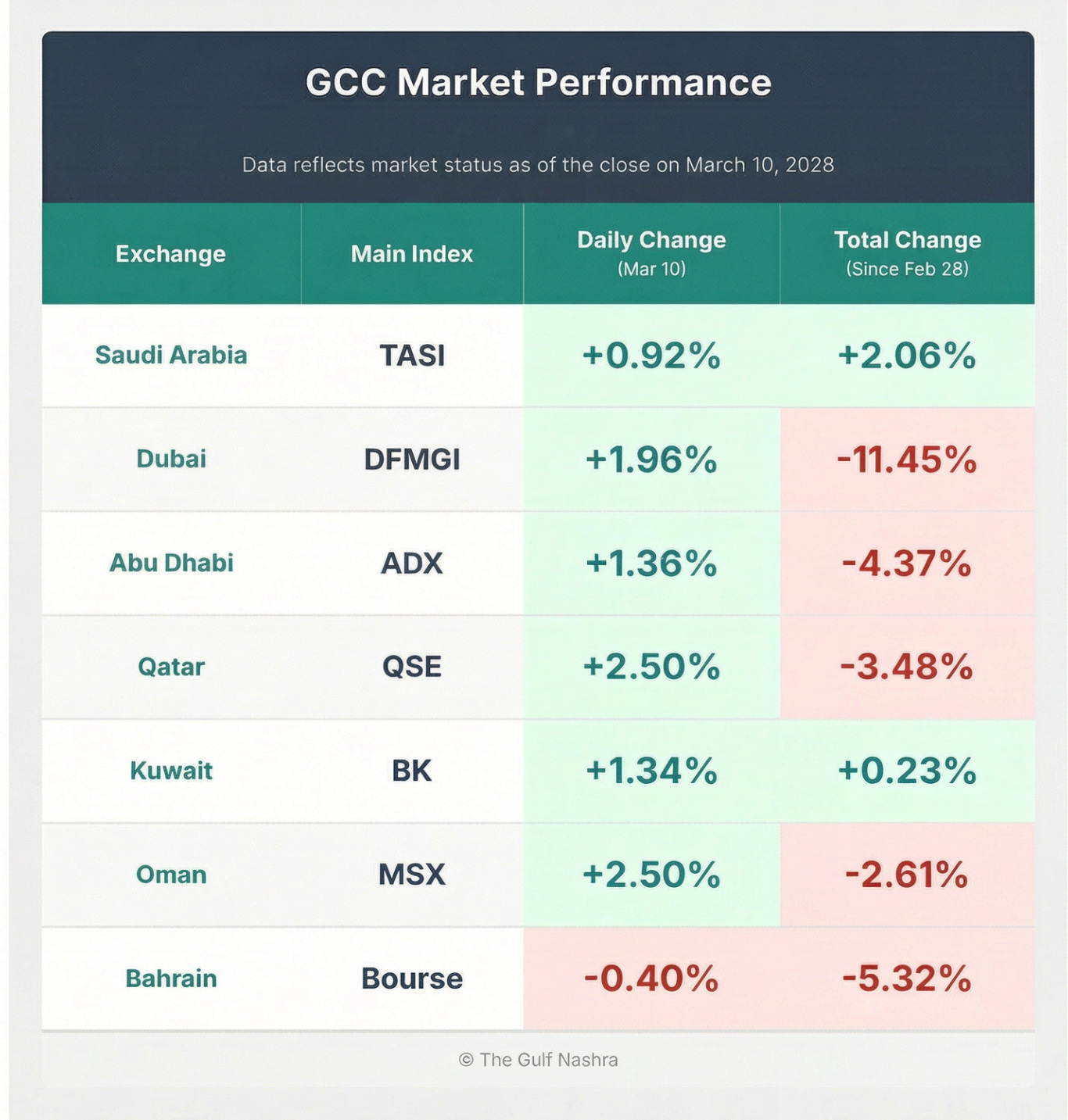
Stock Markets
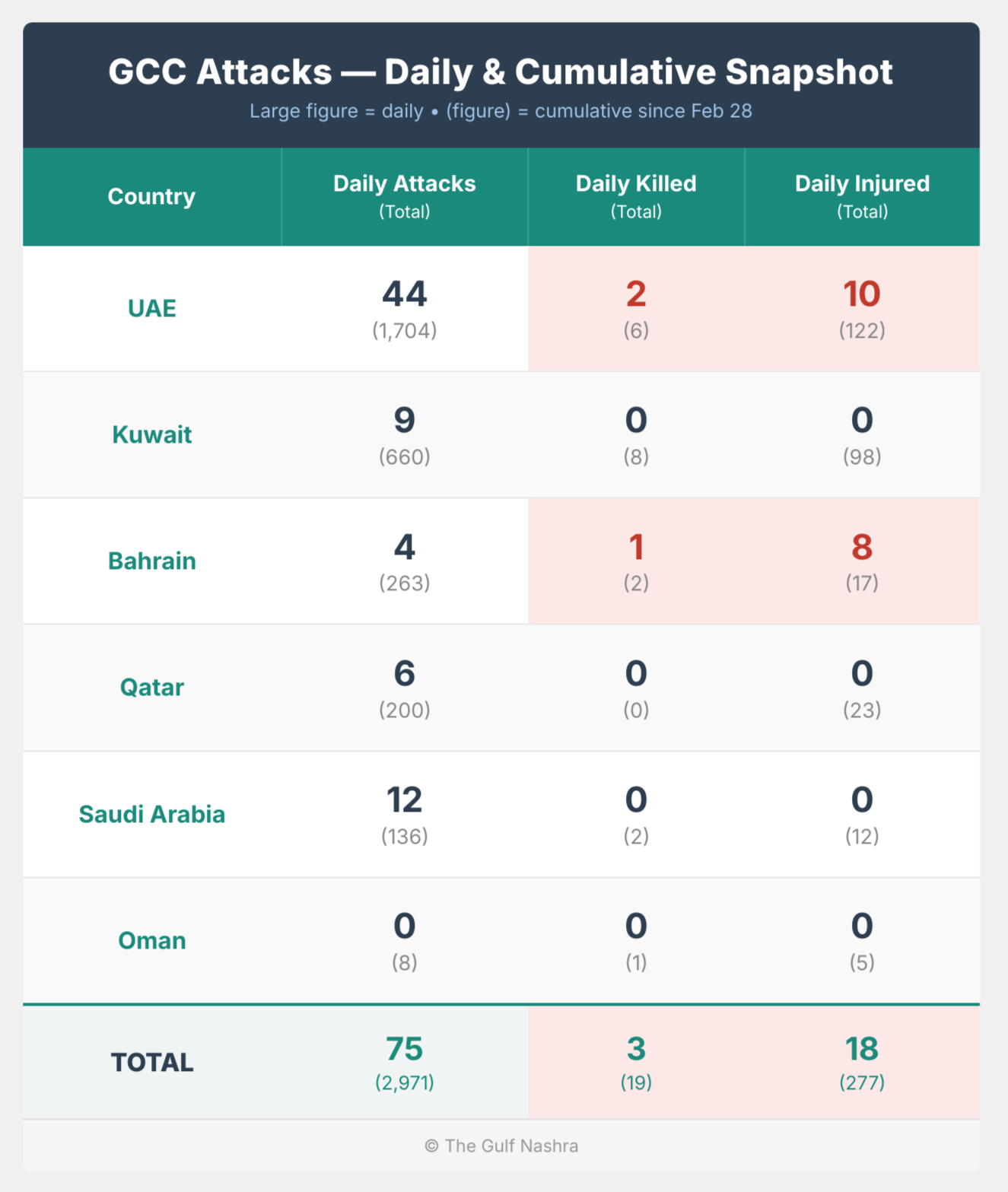
Attacks Summary
States’ Updates
“IEA Proposes Largest Ever Oil Stockpile Release, WSJ Says.” Bloomberg, March 10, 2026.
“Zelensky says Ukrainian drone experts to visit Qatar, UAE, Saudi Arabia this week.” Times of Israel, March 10, 2026.
🇸🇦 Saudi Arabia
“Swinging into action:' The Saudi Arabian pipeline designed to bypass Hormuz.” Middle East Eye, March 10, 2026.
🇦🇪 UAE
“UAE oil giant ADNOC shuts Ruwais refinery after drone strike, source says.” Reuters, March 10, 2026.
“Tankers Shun Fujairah, Freeing Up Oil for Sale at Higher Prices.” Bloomberg, March 11, 2026.
🇶🇦 Qatar
“Qatar’s LNG Export Halt Extends to Longest Since at Least 2008.” Bloomberg, March 11, 2026.
🇴🇲 Oman
“Oman's Grand Mufti: We ask God to guide Iran's strikes accurately into depths of occupied entity.” Saba, March 10, 2026.
Public Debates
The selection of Ayatollah Mojtaba Khamenei as the new Supreme Leader of the Islamic Republic of Iran — and the congratulatory messages sent by Sultan Haitham bin Tariq of Oman and Oman Grand Mufti Ahmed Al-Khalili — became a subject of debate among Gulf commentators this week.
Saudi commentators approached the issue largely from a geopolitical perspective, focusing on what the new leadership might mean for Iran’s regional posture. Abdulrahman Al-Rashed argued that the key question is not the personality of the new leader but “how he differs from his predecessor.” He noted that Imam Khomeini, despite his rigidity, ultimately demonstrated “a degree of pragmatism” when he agreed to end the war with Iraq. His successor, Ali Khamenei, went further by expanding the role of the Revolutionary Guard and the Quds Force, “militarizing” Iran foreign policy, pursuing the nuclear program, and building networks of regional proxies. Whether the new leader will follow the same path, he suggested, remains uncertain. Dawood Al-Shirian expressed similar caution, arguing that influence behind the scenes does not guarantee success in leadership: “In cinema as in politics, it is difficult for a supporting actor to become a hero.”
Emirati commentators were generally more pessimistic, with many describing Mojtaba Khamenei as even more hardline than his predecessor. Abdulkhaleq Abdullah warned that the region may be facing “an Iran that is more radical, more dangerous, and more aggressive.” Jamal Al-Mulla cited claims made by Jaber Rajabi, a former Quds Force member who defected from Iran, alleging that Mojtaba Khamenei believes he is the “Khorasani” destined to lead the army of black banners to Jerusalem, possesses vast wealth distributed across the world under different names, and subscribes to ideas of Persian supremacy, believing the awaited Mahdi will be Persian.
In Kuwait, expectations were similarly low. Veteran diplomat Fuad Al-Hashim described Iran as evolving into what he called a new political model: “a religious hereditary republic,” following earlier examples of hereditary republics in Syria and communist North Korea. Abdullah Al-Shayji examined the broader debate over “regime change,” arguing that transforming Iran through air strikes or bombing campaigns reflects a “superficial understanding” of the Iranian system and ignores its political and “ideological complexity.”
The most contentious issue, however, was Oman’s official congratulations to the new leader. Kuwait’s Nayef Al-Ajmey criticized the message as “provocative to your brothers in the region,” expressing surprise that the Grand Mufti of Oman extended congratulations while remaining silent about recent Iranian attacks on Gulf states. Yet other Gulf voices offered a more pragmatic interpretation. Kuwaiti commentator Anwar Al-Rasheed argued that maintaining communication channels with Iran remains indispensable and that Sultan Haitham’s message should be understood as a diplomatic gesture aimed at preserving the possibility of dialogue. Qatari commentator Hamad Al-Emair echoed this view, writing that “quiet diplomacy is not a departure from the Gulf, but one of the tools for protecting its stability.”
Omani commentators strongly defended this approach. Abbas Al-Zadjali argued that the congratulations should be seen as part of a broader strategy to “keep communication channels open” with an influential neighboring state and preserve space for political understanding during times of tension. Similarly, Badr Al-Hadi emphasized that Oman policy is guided “not by regional alignments” but by the protection of its own “stability and national interests through a long-standing tradition of balance and prudence.” As Ali bin Masoud Al-Maashani concluded, invoking a familiar proverb, “a wise enemy is better than a foolish friend.”
More Gulf Opinions
“After this war, it is difficult to imagine any Gulf state moving forward with expanding the Abraham Accords without a deep reassessment of its political and security calculations. The events have reminded the region that strategic decisions cannot be made in isolation from the lessons of reality and the balance of power in the region.”
Wafaa Alrasheed, X, (Saudi Arabia), March 10, 2026.
“The United States boasts of its Keyhole satellites, capable of detecting the movement of an ant on every meter of the planet, and Israel prides itself on penetrating the finest details of the Iranian system. Yet where are your eyes when missile and drone launch platforms targeting our Gulf are operating?
Is it possible that the ‘behind-the-scenes’ technology you boast about suddenly goes blind when it comes to our security? Or do those eyes open only for your interests and deliberately close when the fire is directed toward us?”
Hassan Al Ameer, X, (UAE), March 10, 2026.
“The appointment of Mojtaba Khamenei as Supreme Leader in Iran ends the false religious narrative surrounding the position of Wilayat al-Faqih. He is neither a mujtahid jurist, nor a source of emulation, nor the most learned scholar of his time, but rather a successor by inheritance — despite the prohibition on passing this position through hereditary succession.”
Abdulaziz Al-Buainain, X, (Bahrain), March 9, 2026.