

Oil, Natural Gas, and the Strait of Hormuz
Oil Price
As of the US market close on March 11, 2026, West Texas Intermediate (WTI) crude oil settled at $93.82 per barrel, a sharp daily increase of $6.57 (+7.53%). Investing, March 11, 2026.
LNG Price
As of the close on March 11, 2026, the Japan-Korea Marker (JKM) LNG futures settled at $15.98 per mmBtu, maintaining its highest levels of the year with 0.00% daily change. Investing, March 11, 2026.
Strait of Hormuz
As of March 11, 2026, the Strait of Hormuz blockade remains firmly in place, largely paralyzing commercial shipping. Only a trickle of non-Western vessels are navigating the choke point via spoofed signals, prompting France to begin deploying “purely defensive” naval escorts to the region. UKMTO, March 11, 2026.
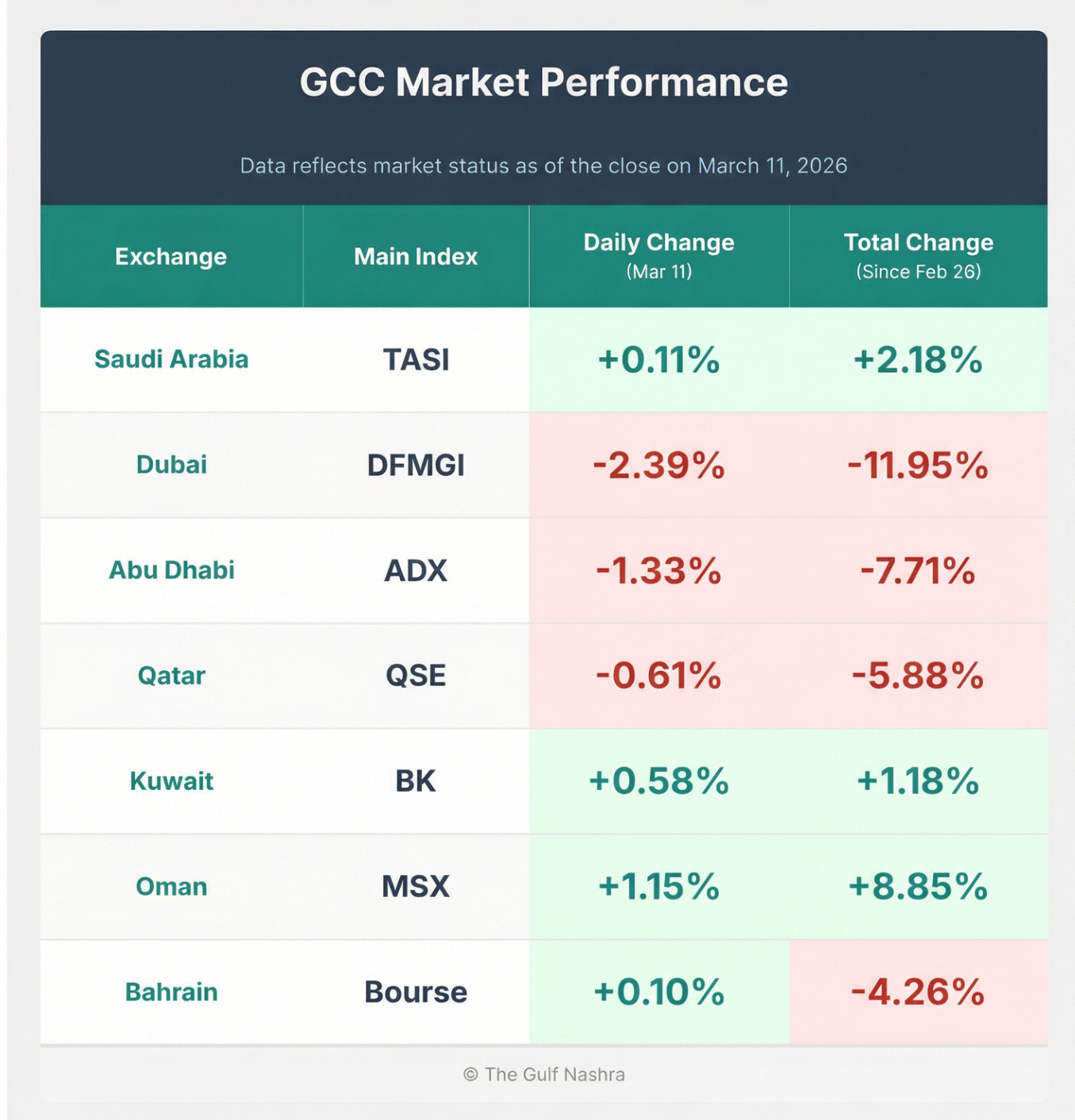
Stock Markets
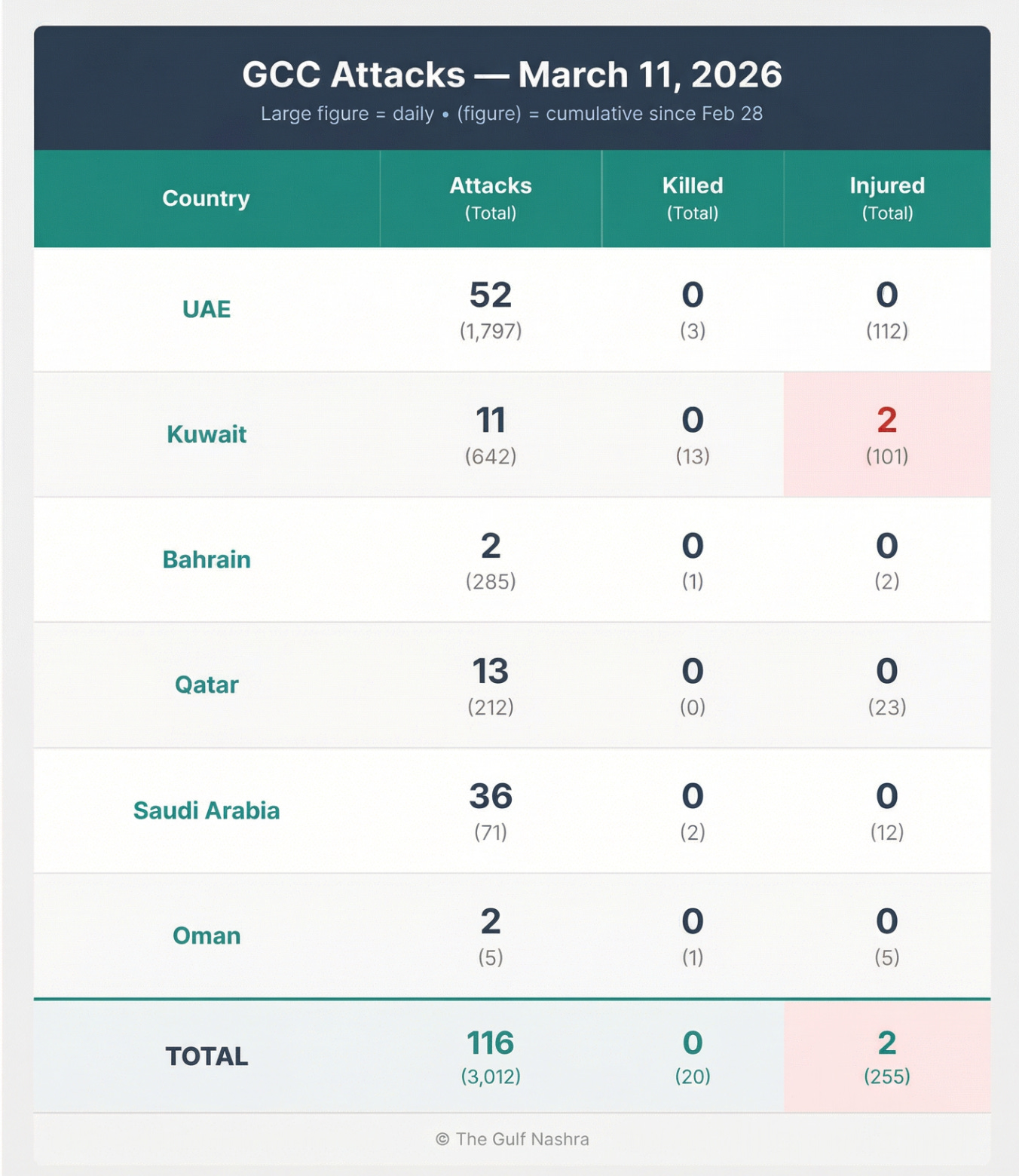
Attacks Summary
States’ Updates
“UN Security Council demands Iran halt attacks on Gulf states.” Al Arabiya, March 11, 2026.
“Oil Surges Above $100 as Oman Evacuates Key Export Terminal.” Bloomberg, March 12, 2026.
🇸🇦 Saudi Arabia
“Aramco warns of oil market ‘catastrophe’ unless strait of Hormuz reopens soon.” The Guardian, March 11, 2026.
“Opec confirms big Saudi oil production hike ahead of Iran war, holds forecasts steady.” Dawn, March 11, 2026.
“Saudi Miner $67 Million IPO Gains in Debut Despite Iran War.” Bloomberg, March 11, 2026.
“Iran War Threatens Saudi Arabia’s $38 Billion Video Game Push.” Bloomberg, March 11, 2026.
🇦🇪 UAE
“UAE says Iran targeting civilians, not US bases, in Gulf attacks.” Al Arabiya, March 11, 2026.
“Container ship hit off UAE coast by ‘unknown projectile’: UK maritime agency.” The Economic Times, March 11, 2026.
“Drones Fall Near Dubai Airport, Injuring Four.” WSJ, March 11, 2026.
🇶🇦 Qatar
“Qatar wants to bolster security partnership with US after Iran’s strikes.” Al Arabiya, March 11, 2026.
“Shell declares force majeure on LNG contracts from Qatar.” Al Jazeera, March 11, 2026.
🇴🇲 Oman
“Strikes hit oil storage facilities in Oman, says maritime security firm.” Middle East Eye, March 11, 2026.
🇧🇭 Bahrain
“Bahrain repositions aircraft to enhance operational readiness: Civil Aviation Affairs.” Al Arabiya, March 11, 2026.
Public Debates
Shortly after Sultan Haitham of Oman sent a message congratulating the new Supreme Leader of Iran, Oman was struck by a severe attack targeting the country’s largest oil storage facility in the Port of Salalah. Across the Gulf, most commentators quickly concluded that Iran was responsible. Yet the incident has also sparked debate. Kuwaiti commentator Sajed Mutaib Al Abdali observed that “attacking Oman in particular is strategically puzzling and difficult to explain… there may be more to the matter than meets the eye.” While many Gulf analysts attribute the strike to Iran, doubts and alternative explanations have surfaced, particularly among Omani commentators, some of whom speculate that a third party may be operating behind the scenes.
Within Oman, reactions quickly diverged. Saeed Jadad criticized the official Oman News Agency statement on the attacks, writing bluntly: “There is no modesty in war. Name the perpetrator.” Others urged caution. Malik Alyahmadi called on fellow Omanis to adhere to what he described as “Omani wisdom” and rely on official government statements, which notably have not pointed the finger at any specific actor. Mukhtar Alhannani also raised questions, arguing that if Iran has denied launching drones toward Oman, the real question becomes who benefits from targeting a state that has long positioned itself as a diplomatic bridge for dialogue. More radical interpretations also appeared, with Raad Albalochi directly accusing the UAE. Meanwhile, Amad Alshanfari called on the government to clarify the source of the drones, arguing that citizens have the right to know where these attacks are coming from and who stands behind them, stressing that national security is not a passing headline but a truth that must be stated clearly.
Others pushed back against such demands. Abdullah Adawi argued that no one has the right to dictate when the government should disclose sensitive security information or how it manages critical files, noting that such decisions depend on precise sovereign and strategic assessments. In times of crisis, he warned, rushed questioning may reflect a limited understanding of how national security and conflict management operate and could unintentionally fuel public doubt during a regional war. Some commentators moved toward structural explanations. Mohammed Gadad argued that just a day after Oman announced its ports were ready to serve Gulf states, they were targeted in an apparent attempt to undermine that readiness. Similarly, Yousef Al Hooti accused Iran directly, describing the attacks as violations of religion, ethics, and neighborly relations. He pointed to the contradiction between Iranian President Masoud Pezeshkian apologizing to Oman and Gulf states while Iranian missiles and drones continue to strike cities and economic facilities. Finally, Badr Al Busaidi (not the foreign minister) urged the public to rely on official terminology issued by government authorities and diplomatic statements, cautioning against premature labels or judgments without an official declaration.
Across the wider Gulf, however, the dominant interpretation remains that Iran is responsible. Emirati commentator Mohammed Taqi offered a harsh critique of Oman foreign policy, arguing that Oman once believed “goodwill and bridge-building with a treacherous neighbor” could ensure good relations, only to discover that security “cannot be protected by good intentions” alone. Yet not all regional reactions were direct. In a more ambiguous message, Qatari writer Abdullah Al Athbah suggested that “some actors do not want the Sultanate of Oman to continue its pivotal role in promoting stability in the region,” without specifying who those actors might be. Saudi commentator Abdulrahman Al Rashed offered a different strategic reading, arguing that “Iran is cornered in a critical moment. Attacking Oman and striking its vital facilities would amount to political suicide, sacrificing one of its most important regional relationships.”
Selected Gulf Opinions
“Like Samson who decided to bring down the temple once he realized his death was inevitable, the signs of the end often leave nothing for tomorrow. This is the first point. The second concerns the reaction of the Gulf states — the pillars of the temple — to what some describe as Iran’s suicidal decision. Unlike the pillars Samson sought to destroy, the Gulf states have chosen to stand firm. If those pillars prove stronger than Samson expected, stronger than the despair driving his act, then the outcome would be different: it would be a suicide carried out alone, while the temple and those within it survive. That is why Gulf states — the pillars of the temple — must remain steadfast against attempts to drag them down together.”
Sawsan Al Sha’er, Al Watan, (Bahrain), March 12, 2026.
“The Iranian escalation today was expected, and the decline in the volume of launches or the reported destruction of missile platforms and logistical infrastructure should not be misleading. In the first phase of escalation, Iran relied on large waves of missiles and drones aimed at overwhelming radars, exhausting air defense systems, and depleting interceptor missiles. As the days pass, the shift appears to be toward fewer but more selective and sensitive strikes, which may explain the targeting of sites in Salalah and Dubai.”
Hesham Alghannam, X, (Saudi Arabia), March 11, 2026.
“The Sultanate attempted in good faith to distinguish its position from the broader Gulf stance, seeking to preserve its role as an accepted mediator while maintaining a policy of neutrality. Yet the Iranian adversary appears to have viewed it simply as another target to be struck, like the others, in order to exert pressure on the Gulf as a whole.”
Khalifa Al Muzain, X, (UAE), March 11, 2026.
“The spread of the current war to Oman, despite the strength and distinctiveness of Iranian-Omani relations compared with other Gulf states, is certainly not random. If the attack is Iranian, it may reflect an attempt to distribute the damage across the Gulf within a reckless and ultimately losing strategy; if it is Israeli-American, it may be part of efforts to draw the Gulf into the war.”
Abdullah Alamadi, X, (Qatar), March 11, 2026.
“Crown Prince Mohammed bin Salman’s vision of transforming Saudi Arabia into a global logistics hub may accelerate dramatically under current conditions, as plans originally scheduled for years ahead could now be implemented much faster due to the unfolding circumstances.”
Meshal Alnami, X, (Kuwait), March 11, 2026.