

Oil, Natural Gas, and the Strait of Hormuz
Oil Price: $94.18 (-1.62%)
As of the morning session on March 13, 2026, West Texas Intermediate (WTI) crude oil is trading at $94.18 per barrel, showing a slight daily pullback of -$1.55 (-1.62%). Investing, March 12, 2026.
LNG Market: $253.84 (+1.41%)
As of the morning session on March 13, 2026, shares of major US exporter Cheniere Energy Inc. (LNG) are trading at $253.84, a daily increase of +$3.52 (+1.41%). Investing, March 12, 2026.
Strait of Hormuz
Strait of Hormuz Status As of March 12, 2026, the threat environment across the Arabian Gulf, Strait of Hormuz, and Gulf of Oman remains at maximum capacity. According to Advisory #2026, the blockade has resulted in 20 official maritime incidents since February 28, severely crippling commercial transit. This includes a staggering 16 direct attacks on vessels and 4 reports of suspicious activity, confirming the aggressive kinetic targeting and ongoing harassment of any ships attempting the crossing. UKMTO, March 12, 2026.
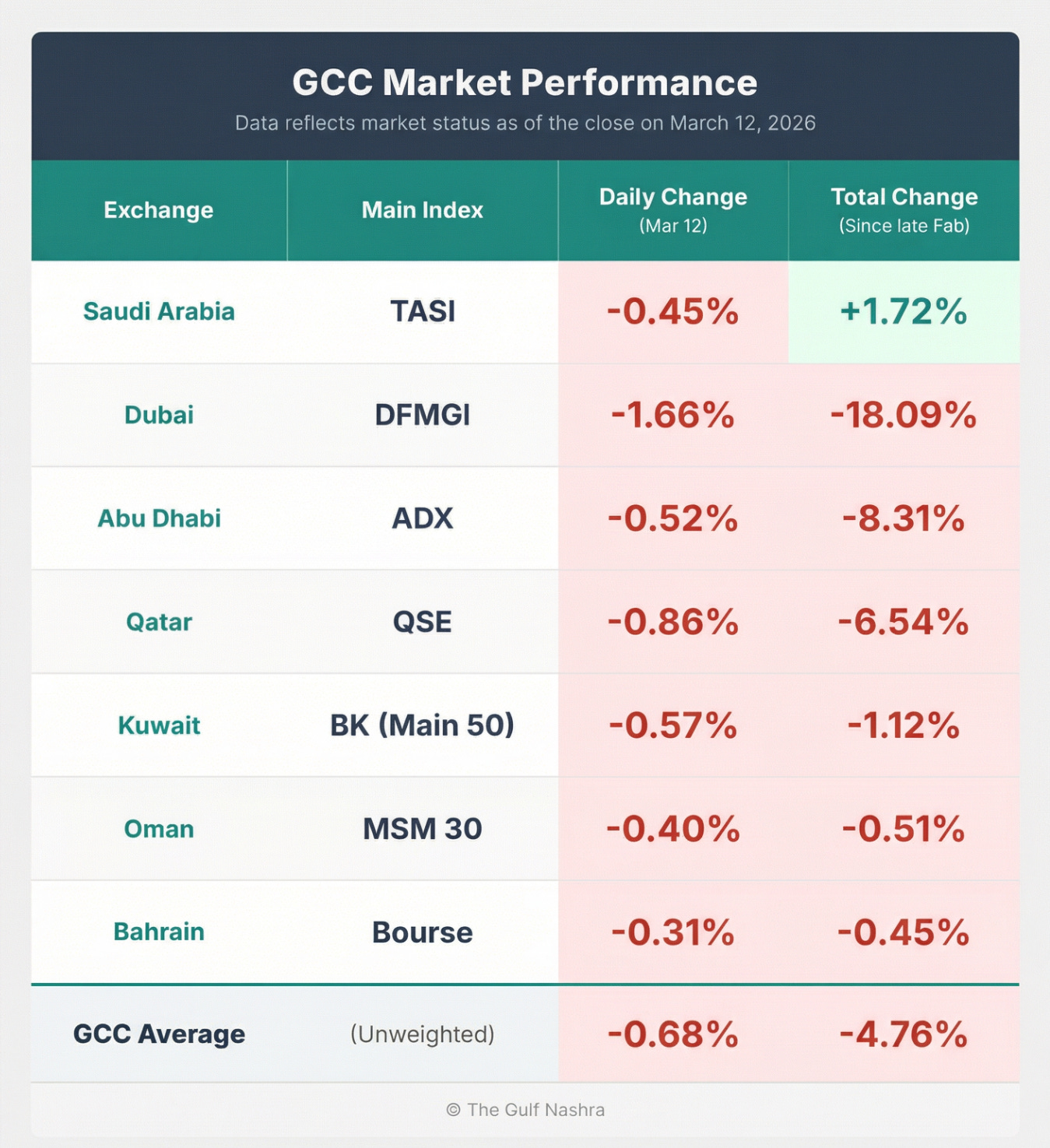
Stock Markets
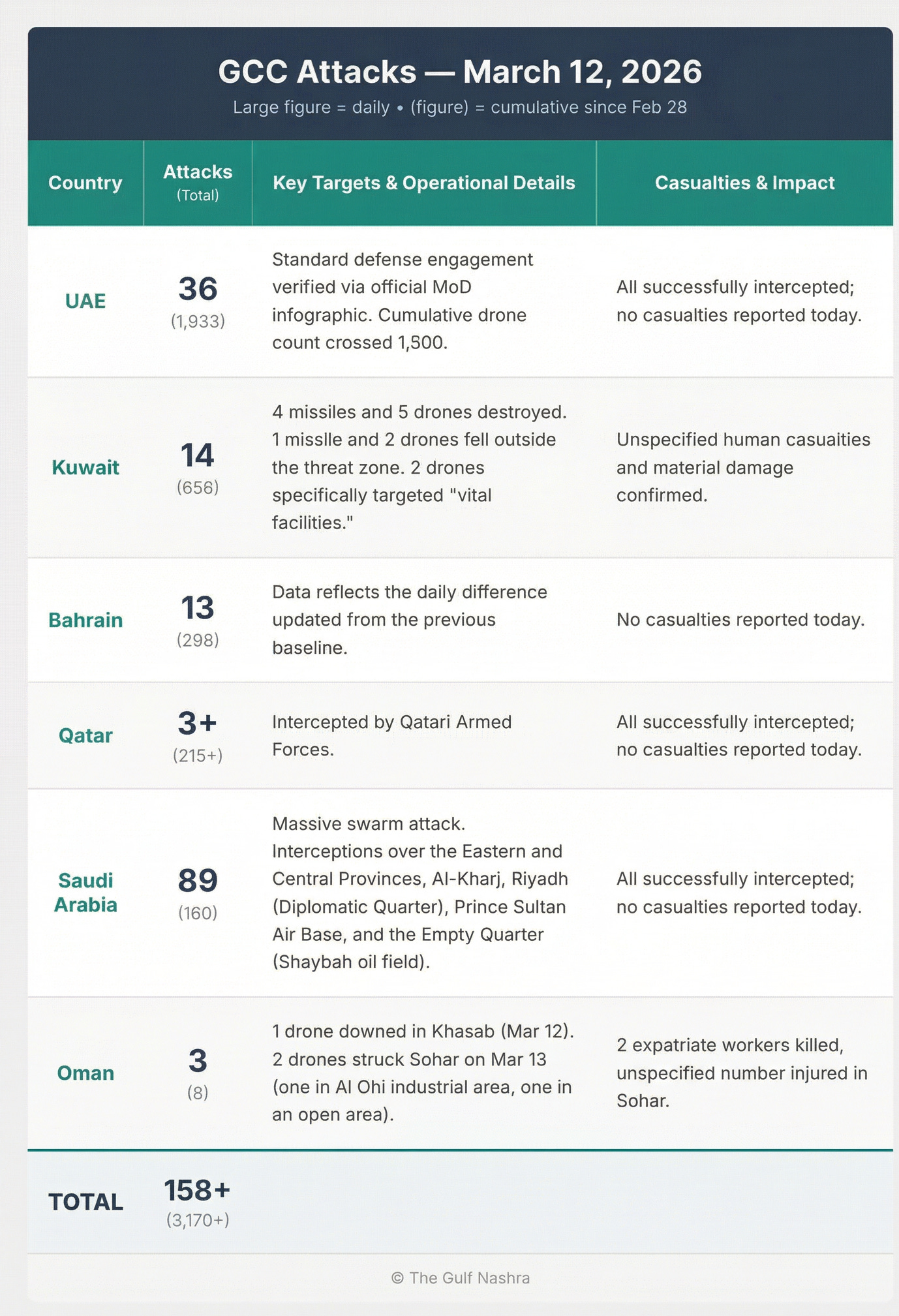
Attacks Summary
States’ Updates
“GCC welcomes UN Security Council adoption of resolution condemning Iran’s missile, drone strikes on Gulf States.” Gulf News, March 12, 2026.
“Iran’s new supreme leader says US bases in Gulf must close or will be attacked.” Middle East Eye, March 12, 2026.
“White House aware of Gulf countries’ concern about missile interceptor shortage.” CBS News, March 11, 2026.
🇸🇦 Saudi Arabia
“Pakistan Pledges ‘Full Support’ to Saudi Arabia After Visit.” Bloomberg, March 13, 2026.
🇰🇼 Kuwait
“Kuwait bans Eid concerts, weddings and theatre events over security concerns.” Gulf News, March 13, 2026.
“Kuwait says drone debris knocks out six power transmission lines.” Al Arabiya, March 12, 2026.
🇴🇲 Oman
“2 expats die, some injured in Oman after two drones crash in Sohar.” Khaleej Times, March 13, 2026.
“Oman FM: No normalisation with Israel, no joining Board of Peace.” Middle East Monitor, March 12, 2026.
🇧🇭 Bahrain
“Bahrain waives off fines for expired visit visas amid airspace closure.” Khaleej Times, March 12, 2026.
“Four Bahrainis arrested for spying activities with Iran's IRGC.” Khaleej Times, March 12, 2026.
Public Debates
Gulf commentators today focused on the recorded message addressed to the Gulf states by Iran’s new Supreme Leader, Ayottallah Mojtaba Khamenei. Across Gulf media and commentary circles, the speech was widely interpreted not as a call for de-escalation, but as a signal of continued confrontation framed under familiar justifications, particularly the “presence of US military bases in GCC countries.” In brief, Khamenei declared that Iran should move “to close all US bases” in the region, while also emphasizing the need to “continue” blocking the Strait of Hormuz as a tool of pressure against Iran adversaries.
Several commentators focused on the nature and tone of the speech itself. From Qatar, Abdulaziz Alkhater argued that the statement bears no connection to the responsibilities of leadership or governance. Meanwhile, fellow Qatari commentator Hamad Lahdan wrote bluntly: “It seems the Iranian regime has lost control of the Revolutionary Guard. This cannot be the language of a state; it is the language of militias.” From the United Arab Emirates, Ebtisam Al Kitbi highlighted what she described as a clear contradiction within the speech: while speaking of “warm relations” with neighboring states, it simultaneously rationalizes striking their territories on the grounds of foreign military bases. In practice, she argues, Tehran appears to be attempting to shift the costs of its confrontation outward—whether through attacks on bases or threats against the Strait of Hormuz—in order to pressure both the region and the global economy while recalibrating the regional deterrence balance. Saudi Arabia’s Fahdah Al Arefi echoed the same paradox, writing: “The strangest and most absurd part is how he speaks of building friendly relations with neighbors while, in the very same speech, threatening them with continued strikes.”
In Kuwait, Saad bin Tifllah Al Ajmi suggested that the speech may not even reflect Khamenei own voice, arguing that it was likely drafted by Mohammad Bagher Ghalibaf and Ali Larijani, two of the most influential figures in Iran’s political establishment today. He pointed to a striking detail in the speech itself: Khamenei claimed that he only learned of his selection by the Assembly of Experts “through radio and television,” raising questions about both his whereabouts and the circumstances surrounding his appointment. For Al Ajmi, the content of the speech nevertheless followed a familiar pattern—hardline in tone and overtly ideological, calling for resistance against the United States and Israel while dismissing neighboring states and justifying continued attacks on them because they “host American bases.”
In Saudi Arabia, the speech also drew wide attention among analysts and intellectuals. Saudi academic and literary critic Abdullah Ghathami argued that Mojtaba Khamenei remarks do not reflect “political or strategic reasoning.” Instead, he wrote, the speech is dominated by threats, calls for personal revenge—particularly for his father—and religious references that reveal the dangers of a theocratic state that views the world as conspiring against it and therefore justifies confrontation with it. As Ghathami put it, “the language of the new Supreme Leader is more violent and more bloody than that of his predecessors,” as if the revolution itself “has learned nothing from its past mistakes.” Other Saudi commentators offered different interpretations. Malik Alrougui argued that the Iranian regime’s behavior is unlikely to change regardless of leadership rhetoric. Hesham Alghannam, however, urged caution in interpreting the speech too literally, noting that propaganda designed for mobilization is not always identical to actual strategic planning. He warned that “a mobilizing speech should not be mistaken for the full strategic calculation behind Iran actions,” suggesting that Tehran likely continues to operate according to a deliberate strategic logic in its confrontation with the region.
Finally, Saudi commentator Jamal Al Tamimi highlighted another striking dimension of the speech, quoting Iranian-American historian Arash Azizi, who noted that “Mojtaba Khamenei’s inaugural message does not even try to offer Iranians a better future. It does, however, repeat the commitment to the destruction of Israel. Who would want a leader obsessed with another country’s existence rather than his own people’s well-being?”
Selected Gulf Opinions
“The Southern National Charter is the product of a comprehensive dialogue among the various southern factions and components, and any Saudi attempt to promote an alternative narrative ignores the fact that southerners have already pursued a clear political path toward building their national project. The southern cause is no longer merely a slogan, but one grounded in three defining milestones.
“If Saudi Arabia claims to be overseeing a southern dialogue conference, it must ask itself—as the world asks it—what about Sanaa and the squandering of eleven years in a long war? Do its people not deserve a genuine national dialogue, rather than merely accepting surrender to the terrorist Houthi group?”
Hani Mes’hor, X, (UAE), March 13, 2026.
“Trump dragged the region into the war, yet now presents stopping it as a ‘peace’ achievement that should be credited to him.”
Ahmad Alyehri, X, (Qatar), March 12, 2026.
“What Ukraine is proposing today is not merely diplomatic rhetoric, but a real experience forged in the fires of war. Since the outbreak of the conflict, Ukrainian cities have faced continuous waves of drones launched by Russia against the Ukrainian people, many of them Iranian-made Shahed drones that have been used extensively in Russian aerial attacks.”
“From this perspective, the proposal carries particular significance for the Gulf states. The world is changing rapidly, and wars are no longer fought as they once were; drones have become a central weapon in contemporary conflicts. Learning from the experience of a country that has confronted this threat on a daily basis for years could represent an important step toward strengthening security and defense.”
Hussain Al Rawi [Kuwait], Al Roya, (Oman), March 11, 2026.
“The ongoing war has clearly revealed the strategic value of Oman geography, as well as the importance of the policy that has kept this position secure and stable. The challenge today lies not in recognizing this reality, but in investing in it with long-term vision—so that this location does not remain merely a temporary refuge in times of crisis, but becomes a lasting pillar for the Omani economy, regional stability, and the global economy.”
Khaled bin Salem Alghassani. X, Al Roya, (Oman), March 11, 2026.