

Oil, Natural Gas, and the Strait of Hormuz
Oil Price: $100.21 (−3.55%)
As of March 16, 2026, Brent crude settled at $100.21/bbl, a daily decline of −$3.69 (−3.55%) Since the war began on February 28, Brent has risen +38.26% from its pre-war close of $72.48. Investing, March 16, 2026.
LNG Market: $251.29 (−0.39%)
As of March 16, 2026, Cheniere Energy Inc. (LNG) closed at $251.29, a daily decline of −$0.98 (−0.39%) Since the war began, the stock has gained +8.08% from its pre-war close of $232.51 on February 26. Investing, March 16, 2026.
Strait of Hormuz: CRITICAL threat level.
As of March 16, 2026, a tanker was struck by an unknown projectile 23NM east of Fujairah while at anchor, causing minor structural damage with no crew injuries — bringing confirmed incidents to at least 21 since March 1. The maritime threat level remains CRITICAL. Daily transits through the Strait remain at approximately 2 vessels/day versus a historical average of ~138. UKMTO, March 17, 2026. [PDF].
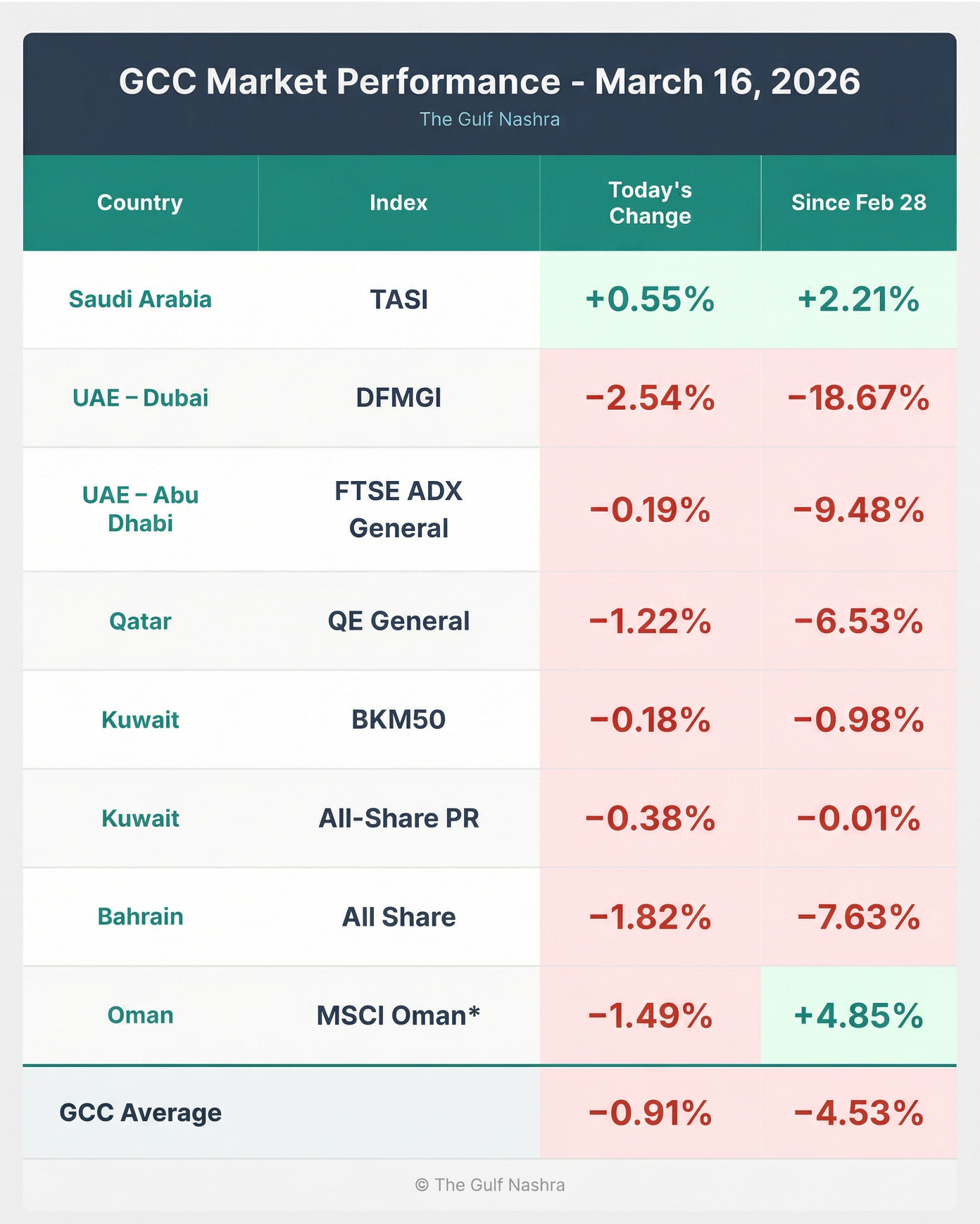
Stock Markets
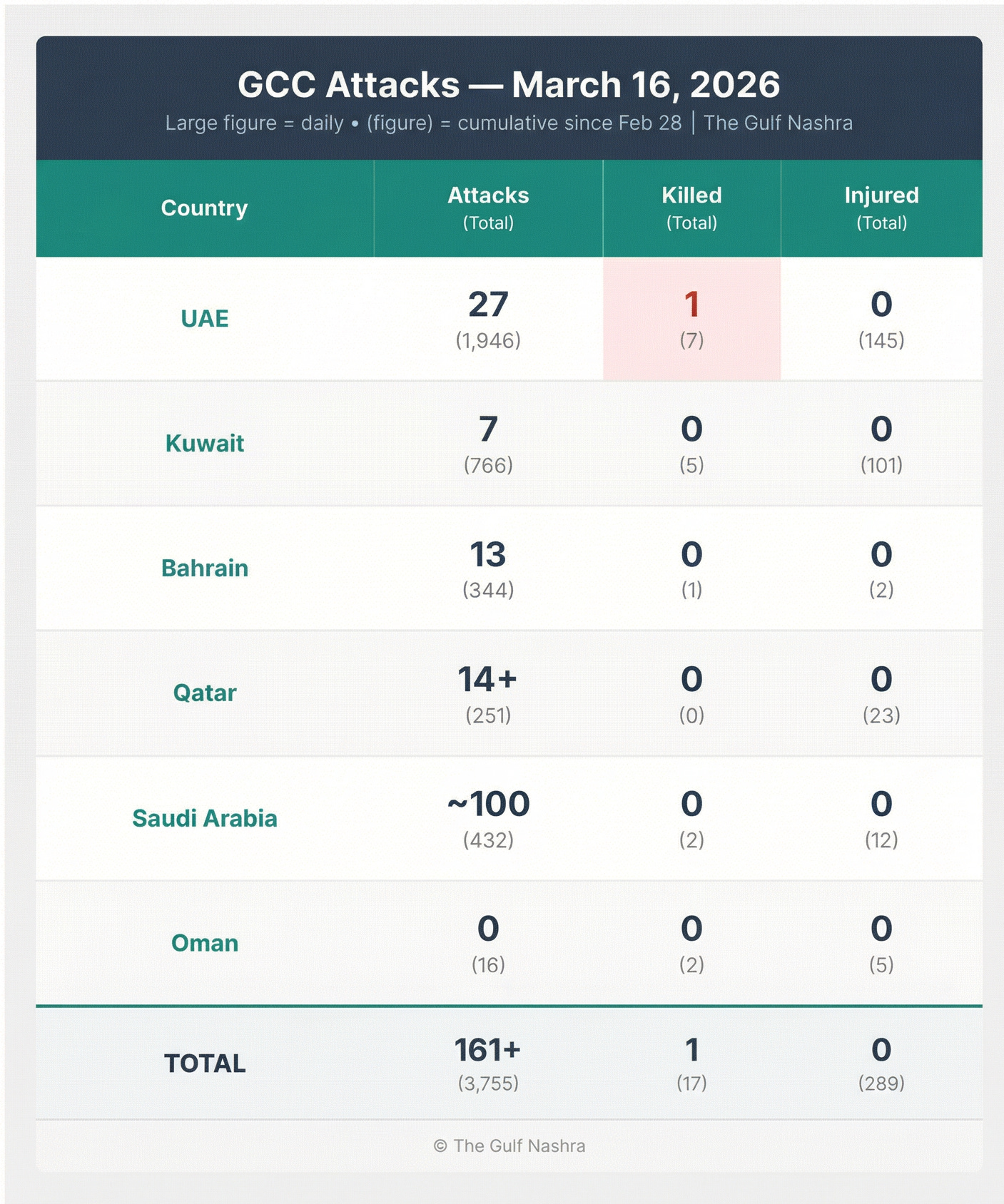
Attacks Summary
States’ Updates
🇸🇦 Saudi Arabia
“UAE President receives phone call from Saudi Crown Prince to discuss regional developments and their repercussions on security and stability.” WAM, March 16, 2026.
“Saudi air defenses destroy 31 drones across Riyadh and Eastern regions.” Saudi Gazette, March 15, 2026.
“King Salman orders establishment of Riyadh University of Arts.” Saudi Gazette, March 14, 2026.
🇦🇪 UAE
“UAE says consulate in Iraqi Kurdistan targeted for second time in a week.” Arab News, March 14, 2026.
“Iran hits UAE oil hub, vows retaliation for US strike on Kharg Island.” Middle East Eye, March 14, 2026.
“UAE arrests 35 for misinformation related to Iran’s aggression: Who are they, what did they post?” Gulf News, March 16, 2026.
🇶🇦 Qatar
“MotoGP postpones Qatar Grand Prix due to Middle East conflict.” Al Jazeera, March 15, 2026.
“Fitch Affirms Qatar at ‘AA’; Outlook Stable.” Fitch, Mar 13, 2026.
🇰🇼 Kuwait
“Drones hit radar system at Kuwait Airport: Civil aviation authority.” Kuwait Times, March 15, 2026.
“Kuwait arrests 16 accused of Hezbollah-linked sabotage plot.” Middle East Eye, March 16, 2026.
🇧🇭 Bahrain
“Five people arrested in Bahrain for disclosing information to IRGC: ministry statement.” Arab News, March 15, 2026.
Public Debates
Although the issue is not new, the outbreak of the war has revived debate among Gulf commentators over the role of U.S. military bases in the region. For Iran, these bases represent the core infrastructure of American military power and therefore a primary target in any confrontation. At the same time, voices across parts of the Arab world have renewed criticism of their presence, questioning the logic of hosting foreign military installations that could draw the region deeper into conflict.
Yet many Gulf commentators argue the debate is not ultimately about whether these bases exist. The more consequential question concerns their purpose and reliability. Even assuming that U.S. bases, defense agreements, and advanced weapons systems are firmly in place across the Gulf, do they truly translate into protection? Or does the presence of American military infrastructure fail to guarantee that Washington will act decisively to safeguard the region—especially in a war the United States itself helped ignite?
On March 3, 2026, the Emirati newspaper Al Khaleej published an unsigned commentary titled “Iran’s Big Lie: U.S. Bases Are Safe… While the Gulf Pays the Price.” The article rejected Iran’s claim that its attacks target American installations in the UAE, arguing that in reality the strikes have hit Gulf states and civilian infrastructure. The article suggested the objective is not merely to strike U.S. bases but to undermine the region’s economic and political stability. UAE commentator Ibrahim bin Hatim also questioned the logic behind Iranian attacks on the Gulf. He asked whether Tehran has the right to dictate Gulf alliances while maintaining its own partnerships with Russia and China. Bin Hatim noted that American forces are “spread across large parts of the Middle East,” not limited to the Gulf, and highlighted the contradiction of Iran targeting the UAE despite the presence of “more than half a million Iranians living and trading freely” there. He ultimately framed the issue in moral terms, asking whether “hotels, civilian airports, residential towers, and commercial ports” can be treated as legitimate military targets, or whether “safe cities built on trade and openness” are being turned into arenas for missile messages.
In a veiled message—likely aimed at Arab states hosting Israeli embassies—Kuwaiti commentator Ahmed Al-Maimoni questioned what he saw as inconsistencies in the debate. Writing on social media, he remarked: “He speaks about U.S. bases while being the largest economic, tourism, and political partner of the Zionist entity in the region.” In essence, Al-Maimoni argued that some critics accusing Gulf states of hosting U.S. forces to protect Israel maintain their own diplomatic and economic ties with Israel. Qatari commentator Omar Ghanim dismissed calls to remove foreign bases from the Gulf, describing them as a fashionable slogan that has “turned into a ball rolling between lips and fingers,” repeating the phrase “remove the foreign bases.” He noted that the United States operates about 750 military installations across 86 countries, including advanced economies such as Japan, Germany, Britain, and Singapore. In his view, the presence of U.S. bases reflects “the interests of states that consider them appropriate,” not the demands of what he called “keyboard enthusiasts.”
Other commentators focused on clarifying the legal nature of U.S. military access. Omani commentator Ali Mohammed Gaboob emphasized that “there are no American bases in the Sultanate of Oman,” explaining that what exists are “defense cooperation agreements.” Under these arrangements, the United States may receive “facilities at specific bases,” but this does not constitute “permanent bases or occupation.” Instead, access is granted “when needed” and only with “the approval of the Omani government.” Similarly, Omani commentator Sultan Al-Maqrashi argued there is no evidence that U.S. bases in the Gulf were used to launch attacks against Iran. In his view, Tehran’s narrative about American military infrastructure serves primarily as a “justification” for targeting Gulf states.
Other Gulf commentators have taken a more critical view of the U.S. military presence and the region’s security arrangements. Kuwaiti commentator Obaid Al-Wasmi argued that Washington’s leadership places little value on “Gulf security” and is effectively contributing to the erosion of the region’s “security architecture.” He described the American presence as “temporary,” serving mainly to “militarily exhaust the region” and “economically exploit it,” while “creating conflicts” that ultimately benefit Israel. Omani commentator Mohammed bin Saeed Al-Fateesi pointed to another lesson from the confrontation involving Iran, the United States, and Israel: “a state that manufactures its own weapons can defend itself, respond to its enemies, and prolong the conflict until the very last breath,” highlighting the strategic advantage of domestic military production. Meanwhile, Malik Alyahmadi reacted to reports that the U.S. military had deployed roughly 10,000 AI-enabled drones across the Middle East, asking: “After this, does it really require great effort to identify who is attacking our countries and our vital facilities with drones?”
Finally, Omani commentator Mukhtar Al-Hannani criticized Gulf states for their reliance on imported Western weapons, arguing that such dependence constrains their ability to make independent decisions in moments of crisis. He wrote: “Gulf states that have spent billions purchasing weapons from abroad—had even a quarter of this money been invested in education and building local technology and military industries—would today be far more capable of protecting themselves and shaping their own decisions.” His argument, however, drew strong criticism online, with many respondents insisting that U.S. weapon systems remain the first line of defense against repeated Iranian attacks.