

Oil, Natural Gas, and the Strait of Hormuz
Oil Price: $103.42 (+3.20%)
As of March 17, 2026, Brent crude is trading at $103.42/bbl, a daily gain of +$3.21 (+3.20%). Since the war began on February 27, Brent has risen +42.69% from its pre-war close of $72.48. Investing, March 17, 2026.
LNG Price: $251.50 (+0.08%)
As of March 17, 2026, Cheniere Energy Inc. (LNG) is trading at $251.50, a daily gain of +$0.21 (+0.08%). Since the war began, the stock has gained +6.69% from its pre-war close of $235.73 on February 27. Investing, March 17, 2026.
Strait of Hormuz: CRITICAL threat level.
For the week of March 9–15, 2026, JMIC recorded 6 serious attacks and 1 near-miss, with bulk carriers, tankers, and container vessels among those targeted — most recently on March 10–12. Weekly transits through the Strait have collapsed to just 17 vessels, a 56.4% decline from the prior week and a fraction of the 2023 historical average of ~839/week. The maritime threat level remains CRITICAL. JMIC/UKMTO, Week 11 Dashboard [PDF].
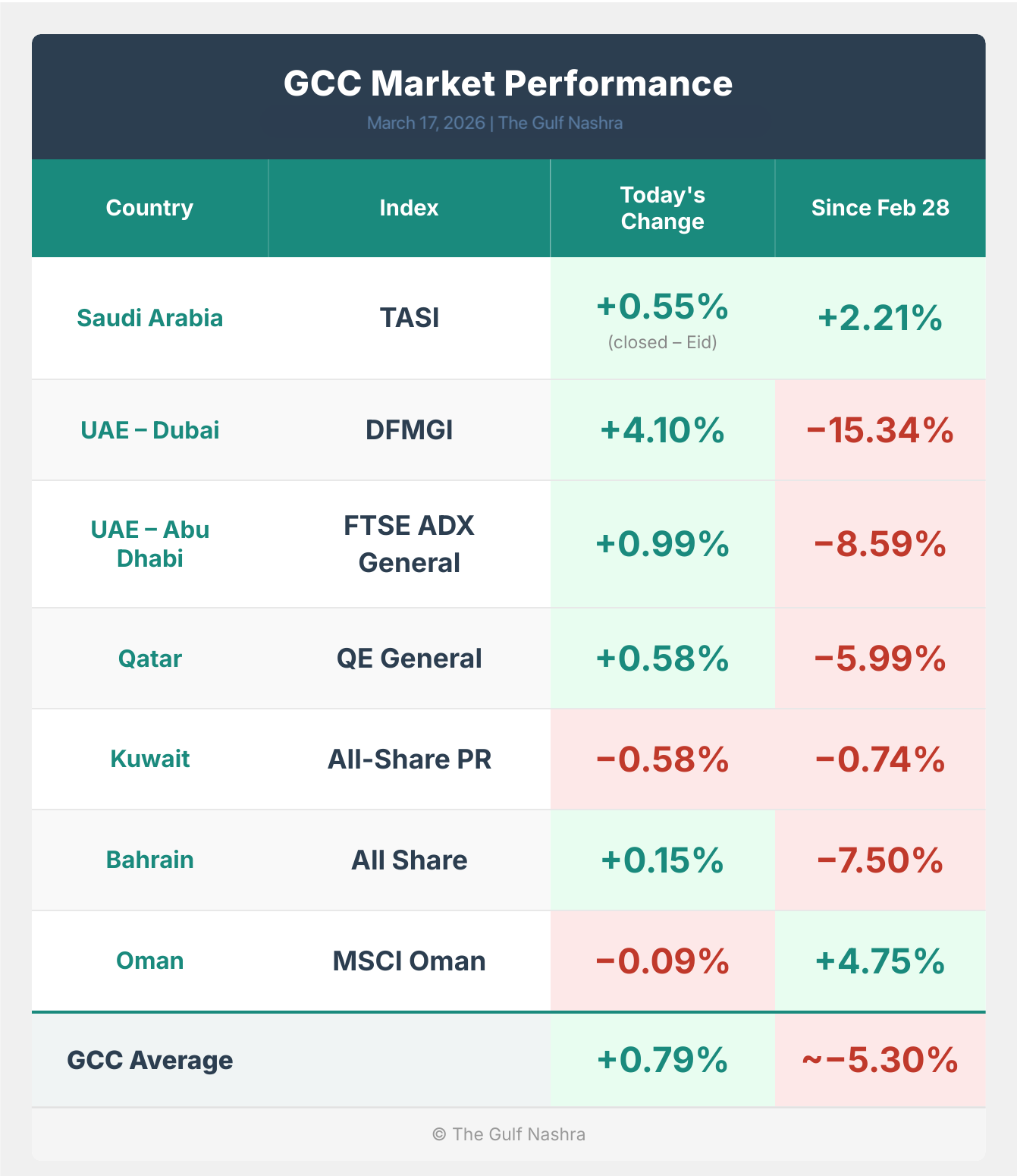
Stock Markets
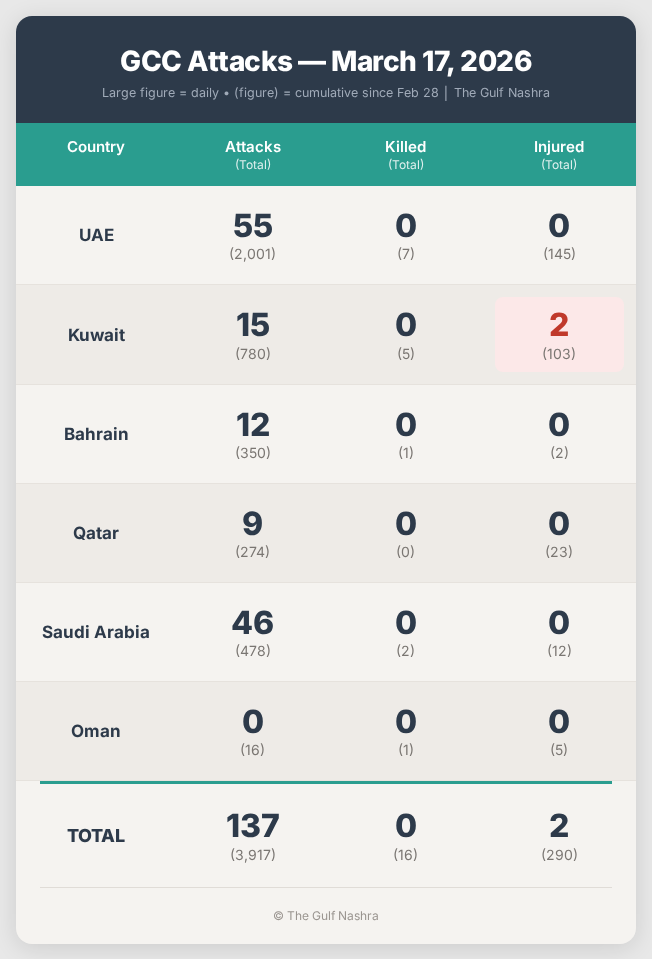
Attacks Summary
States’ Updates
“Over 200 Ukrainian military experts in Gulf region to counter Iran’s drones.” Al Jazeera, March 18, 2026.
“Inside the Ukrainian interceptor drones wanted around the Gulf.” Reuters, March 17, 2026.
“Gulf oil producers scramble to bypass Hormuz as Iran locks down the strait.” Reuters, March 17, 2026.
“Gulf banks face $307 billion deposit flight risk if war worsens, S&P says.” Reuters, March 17, 2026.
🇸🇦 Saudi Arabia
“UN body finds Saudi executions on drug charges ‘inexcusable’, document shows.” Reuters, March 17, 2026.
“Iran Ups Attacks on Oil-Rich Saudi Arabia as War Rages On.” Bloomberg, March 17, 2026.
🇦🇪 UAE
“UAE could join any US-led effort to secure Strait of Hormuz, says senior official.” Reuters, March 17, 2026.
“UAE Official Says Iran War Tightens Gulf Ties to US, Israel.” Bloomberg, March 17, 2026.
🇰🇼 Kuwait
“Exclusive: Macquarie walks away from Kuwait oil pipelines deal amid Iran war, sources say.” Reuters, March 17, 2026.
🇴🇲 Oman
“Oman Keeps Trickle of LNG Flowing from Middle East Amid Iran War.” Bloomberg, March 17, 2026.
Public Debates
The killing of Iran high-ranking leader and Secretary of the Supreme National Security Council, Ali Larijani, dominates Gulf commentary, with analysts converging on its implications for negotiation and escalation. From Kuwait, Saad bin Tiflah Al Ajmi describes Larijani as “a pragmatic conservative” and “a pillar of the ruling establishment,” arguing that his killing may be seen as “the assassination of the opportunity for negotiation with the Americans,” while raising the question: “will they be the next targets, or will they try to save what can be saved to preserve the system?” Similarly, Qatar’s Abdullah Al Etaibi stresses that Larijani was a rare bridge between security rigidity and diplomatic “pragmatism,” and that his removal weakens negotiation prospects while strengthening hardline dynamics.
Saudi voices reinforce this view, emphasizing that the killing undermines diplomatic pathways. Abdulrahman Al Rashed notes that despite being labeled a hardliner, Larijani was regarded by insiders as a “pragmatic figure” and among the few remaining moderates, concluding that “the assassination of Larijani strips the Iranian leadership of its moderates, not the other way around.” Dawood Alshirian adds that “the killing of Larijani raises the cost of a political solution with Iran and weakens the prospects for negotiation,” while Hesham Alghannam frames the act as “a deliberate Israeli undermining of any pathways based on de-escalation,” aimed at eliminating “any room for maneuver or compromise.”
From a more technical perspective, Abdullah Al-Jadi’a, from Saudi Arabia, describes Iran as a “medieval fighter,” arguing that “intelligence” has become the decisive factor in the war, an area where Israel has dominated while Iran has failed to produce precise targeting. Echoing this concern, Kuwait’s Sajed Al Abdali questions whether this “staggering intelligence exposure” is uniquely Iranian or reflects a broader vulnerability, asking: “is this a uniquely Iranian failure, or is everyone exposed in the same way—we just have not seen it yet?” In the UAE, Ebtisam Al Kitbi warns that the killing represents “a dual strike against the structure of the Iranian system,” marking a shift toward a “strategy of dismantling the system” and the “reconfiguration of Iran internal order.”
In Oman, commentary reflects both convergence and divergence. Zakaria Al Muharrami aligns with the dominant Gulf view, arguing that the region has lost one of the most balanced and diplomatic figures, and that his removal strengthens hardliners while signaling a more chaotic phase ahead. In contrast, Naser Al Busaidi sees the killing as a strategic miscalculation that may transform Larijani into a symbol of “sacrifice and dignity,” warning that silencing such a figure empowers a more dominant “military, retaliatory voice” and deepens escalation.
Finally, Khalifa Al Mahmood offers a far more pessimistic reading, arguing that “with the assassination of Larijani, Iran… has reached what can be described as a stage of certain death,” where only the “decision to remove life support” remains, driven by leadership fragility and widening internal breaches. Yet he does not present this as a closed end-state, instead outlining two possible paths: either “comprehensive destruction” with limited capacity to respond, or a shift toward “the logic of wars and settlements,” similar to post-war reconstruction models. In this sense, the moment is not necessarily the final collapse, but a “decisive turning point” whose outcome depends on whether Iran continues escalation or pivots toward strategic recalibration.
Selected Gulf Opinions
“If we compare this [Iran], for example, to the regime of Saddam Hussein in Iraq, despite all attempts by both East and West, the leadership remained cohesive and secure, and no key figures were assassinated until the full ground invasion occurred, after which the state security structure naturally collapsed. Even the resistance in Gaza, despite its limited capabilities, proved difficult to penetrate and endured for a long period—unlike the cases of Hezbollah, Iran, or the Iraqi Popular Mobilization Forces, whose leaders are now being systematically targeted with apparent ease. This suggests not isolated breaches, but rather a condition of near-total exposure, which typically points to one of two possibilities: either internal betrayal at the highest levels by those with access to comprehensive data networks, or that the Iranian and Western projects were once in a form of partnership, and once that alignment ended, the weaker side became exposed to the stronger.”
Mohammed Aiash Alkibisi, X, (Qatar), March 17, 2026.
“We will soon discover that the greatest deception Iran tried to pass on us as Shiites was the claim that it was a state preparing for the emergence of Al Mahdi [awaited savior] at the end of times. We will realize that it was nothing more than an attempt to mobilize us politically under a religious banner.”
Jaffar Salman, X, (Bahrain), March 17, 2026.
“The arrival of a US vessel carrying thousands of Marines near the Middle East is not a routine move, but a clear strategic signal marking a shift from managing escalation to preparing for worst-case scenarios. This deployment reflects three overlapping dimensions: strengthening deterrence against Iran, protecting global trade arteries, and reassuring Washington allies in the Gulf. More importantly, the region is no longer merely a theater of containment, but has become a central arena in global power balances, where geography intersects with energy, security, and economics.”
Ebtisam Al Kitbi, X, (UAE), March 17, 2026.
“Iran appears as a peculiar case in modern history; a revolution that began with grand slogans but ended in a reality defined by aggressive policies. It came to lead in the fragmentation of states and the spread of hatred, until the slogan became merely a façade, and practice something entirely different. Iran has not prevailed as it may seem, nor will it return to what it was after this war. The blows have been severe and different, and the internal landscape itself has changed; a broad segment of Iranians lives in disconnection from the path imposed by the religious system. Sentiments toward America and Israel remain rejecting, yet the idea of liberation from the rule of the mullahs persists despite the consequences of war.”
Dawood Alshirian, X, (Saudi Arabia), March 17, 2026.