

Oil, Natural Gas, and the Strait of Hormuz
Oil Price: $100.23 (+4.49%)
As of March 24, 2026, Brent crude rebounded to $100.23/bbl, marking a daily gain of +$4.31 (+4.49%). This follows a volatile session where the price recovered a significant portion of the previous day’s sharp decline. Since the baseline of February 26 ($70.75), Brent remains up +41.67%.
Source: Investing.com - Brent Oil Historical Data
LNG Price: $294.58 (+2.57%)
As of March 24, 2026, Cheniere Energy Inc. (LNG) closed at $294.58, a daily gain of +$7.38 (+2.57%). The stock reached a new session high of $298.53 as demand for non-regional energy remains elevated. Since the conflict began, the stock has gained +26.70% from its pre-war close of $232.51 on February 26.
Source: Investing.com - Cheniere Energy (LNG) Historical Data
Strait of Hormuz Status: Critical Blockade
The status remains CRITICAL across the Arabian Gulf, Strait of Hormuz, and Gulf of Oman due to persistent operational disruption and navigation interference. Commercial traffic remains extremely limited; while monitored transits slightly increased to 6 vessels on March 23, this remains a collapse compared to the historical average of 138 vessels per day. Current strike patterns suggest a campaign of broad maritime disruption, with 21 confirmed incidents reported since March 1.
Source: UKMTO - Current Incidents & Advisories
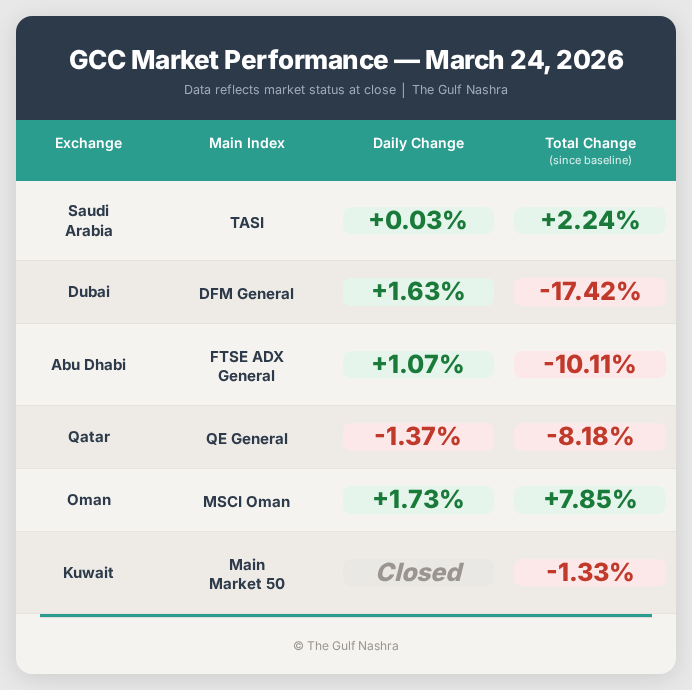
Stock Markets
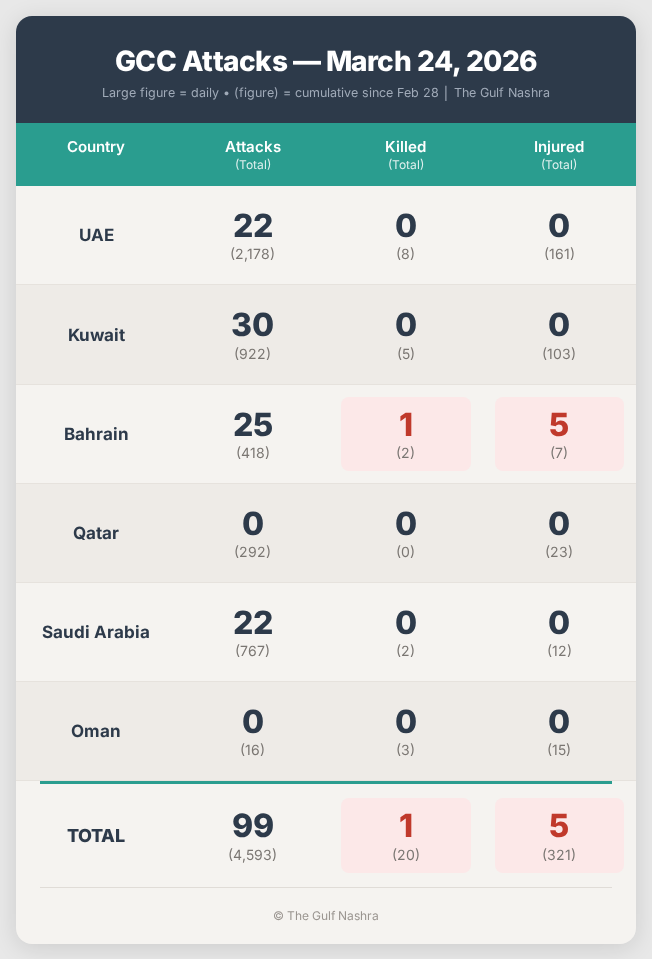
Attacks Summary
States’ Updates
🇸🇦 Saudi Arabia
“AFC confirm Jeddah to host postponed Asian Champions League matches.” Reuters, March 24, 2026.
“Saudi prince said to push Trump to continue Iran war in recent calls: Report.” Middle East Monitor, March 24, 2026.
🇶🇦 Qatar
“Qatar Is Not Mediating U.S.-Iran Talks, Foreign Minister Says.” The New York Times, March 24, 2026.
🇧🇭 Bahrain
“Civilian working for UAE Armed Forces killed in Bahrain.” Gulf News, March 24, 2026.
“Exclusive: Amazon says AWS’ Bahrain region ‘disrupted’ following drone activity.” Reuters, March 24, 2026.
“Bahrain pushes UN-backed action for Hormuz shipping; France tables rival text.” Reuters, March 23, 2026.
🇴🇲 Oman
“Oman says working to secure ‘safe passage arrangements’ through Hormuz.” Middle East Eye, March 23, 2026.
Public Debates
The debate was triggered by a sudden shift in timing: Donald Trump moved from an imminent 48-hour threat to a five-day postponement, framing the delay as space for “productive negotiations” even as Iran denied any talks were underway. That single pivot immediately divided Gulf commentary. For some, the extension signaled hesitation; for others, it reflected a deliberate calibration of pressure. The question was no longer whether a strike would happen, but what it meant that it had not happened when expected.
Qatari writer Nayef Nahar saw no ambiguity in it. Trump, he argued, postponed striking Iran’s energy infrastructure out of fear of market volatility — watching Gulf economies absorb massive losses under Iranian strikes for over twenty days without adjusting course. From Oman, Mohammed Alwardi pointed to the immediate aftermath: oil prices fell sharply following the announcement, reinforcing the view that Trump’s moves were calibrated as much for markets as for military objectives. In Bahrain, Adel Marzooq stripped the logic down further — if this was a tactic, it was not working as one; if it was genuine, Trump had simply backed down, breaking the trajectory of escalation and deflating the broader ambitions tied to it.
That reading was firmly rejected elsewhere. In the UAE, Dhahi Khalfan dismissed the notion that Trump was operating under pressure, arguing instead that he has nothing to lose and is therefore free to move between coercion and flexibility without constraint. Emirati academic Ebtesam Al-Kitbi gave that argument its full architecture, describing the delay as part of a new negotiating equation sustained by military threat, where postponement signals not retreat but reconfiguration. In her reading, the contradiction is deliberate: claims of overwhelming military success paired with a measured pause are designed to weaken Iran’s position, steady markets, and lay the groundwork for a broader deal. The strike, in this framing, is not cancelled — it is being held in reserve.
Others shifted focus away from Trump entirely. Bahraini writer Sawsan Alshaer argued that what is unfolding will create an opening for Gulf states to advance, pointing to the contrast between a damaged Iran and Gulf systems that have remained intact and capable under pressure. Kuwaiti commentator Meshal Alnami sharpened that point, pushing back against any framing that cast Iran as victorious simply because it had survived destruction, while Gulf societies continued to function. For both, the central question is not whether Trump delayed a strike, but who is actually holding together.
A more measured note came from Saudi analyst Hesham Alghannam, who cautioned that the war of statements and their contradictions is a natural feature of this stage — and that reading too deeply into shifting timelines risks mistaking messaging for strategic reality. Al-Kitbi added another dimension, noting that American engagement with figures such as Mohammad Bagher Ghalibaf reflects a calculated effort to probe the decision-making architecture inside Iran’s security establishment. In that light, the delay is not itself the signal — it is one visible piece of a much larger, less visible process.
What emerges is not a settled interpretation of the five-day postponement, but a deeply divided one. The same move — from 48 hours to five days — is read as hesitation, as strategy, as irrelevance, or as misdirection, depending on the vantage point. The debate, in the end, is less about what Trump did, and more about what that pause reveals — or carefully conceals — about the balance of forces now shaping the region.
Selected Gulf Opinions
“They are targeting the Gulf just as much as they are targeting Iran—this is the unspoken agenda.”
Sajed Al Abdali, X, (Kuwait), March 23, 2026.
“In theory, at least, the Arab majority would be expected to take a clear stance against Iran in its aggression toward eight Arab states—six in the Gulf, in addition to Iraq and Jordan. Yet the reality is more complex and far less cohesive. Pockets and currents exist that do not merely remain silent, but instead raise their voices in justification, or even support, of Tehran’s attacks.”
“Paradoxically, this confusion is not limited to countries geographically distant from Iranian missiles and drones; it can be observed within the Gulf states themselves. It is not because ‘some’ Gulf citizens are unaware, but because they, as part of the broader public, remain captive to narratives shaped by media and culture over decades: Iran as a victim targeted by the West, and ‘Hezbollah’ as a resistance movement. Even within the heart of the states confronting Iran, these convictions continue to be sold and embedded.”
Abdulrahman Al Rashed, Asharq Al-Awsat, (Saudi Arabia), March 23, 2026.
“This simple truth should not be overlooked: Iran did not ignite this war; rather, it stems from Netanyahu’s adventurism and Trump’s humiliating acquiescence, within a broader plan to reshape the region. The choice now is between the voice of reason—articulated by Oman, as noted by Sayyid Badr bin Hamad—or allowing events to be driven by the highly personal agendas of Netanyahu and Trump at the expense of the Gulf states. Advocates of war may distort parts of history, but they cannot alter geography; they will pass, while we will remain alongside Iran in a shared Gulf. The priority, therefore, must be to pursue policies and solutions that place Gulf states first, not the interests of lobbying groups in the United States.”
Hashar Al Mandhari, X, (Oman), March 23, 2026.
“How one wishes there were an Arab—or pan-Arab—project like the Iranian one, centered on building the self and developing capabilities.”
Abdulaziz Alkhater, X, (Qatar), March 23, 2026.
“I believe that the transition from a phase of sharp escalation to a path of de-escalation will neither be smooth nor immediate. Stepping back from the brink typically requires complex mechanisms, foremost among them preserving face, as all parties seek to avoid appearing defeated. At the same time, the cumulative damage to energy infrastructure and the mounting global economic pressure are pushing everyone toward finding an exit that safeguards at least a minimum of capabilities and interests.”
Hesham Alghannam, X, (Saudi Arabia), March 23, 2026.