

Oil, Natural Gas, and the Strait of Hormuz
Oil Price: $97.26 (-2.96%)
As of March 25, 2026, Brent crude declined to $97.26/bbl, marking a daily loss of -$2.97 (-2.96%). The pullback follows the prior session’s strong rebound, indicating continued volatility as markets react to shifting supply expectations. Despite the drop, prices remain elevated overall. Since the baseline of February 26 ($70.75), Brent is still up +37.47%.
Source: Investing.com - Brent Oil Historical Data
LNG Price: $284.39 (-3.46%)
As of March 25, 2026, Cheniere Energy Inc. (LNG) closed at $284.39, a daily loss of -$10.19 (-3.46%). The stock traded between $282.20 and $289.49, pulling back after the prior session’s strong rally. Despite the decline, LNG remains elevated amid sustained global demand for U.S. energy exports. Since the conflict began, the stock has gained +22.31% from its pre-war close of $232.51 on February 26.
Source: Investing.com - Cheniere Energy (LNG) Historical Data
Strait of Hormuz Status: Critical Blockade
The status remains critical across the Arabian Gulf, Strait of Hormuz, and Gulf of Oman. According to the latest UKMTO update, no new security incidents were reported during the period from 1700 UTC 24 March to 1700 UTC 25 March.
Source: UKMTO
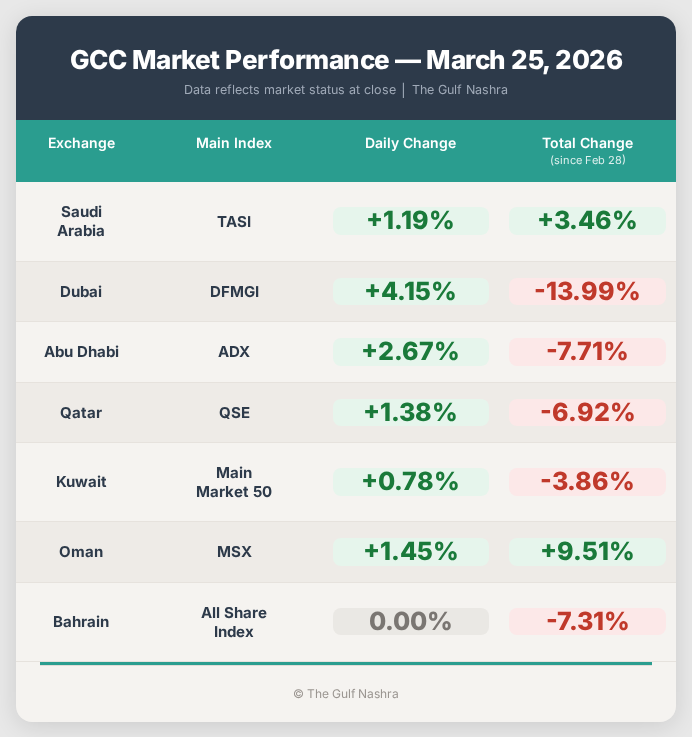
Stock Markets
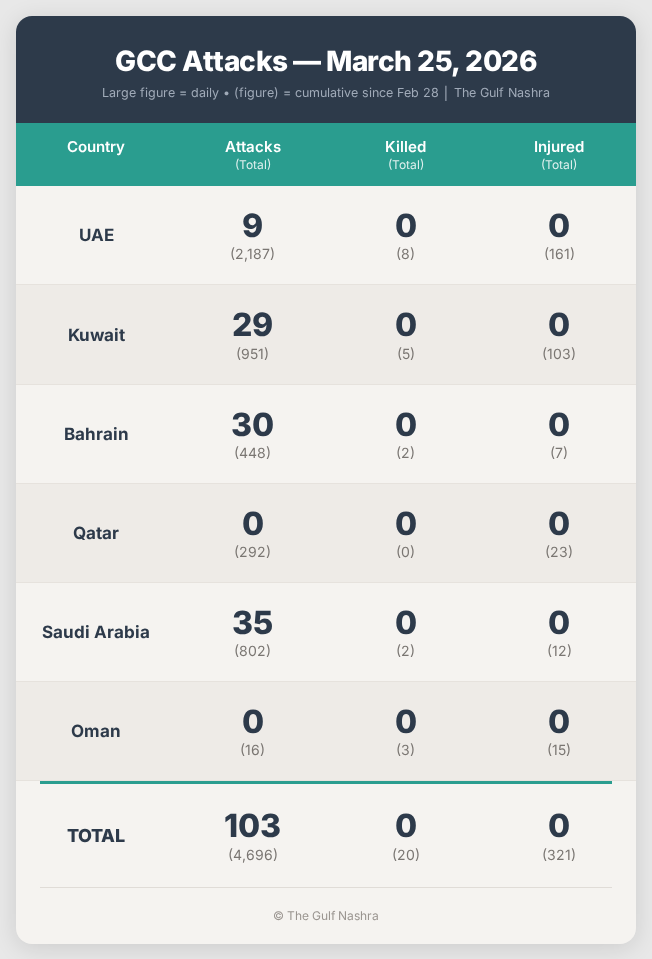
Attacks Summary
States’ Updates
“Iran Launched 83% of Missiles and Drones at the Gulf Compared to 17% at Israel.” Asharq Al-Awsat, March 26, 2026.
“Six Arab Nations Issue Statement Condemning Attacks by Iran-aligned Iraqi Factions.” Asharq Al-Awsat, March 26, 2026.
🇸🇦 Saudi Arabia
“Saudi Arabia Denies it Favors Prolonging the War.” Asharq Al-Awsat, March 25, 2026.
🇶🇦 Qatar
“Iran war damage to Qatar hits global LNG outlook, upends Asia demand growth.” Reuters, March 26, 2026.
🇰🇼 Kuwait
“Kuwait foils plan to assassinate state leaders, busts terror cells.” Khaleej News, March 26, 2026.
Public Opinion
A single tweet can sometimes reveal more than a formal poll—especially when it triggers a unified reaction among influential Gulf commentators. When Dhahi Khalfan urged, “O people of the Arab Gulf… strengthen your cooperation with Israel—this is advice. There is no good in the countries of the region at all,” the response was swift and notably cohesive, amounting to a clear intellectual and moral pushback against his premise. Rather than endorsement, these reactions reflected a shared refusal of normalization under current conditions, alongside a broader insistence on strategic autonomy, political realism, and defined moral boundaries.
From Saudi Arabia, Abdullhadi Alshihri cautioned against generalizations, arguing that each state ultimately acts according to its own interests, yet maintaining that Israel remains an adversary alongside Iran and its regional projects. He stressed that normalization cannot be acceptable or sustainable unless it is tied to a two-state solution, including an independent Palestinian state on the 1967 borders with East Jerusalem as its capital. Meanwhile, Saudi commentator Turki Al Rumaih posed a pointed question that echoed widely: “What has Israel offered its allies in the region during this war?”
From Kuwait, Naif Al Ajmi emphasized that Gulf states, despite recent policy divergences, remain “in the same boat,” arguing they are likely to emerge from the war more unified and resilient. He rejected calls to align with Israel as provocative and strategically misguided, warning that both Israel and Iran are attempting to draw the Gulf into a conflict that does not serve its interests. In a similar vein, Abdulaziz Al Anjeri argued that “the disputes within the Arab house are still curable,” while describing Israel as “a security, moral, and strategic burden,” and warning that trusting it amounts to “placing trust in the source of danger.”
Omani voices reinforced the same trajectory with sharper moral framing. Sultan Al Hasani wrote that “seeking support from the executioner is suicide,” adding that aligning with adversaries amid ongoing violence is not cooperation but “complicity in the crime.” Similarly, Mahdi Bu Saidi argued that cooperation with Israel implies acceptance of the occupation of Palestine and complicity in its consequences, effectively signaling that “my country, too, is open to occupation.” Yousef Al Qasmi, also writing from Oman, framed the issue in strategic terms, asserting that real security lies in a “Gulf strong in itself,” not in dependence on external powers that offer no “free security guarantees” and may abandon allies when interests shift.
From Qatar, Halaa Al Thani distilled the moral dimension succinctly: “Palestine is not a matter of opinion; it is a measure of whether you still possess humanity or not.” Meanwhile, Ramzan Alnuaimi captured the scale of the reaction itself, noting that “a single tweet from a ‘trivial person’ is enough to provoke entire populations.” Gulf commentators are reasserting a framework built on self-reliance, regional balance, and principled limits—where security is produced internally, and engagement with others is defined by conditions, not impulses.
Selected Gulf Opinions
“The statement issued by the UAE, Kuwait, Qatar, Bahrain, Saudi Arabia, and Jordan condemning Iran’s attacks and those of its proxies on their territories does more than express denunciation; it reflects a shift in the architecture of the regional stance. There is a clear alignment among Gulf states and their partners in defining the threat—from the state to the proxy, and from isolated incidents to a broader pattern.
The message is decisive: aggression, in any form or under any cover, will no longer be reinterpreted or justified, and the right to self-defense is no longer a political option but a firmly established sovereign principle. What is taking shape is a consensus that regional stability cannot coexist with the logic of militias or chaos.”
Ebtisam Alkitbi, X, (UAE), March 25, 2026.
“The role of the United Nations in this war resembles that of magazine reporters who miss the news, then return to narrate it later with more images and stories.”
Dawood Alshirian, X, (Saudi Arabia), March 25, 2026.
“Instead of building a joint force, Gulf states have for many years relied on American protection. But Washington prioritizes Israel’s security above all else. The paradox is that some of these states still believe that strengthening their security cooperation with Israel will make them safer, while Israel is determined to dominate the entire region.”
Abdullah Ba Abood, X, (Oman), 2026.
“It is not easy for the Iranians, after all the arrogance, superiority, and declarations of “divine victory,” to accept the negotiation announcements made by President Trump—not because they are untrue, but because they would shake their image of strength, especially domestically. Therefore, denial and rejection are entirely expected.”
Jaffar Salman, X, (Bahrain), March 25, 2026.
“At this critical moment in the region’s history, and amid reports of ongoing talks between the United States and Iran to halt military operations, I would like to emphasize that the Gulf Cooperation Council states cannot be absent from any table where the contours of the regional future are drawn.
The security of this region is not a secondary matter, nor a file to be discussed on our behalf; it is the essence of our stability and existence. In this context, the issue of the Strait of Hormuz must be placed in its proper position:
The Strait of Hormuz is not a bargaining chip, nor a tool of pressure. It is an international waterway that must remain open, unconditionally and under all circumstances.”
Hamad Al Thani, X, (Qatar), March 24, 2026.
“The first lie Trump told his people this month was that it would be a quick operation that would end in days.
The second lie was that all Iranian capabilities had been destroyed.
The third was that Iranian oil would not be threatened.
The fourth was that negotiations are now underway with a senior Iranian leader and that the Iranians will agree to our terms.
The fifth was a five-day deadline before targeting Iranian energy facilities, yet they were struck after two days.
The final lie is that Saudi Arabia, Qatar, and the UAE are fighting alongside the United States and Israel—and that is false.”
Turki Al Rumaih, X, (Saudi Arabia), March 24, 2026.