

Oil, Natural Gas, and the Strait of Hormuz
Oil Price: $101.89 (+4.67%)
As of March 26, 2026, Brent crude rose to $101.89/bbl, marking a daily gain of +$4.63 (+4.76%). The increase follows the previous session’s pullback and reflects continued volatility in energy markets amid ongoing geopolitical tensions. Since the baseline of February 26 ($70.75), Brent remains up +44.02%.
Brent Oil: Investing.com - Brent Oil Historical Data
LNG Price: $291.40 (+2.46%)
As of March 26, 2026, Cheniere Energy Inc. (LNG) closed at $291.40, marking a daily gain of +$7.01 (+2.46%). The stock traded between $286.30 and $292.38, recovering after the previous session’s pullback. Despite ongoing volatility, LNG remains elevated amid sustained global demand for U.S. energy exports. Since the conflict began, the stock has gained +25.33% from its pre-war close of $232.51 on February 26.
Cheniere Energy Inc (LNG): Investing.com - Cheniere Energy (LNG) Historical Data
Strait of Hormuz Status: Critical Blockade
The status remains elevated across the Arabian Gulf, Strait of Hormuz, and Gulf of Oman. According to the latest UKMTO update, no new security incidents were reported during the period from 1700 UTC 25 March to 1700 UTC 26 March.
However, the regional security environment remains volatile, with ongoing military activity and continued underlying threats to commercial shipping. Vessels transiting the area are still advised to exercise caution despite the absence of reported incidents.
Website: UKMTO
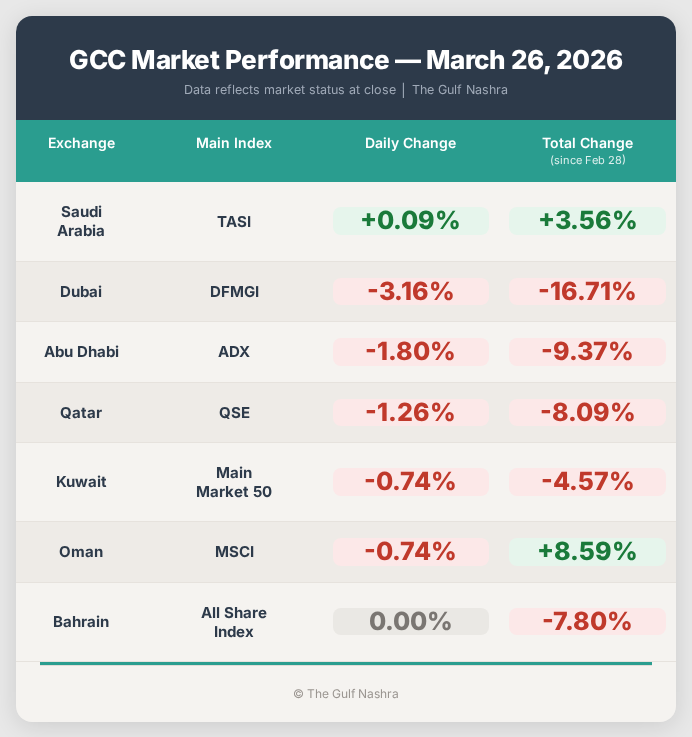
Stock Markets
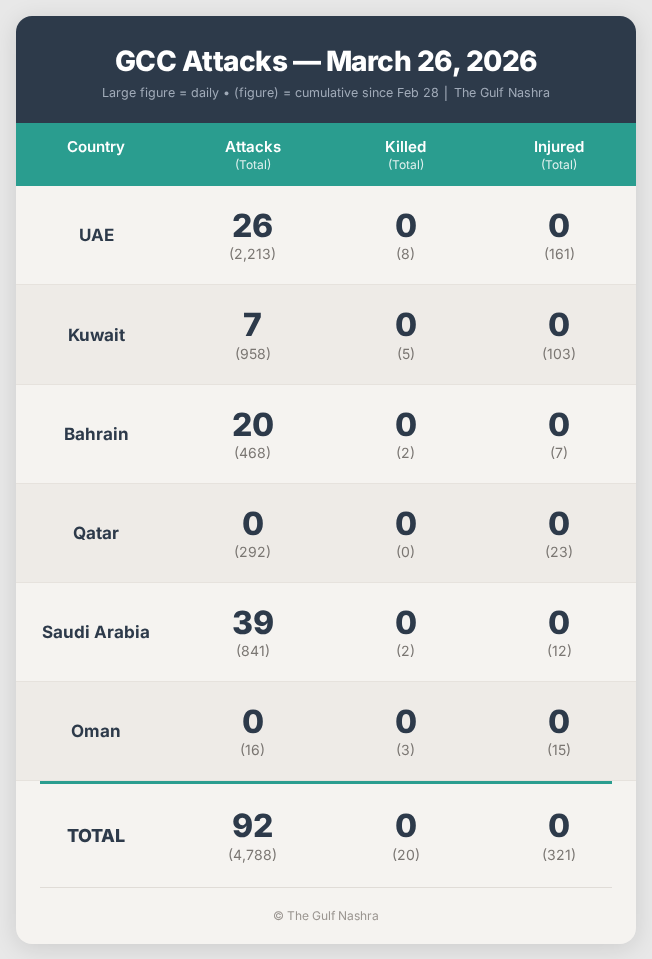
Attacks Summary
States’ Updates
“Gulf countries want Trump to end Iran war — but not yet, officials say.” The Washington Post, March 26, 2026.
“Gulf energy repair costs may reach $25bln, E&C to take lion’s share: Rystad.” Zawya, March 25, 2026.
“Riyadh, Dubai Delay Finance Events as Iran War Disrupts Region.” Bloomberg, March 27, 2026.
🇸🇦 Saudi Arabia
“Ukraine announces ‘mutually beneficial’ defence deal with Saudi Arabia.” Al Jazeera, March 27, 2026.
🇦🇪 UAE
“UAE pushes for international force to reopen Hormuz.” Financial Times, March 27, 2026.
🇰🇼 Kuwait
“Kuwait foils assassination plot.” Kuwait Times, March 26, 2026.
🇧🇭 Bahrain
“14 referred to criminal trial in Bahrain on charges of spying for Iran's IRGC.” Khaleej Times, March 26, 2026.
Public Opinion
Gulf commentators focused on the Strait of Hormuz as it has shifted from a logistical passage into the central arena shaping the trajectory of the conflict. What was once a transit corridor is now a core strategic lever through which military, economic, and political outcomes are contested, placing the strait at the heart of both escalation and potential resolution.
At the center of this dynamic lies a paradox. From Saudi Arabia, Akal Alakal argues that Hormuz represents both “the key to the solution” and a “trap of entanglement,” where Iran’s attempt to leverage disruption is designed to internationalize the crisis—but risks backfiring by triggering broader intervention. Also from Saudi Arabia, Mishary Dhayidi reinforces this view, warning that efforts to “blackmail the world” may provoke overwhelming global retaliation, turning the strait from a pressure tool into a pathway toward wider war rather than de-escalation.
Beyond immediate confrontation, the issue is increasingly framed as structural rather than tactical. From the UAE, Mohammed Al Dosari emphasizes that Hormuz is now embedded within the Gulf long-term security architecture, where the real danger lies not only in closure but in the erosion of trust through selective disruption and rising costs. In this sense, the conflict is no longer about access alone, but about redefining the rules governing one of the world’s most critical energy corridors.
This transformation is not new but cumulative. Also from the UAE, Salah Alghoul, alongside Bahrain’s Abdullah Almadani, situate the current moment within a longer pattern of “strait bullying,” arguing that repeated Iranian threats and actions have gradually militarized the waterway and undermined international norms. What emerges is a persistent condition of instability, one that has already driven deeper Gulf coordination and sustained international military presence to secure navigation.
At the same time, the stakes extend far beyond the region. From Oman, Muhammad Al-Mashikhi frames Hormuz as both a “lifeline” and a “lethal card,” while Qatar’s Ibrahim Flamurzi highlights the systemic consequences of disruption—ranging from energy shocks and inflation to supply chain breakdowns and financial volatility. From Bahrain, Ali Al-Bastaki goes further, arguing that the overlooked risk lies in fertilizers, warning that disruptions could trigger delayed but severe global food inflation, making Hormuz a potential source of both energy and food crises.
Taken together, these perspectives point to a clear conclusion: the Strait of Hormuz is no longer simply a chokepoint to be reopened after each crisis, but a structural fault line in the global system. The emerging consensus is that temporary fixes are insufficient; what is required is a durable framework that prevents its weaponization altogether—otherwise, the strait will remain a recurring source of instability, where each escalation carries the risk of transforming regional tensions into global shocks.
More Gulf Opinions
“Overall, there is a complex and intertwined network of Western and Eastern military presence across the Arab region. Yet there is a deliberate overlooking of what exists in Arab republics, contrasted with an exaggerated and often hostile focus—by elites and even segments of the public—on what exists in some monarchies and emirate systems, often for purposes of distortion, political pressure, or populist mobilization.
In reality, military cooperation, shared use of airports, and designated runways between Arab armies—without exception—and Western forces are widespread and constitute sovereign decisions that do not inherently discredit those states. The real issue lies in a prevailing mindset that justifies such arrangements for some while condemning them for others, applying a double standard rooted in selective judgment rather than principle.”
Mohammad AL Saaed, Okaz, (Saudi Arabia), March 26, 2026.
“The Gulf states, with their vast natural resources, highly strategic geographic position, and political stability, are capable—if united—of forming a formidable regional power. Such unity would not be mere political coordination, but a transition toward genuine integration that would grant the region significant political, economic, military, and security weight, with far-reaching positive impact on Gulf societies and the wider world.”
Hamad Al-Hadrami, Al Roya, (Oman), March 25, 2026.
“The wealthy Gulf states have made significant strides in developing infrastructure, economic growth, and public services, yet this progress remains incomplete and unsustainable without deeper economic and strategic integration among them. Had such integration already been in place, it would have significantly reduced the cost of the current war—yet crises can carry opportunity.
This moment may serve as a catalyst for advancing Gulf integration across energy production and export, diversified industries, unified markets, and transport networks, including expanding export routes across multiple seas, linking Qatari gas supply networks across the region and beyond to Europe, and strengthening interconnections in electricity grids and railway systems. Ultimately, such efforts would support broader economic diversification, market integration, and the development of shared strategic infrastructure across the Gulf.”
Khaled Alkhater, Al Sharq, (Qatar), March 25, 2026.
“The exclusion of Oman from mediating between Iran and the United States, and its replacement with Pakistan, was not a natural development. The Sultanate had long been the preferred intermediary for both sides, and it was expected to resume this role at this stage, yet it appears that one party had a different view.
Did the statements by Oman foreign minister Badr Al Busaidi, following the collapse of negotiations and the outbreak of war—where he placed responsibility on the American side—play a role in prompting the search for a new mediator?”
Saleh Alfahid, X, (Saudi Arabia), March 25, 2026.
“Each time Gulf states face attacks or threats, certain voices in the Arab media space emerge that go beyond merely supporting the aggression—to outright expressions of gloating. This was evident in recent days when Iranian strikes targeted airports and civilian areas in the Gulf; instead of a unified Arab rejection of attacks on cities inhabited by Arab civilians, a small but loud segment responded with visible schadenfreude. The question here is not only moral but analytical: why does this reaction appear, and why does it recur every time Gulf states face a crisis?”
Mohammed Al Rumaihi, Annahar, (Kuwait), March 24, 2026.
“Instead of leveraging this advantage to maintain cooperative relations with its neighbors, Iran turned to aggression, effectively eroding trust across the region. By virtue of geography, Gulf markets had long served as a vital outlet for Iran, helping to mitigate the impact of sanctions in place since 1979; today, however, Tehran has lost not only that economic space but also the trust it had spent years trying to rebuild.
As a result, the recent war has fundamentally altered relations between neighbors, and this shift is likely to endure for decades—even if the Iranian regime were to change in the coming years—because the underlying trust has been broken.”
Fahad Al Sabah, Al Seyassah, (Kuwait), March 23, 2026.
“In the final analysis, the war has not achieved decisive military resolution, but it has clearly revealed a new equation: military superiority alone is insufficient, and true stability is built on internal state strength and the ability to protect oneself. In this context, the UAE and other Gulf states have demonstrated that they are not merely arenas of conflict, but models of states capable of safeguarding their security and stability with efficiency and capability. In an increasingly turbulent world, the real bet lies on states that can protect their populations and preserve their stability, rather than those that pursue escalation policies which lead only to further crises.”
Abdullah Alhashmi, Al Etihad, (UAE), March 23, 2026.