

Oil, Strait of Hormuz, and Stock Markets
As of the market close on March 5, 2026, West Texas Intermediate (WTI) crude oil settled at $81.01 per barrel, representing an 8.51% increase from the previous day’s close of $74.66. This surge marks a multi-year high as markets price in a sustained paralysis of Middle Eastern energy exports. Investing.com, March 5, 2026.
UKMTO reports the area is “deeply disrupted” with a sustained collapse in transit activity following Iran’s military threats. As of March 5th, only 5 crossings were recorded today, far below the baseline of ~100. UKMTO Warning 014-26 confirmed a tanker explosion near Kuwait today, further deterring commercial traffic.
“Most Gulf bourses end higher; UAE shares extend losses.” Reuters, March 5, 2026.
States’ Updates
🇸🇦 Saudi Arabia
“Saudi Arabia Starts to Shift Crude Exports to Red Sea as Hormuz Disruption Mounts.” WSJ, March 5, 2026.
🇦🇪 UAE
“U.A.E. Explores Freezing Iranian Assets to Punish Tehran for Attacks.” WSJ, March 5, 2026.
🇶🇦 Qatar
US, Qatar discuss acquiring Ukrainian drones to down Iran’s Shaheds, source says.” Reuters, March 5, 2026.
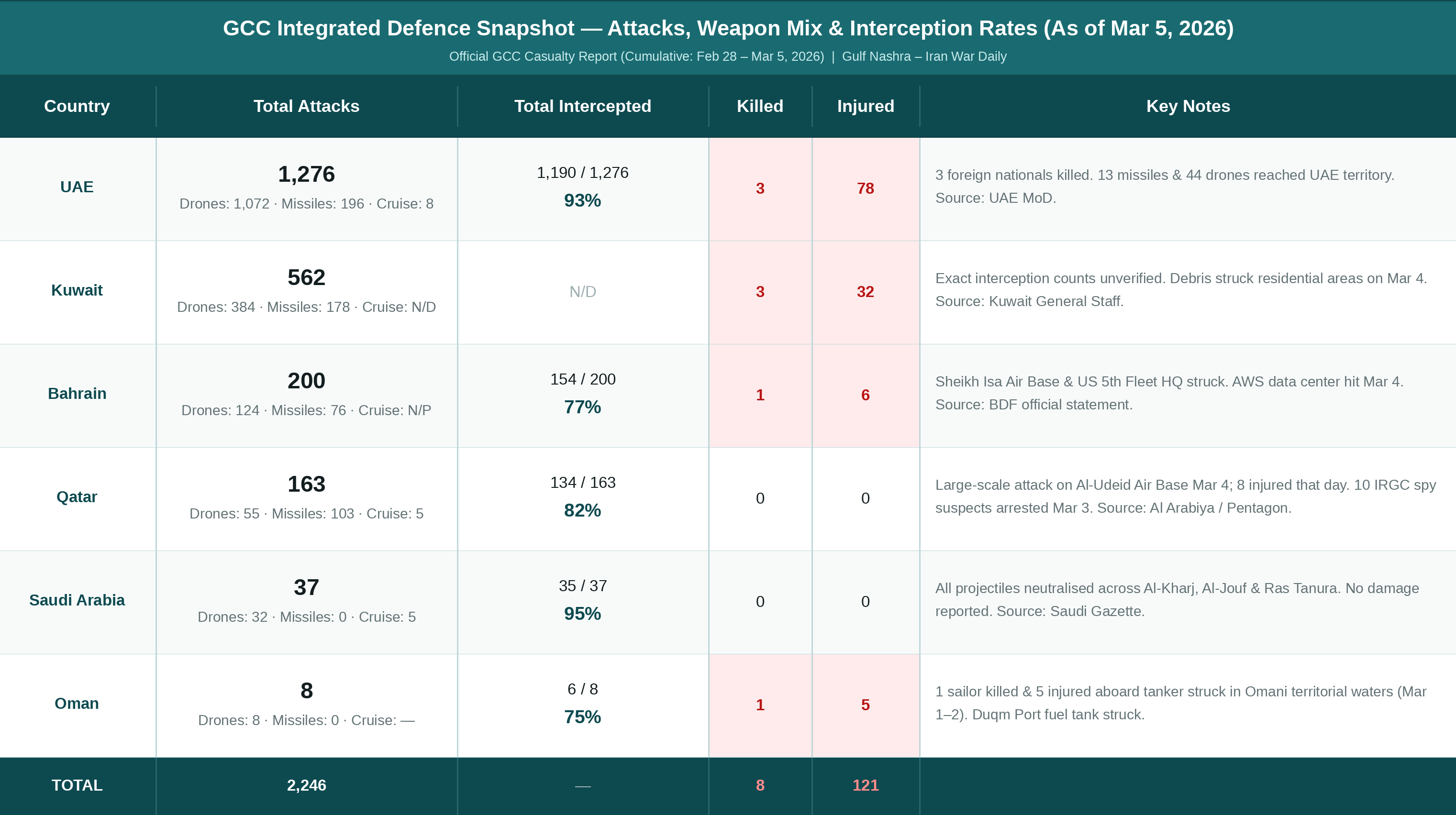
Defense Summary
Public Opinion
🇸🇦 Saudi Arabia
“One of the most positive developments amid the chaos of war is Saudi Arabia’s decision to redirect part of its oil exports to the port of Yanbu on the Red Sea. This is an important step toward stabilizing the market.
It provides an alternative route away from the Strait of Hormuz and helps ensure the continued flow of global supplies, which reduces market anxiety and limits volatility in oil prices.”
Mamdouh Al Muhaini, X, March 5, 2026.
“Washington concealed the details and timing of the strikes against Iran from London, and Britain refused to allow the use of its bases for the operation. This reflects a rare division within the Western alliance. Paris entered the war through Cyprus — will London follow?”
Dawood Alshirian, X, March 5, 2026.
🇦🇪 UAE
“Mr. President Donald Trump,
A direct question: who gave you the authority to drag our region into a war with Iran? And on what basis was this dangerous decision made?
Did you calculate the collateral damage before pulling the trigger? Did you consider that the first to suffer from this escalation would be the countries of the region?
The peoples of this region also have the right to ask: was this decision yours alone, or was it the result of pressure from Benjamin Netanyahu and his government?
You have placed the states of the Gulf Cooperation Council and other Arab countries at the center of a danger they did not choose. Thank God, we are strong and capable of defending ourselves. We have armies and defenses that protect our nations. Yet the question remains: who allowed you to turn our region into a battlefield?
Before the ink had even dried on the Board of Peace Initiative that was announced in the name of peace and stability, we now find ourselves facing a military escalation that puts the entire region at risk. So where have those initiatives gone? What happened to the commitments that were presented in the name of peace?
Most of the funding proposed for those initiatives came from the countries of the region themselves, particularly Arab Gulf states that contributed billions of dollars in support of stability and development. These countries have the right today to ask: where did that money go? And are we funding peace initiatives, or are we financing a war that puts us in danger?”
Khalaf Al Habtoor, X, March 5, 2026.
“Iran’s new leaders appear to believe that intensifying attacks on the United Arab Emirates and other Gulf states could serve as an indirect way to pressure Washington to halt its war against Iran. It is not unlikely that Iran may seek to draw the United Arab Emirates and the rest of the Gulf countries into its war with the United States and Israel. Such a miscalculation could backfire on Iran and push some Gulf states toward normalization with Israel.”
Abdulkhaleq Abdullah, Mufakiru Al Emarat, March 4, 2026.
🇶🇦 Qatar
“Because if we enter into a futile war against Iran, we would be giving a lifeline to Donald Trump to pull himself out of the predicament that Netanyahu pushed him into. He and Netanyahu would escape their dilemma as soon as we become entangled in the war.”
Abdullah Alamadi, X, March 5, 2026.
“White House — Donald Trump holds a ‘laying on of hands’ session in the Oval Office to receive a blessing for the war against Iran.
Note: This is a religious ritual in Evangelical Protestantism, where people place their hands on someone while praying for divine blessing or guidance. Within some strands of Evangelical Christianity, the establishment of a greater Kingdom of Israel is considered part of the prophetic belief linked to the return of Jesus Christ.”
Ahmad Alyehri, X, March 5, 2026.
🇴🇲 Oman
“After the war comes to an end, the Gulf states should take the following steps:
First: Close the American military bases located in some countries, as reality has shown that they have become a source of trouble rather than a source of defense.
Second: Move toward establishing a military bloc that includes a joint army and diversifying sources of armament.
Third: Open a new chapter with Iran and all countries of the region based on cooperation and the exchange of mutual interests.
Reality suggests that the American bases were established to protect Israel rather than the countries that host them — and perhaps there is some benefit that may come out of this adversity.”
Ali bin Salim Alrashdi, X, March 5, 2026.
“There is no justification for the United States to strike Iran, regardless of what is being said here and there. What is happening is the shaping of a regional order according to an Israeli-American vision, supported from behind by some Western countries. The real concern for the Arabs is the uncertain future. The attack has effectively derailed the negotiations between Tehran and Washington, which in their third round in Geneva had produced outcomes satisfactory to the United States. However, Netanyahu has other objectives.”
Ahmed bin Salim, Al Bilad, March 6, 2026.
🇰🇼 Kuwait
“Unfortunately, the Iranian aggression continues with strikes on facilities and infrastructure. The attacks have even reached mediator states, particularly the Sultanate of Oman and the State of Qatar, including QatarEnergy facilities, as well as oil installations in Saudi Arabia and other Gulf countries.
This deepens the level of doubt about intentions and the future of relations between the current generation and future generations who are living through and witnessing the shocks of attacks, aggression, and the sound of air-raid sirens.
The important question now is: who holds the decision-making authority today after the departure of the Supreme Leader?”
Abdullah Alshayji, X, March 5, 2026.
“People in the Gulf countries are asking: Why is Iran bombing us?
The short answer is that the mullahs want to send us a message: expel the Americans from your lands and their bases.But they did not complete the message, which is: so that we can come instead, and those bases become Iranian bases on your territory, turning the Gulf into a Persian lake rather than an American one.
The ironic part is that we in the Gulf states signed defense agreements with the Americans so they would protect us. Accordingly, we allowed them to establish bases on our soil, and we even pay for them ourselves. Yet the opposite has become clear. In the current war, our Gulf armed forces have been defending themselves on their own—and even defending the Americans in their bases as well.”
Fuad Al Hashim, X,March 5, 2026.
🇧🇭 Bahrain
“After a long silence, Ahmed Aboul Gheit, Secretary-General of the Arab League, issued a statement on the current events. It would have been better had he remained silent rather than issuing such a weak statement. While Iran is launching its missiles and drones at the Gulf states that pay his salary, he speaks about “deepening divisions.”
Abdullah Almadani, X, March 5, 2026.
“What is actually happening in Iran is that the Islamic Revolutionary Guard Corps is no longer merely a military arm of the regime. It has evolved into a ‘state within a state,’ managing the war with a degree of independence. This new situation has profound implications for the course of the war, fundamentally altering the rules of the game and carrying direct consequences for the Gulf states.”
Samira Rajab, Akhbar Alkhaleej, March 6, 2026.