

Oil, Natural Gas, and the Strait of Hormuz
Oil Price Update (72% increase)
As of the early market open on March 9, 2026, West Texas Intermediate (WTI) crude oil has rocketed to $114.86 per barrel, a massive 6.3% jump from Sunday’s open. Brent crude has surpassed $117 per barrel. This represents a near 72% increase in just ten days as the market reacts to the intensification of the air campaign and the continued blockade of the Gulf. Investing.com, March 9, 2026.
LNG Price Update (72.7% increase)
As of the early market open on March 9, 2026, the Japan-Korea Marker (JKM) has surged to $18.52 per mmBtu, representing a 72.7% increase from the pre-war price of $10.72. Similarly, the European Dutch TTF benchmark climbed to €53.39 per megawatt-hour, a 67.0% weekly jump. The market is pricing in the complete loss of Qatari volumes following the declaration of Force Majeure and the blockade of the Strait of Hormuz. Investing.com
Strait of Hormuz Status: (Near-Total Halt)
UKMTO reports that transit through the Strait remains “critically dangerous.” As of March 9, the Joint Maritime Information Center (JMIC) confirmed that commercial traffic has effectively stopped, with only 4 cargo vessels and 2 tankers recorded as attempting the crossing in the last 48 hours. The area is plagued by significant GNSS/GPS interference and active kinetic threats. UKMTO, March 9, 2026.
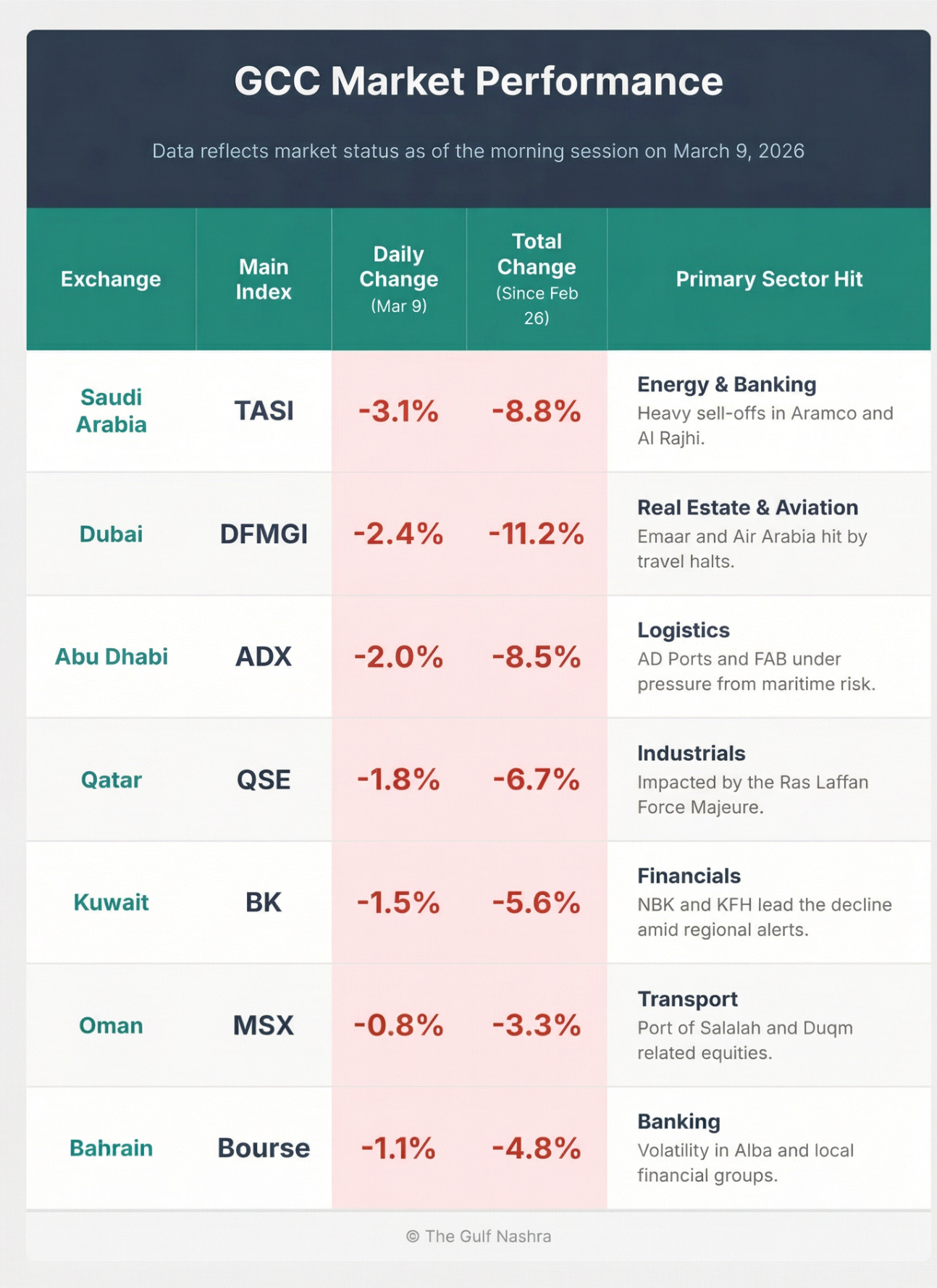
Stock Markets
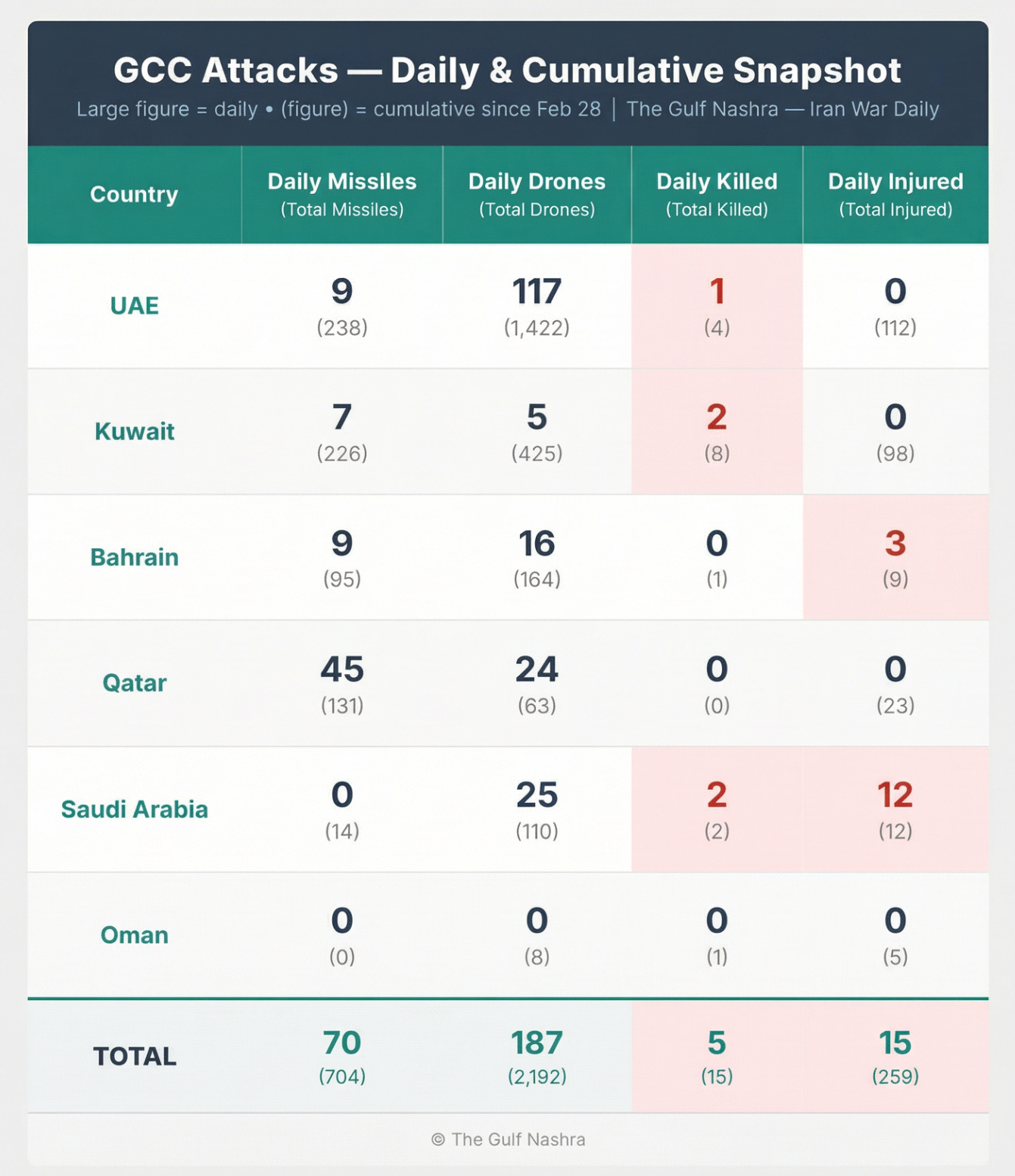
Attacks Summary
States’ Updates
🇸🇦 Saudi Arabia
“US Orders Diplomats in Saudi Arabia to Leave Due to Safety.” Bloomberg, March 8, 2026.
“Riyadh becomes key exit route as Gulf travelers scramble for flights amid Iran war.” Alarabiya, March 8, 2026.
“Two killed in Saudi Arabia after ‘projectile’ falls on residential building.” Al Jazeera, March 8, 2026.
🇦🇪 UAE
“Emirates says all flights to and from Dubai suspended.” Alarabiya, March 8, 2026.
“Three Indonesian crew missing after UAE tugboat sinks in Strait of Hormuz.” The New Arab, March 8, 2026.
🇶🇦 Qatar
“Qatar PM Says Iran ‘Betrayed’ Gulf With Attacks.” WSJ, March 8, 2026.
“Qatar LNG Outage Erases 2026 Supply Surplus, Morgan Stanley Says.” Bloomberg, March 8, 2026.
🇰🇼 Kuwait
“Kuwait government building hit by Iranian drone.” BBC, March 8, 2026.
🇧🇭 Bahrain
“Bahrain says water desalination plant damaged in Iran attack, 3 people injured by debris.” Alarabiya, March 8, 2026.
Public Opinion
Statements by the Secretary-General of the Arab League, Ahmed Aboul Gheit, and former Secretary-General Amr Moussa sparked widespread backlash across Gulf social media. Aboul Gheit described the events as “reckless Iranian escalation” against the Gulf, while Moussa wrote on X (formerly Twitter) that what is unfolding represents an “Israeli adventure” aimed at reshaping the Middle East. These characterizations triggered sharp reactions from Gulf commentators, many of whom criticized both statements and questioned the framing of the conflict. Veteran Saudi commentator Abdulrahman Al-Rashed responded that “the claim that what is happening is merely an Israeli or American adventure to reshape the Middle East may contain some truth,” but warned that it “simultaneously ignores a fundamental reality: the Iranian threat has not been directed at Israel alone.” According to Al-Rashed, Iran has targeted at least eight Arab countries through missiles, drones, and proxy militias affiliated with Tehran. From the Gulf to Iraq, Lebanon, Yemen, and Syria, he argued, Arab states have lived for decades under an Iranian expansionist project that used militias and missiles as tools of destabilization. Reducing the crisis to an “Israeli–Iranian conflict,” he noted, overlooks the fact that Arabs themselves have long been targets rather than spectators. Saudi commentator Dawood Al-Shirian observed that the debate unfolding between Al-Rashed and Amr Moussa raises a serious issue that deserves broader Arab discussion. In his view, both Iran and Israel represent expansionist projects, bound by what he described as “historical myths used to justify conflict and domination.” Al-Shirian concluded that “choosing between these colonial projects has long misled us—perhaps recognizing this is the first moral gain of this war.”
Emirati commentators largely echoed the Saudi perspective. Dhahi Khalfan wrote on X that “it appears that Amr Moussa did not see—or chose not to see—how the map of the Middle East has changed over the past two decades as a result of Iranian policies.” He argued that Iran did not limit itself to a controversial nuclear program, but instead built cross-border influence through military and political arms across several Arab countries, altering the regional balance of power. Similarly, UAE academic Abdulkhaleq Abdullah stated that “it is shameful to defend an aggressive, terrorist Iranian model, and equally shameful not to condemn Iran’s blatant aggression against eight Arab states—Jordan, Iraq, and six Gulf countries,” asking rhetorically whether Iranian blood had become “more valuable than Arab blood,” and whether Iran had somehow become less dangerous than Israel.
Criticism was also directed at the Arab League itself. Bahraini commentator Abdulla Al-Jenaid wrote that “the Arab Gulf Cooperation Council states are confronting this aggression without you [the Arab League]—and your statements will not stop a single Iranian drone.” Kuwaiti writer Duwai’ Al-Ajami argued that Gulf states may need to reconsider the presence of Arab individuals who celebrate attacks on Gulf countries while benefiting from their prosperity. Qatari commentator Abdulla Al-Khater similarly suggested that once the war ends, Gulf states may need to adopt a different stance toward the Arab League. Despite the broad alignment among many Gulf commentators, some voices offered a more nuanced reading. Saudi diplomat Ziad Aldrees argued that remarks such as Amr Moussa’s were misinterpreted by some as defending Iran, even though Moussa explicitly called for “continued Arab support for Gulf states against Iranian attacks.” At the same time, Aldrees cautioned that warning about the “Greater Israel” project does not justify Iranian aggression. In his view, the region faces two dangers—“Khomeinist enclaves” and “Greater Israel”—and it is misleading to frame the crisis as if the Middle East were confronting only a single adversary.
More Gulf Opinions
“As for the Nasserist ideological theories that belong to an era of slogans and confrontations, experience has shown that they brought the Arab world nothing but crises. What you [Amr Moussa] wrote in your tweet today reminds me of the Arab proverb: “The mountain labored and gave birth to a mouse”—outdated theories long overtaken by time.”
Mohammed Al Mulla, X, (Kuwait), March 8, 2026.
“Israel desire to implicate the United Arab Emirates and pull it into participating in—or contributing to—the war is evident. This begins with the circulation of repeated reports from various sources about an alleged Emirati strike on an Iranian desalination plant, and extends to Israel deliberate targeting of vital infrastructure in Iran. Denials alone are not enough; what is needed is a reassessment of alliances and agreements that entangle you while you believed they were protecting you.”
Hesham Alghannam, X, (Saudi Arabia), March 8, 2026.
“One of Israel’s main priorities now is to draw the Gulf into the conflict in any way possible. It hopes to declare—sooner rather than later—that its partner in the Abraham Accords has joined what it presents as its “sacred war” against Iran. In contrast, there is broad Gulf awareness and determination to avoid this scenario by all possible means—even the unlikely ones.”
Hesham Alghannam, X, (Saudi Arabia), March 8, 2026.
“You say that the report [UAE carried out the first military strike inside Iran] had not been confirmed when you published it. So how can such a serious claim be published without confirmation or an official statement from the UAE? Especially since the UAE denied the report and affirmed that any step it takes would be announced officially.”
Mohammed Al Hammadi, X, (UAE), March 8, 2026.
“Now, Arabs themselves have become the ones serving the Zionist project—whether by encouraging the elimination of resistance and pursuing direct normalization, or through their complete silence regarding the daily crimes committed by the Israeli entity against Palestinians, Lebanese, and even Iran. And what has been the result? Israel has transformed into a global hub for technology and defense, to the point that countries such as India no longer see Arabs as reliable partners, but merely as financiers who consume technology rather than produce it. By contrast, Israel presents itself as an innovation power capable of offering solutions in cybersecurity, advanced agriculture, military industries, and artificial intelligence. Can Narendra Modi—or any other state seeking to benefit from Israel capabilities—really be blamed for turning toward Israel at the expense of the Arabs, who have largely confined themselves to the role of passive spectators?”
Zahir bin Harith Al-Mahrouqi, Oman Daily, (Oman), March 8, 2026.