

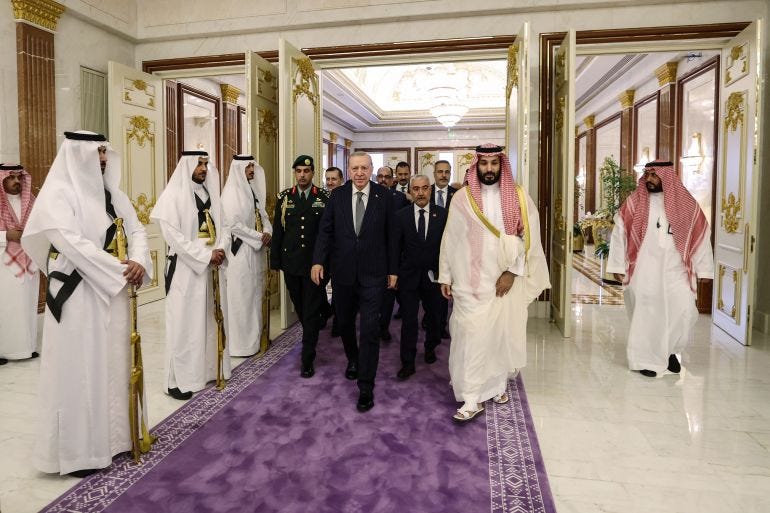
A week after the Makkah Joint Defense Agreement between Saudi Arabia, Turkey, and Pakistan triggered debate over whether new security arrangements outside the Gulf Cooperation Council might strengthen or weaken Gulf cohesion, Gulf commentary has moved toward a broader question: what does the agreement say about the changing model of regional security? For some, the pact exposes limitations in existing Gulf and Arab collective-security institutions. For others, it represents a transition from dependence on external protection toward regional deterrence and strategic autonomy. A third discussion concerns whether the pact could eventually expand and connect more directly with the GCC.
Emirati academic Abdulkhaleq Abdulla offers one of the more explicitly political interpretations, describing the agreement as an “Islamic alliance.” He points particularly to its collective-defense provision, under which an attack against one member is considered an attack against all three. Abdulla has also noted what he considers the disproportionately enthusiastic response of the Muslim Brotherhood, including statements by its leaders and commentary across its media platforms. His intervention raises the question of whether an agreement among three major Muslim states could acquire an Islamic political identity beyond its immediate defense provisions.
Emirati writer Mohammed Alhammadi approaches the agreement primarily through the shortcomings of existing Gulf and Arab collective security. His central question is why Gulf states, despite possessing advanced militaries and substantial defense resources, continue to seek additional security arrangements outside their immediate regional institutions. In his view, the recent U.S.-Israeli war with Iran demonstrated that possessing sophisticated weapons is not the same as possessing collective deterrence. Regional governments condemned attacks against states in the region, he argues, but did not translate that position into a unified security response.
Alhammadi does not oppose partnerships with outside powers, which can provide technology, intelligence, training, and military capabilities. But he distinguishes between partnerships that reinforce an existing regional system and those that compensate for its weaknesses. External partnerships are useful when they “add to an existing system, not when they compensate for its absence.” When a Gulf state seeks additional defense guarantees, he argues, the question is not only what it found among new partners, but “what it lacked in the Gulf home.” The danger is that reliance on external arrangements could expose continuing weaknesses in Gulf and Arab collective-security institutions.
Qatari academic Khalid Al-Jaber sees the Makkah Agreement as part of a possible transition from “imported security,” based heavily on external guarantees, toward greater regional responsibility for deterrence. He argues that changing U.S. priorities have exposed the limits of relying on Washington as the region’s principal security guarantor, while the Arab world has struggled to transform its own resources into collective power. The pact could therefore shift the relationship with outside powers from “strategic dependence” toward “strategic partnership.”
For Al-Jaber, however, its significance depends on implementation. If the agreement develops credible mechanisms for collective defense and protection of critical infrastructure, it could become the “nucleus of an Arab security system”; otherwise, it risks becoming another symbolic regional agreement.
Saudi diplomat and GCC Assistant Secretary-General for Political Affairs and Negotiation Abdel Aziz Aluwaisheg offers a complementary interpretation. He describes the agreement as evidence of movement toward “regional strategic autonomy,” while emphasizing that it should augment rather than replace existing arrangements. The pact combines diplomacy, defense, and deterrence, with its collective-defense provision intended primarily to discourage aggression.
Aluwaisheg explicitly rejects interpreting the agreement as a replacement for either the U.S.-led security order or the GCC’s military framework. Instead, it can operate alongside them through exercises, intelligence sharing, logistical cooperation, training, defense industries, and maritime security. The alliance is also expected to establish a secretariat in Saudi Arabia. In this reading, the pact represents defense burden-sharing and diversification rather than a choice between regional autonomy and existing international partnerships.
