

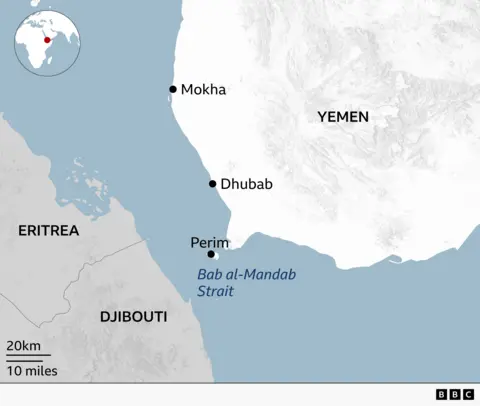
The latest Houthi advances in Yemen, particularly the group’s seizure of Mokha, Dhubab and Perim Island near the Bab al-Mandab Strait, have reopened a wider Gulf debate over Saudi Arabia’s security strategy and the effectiveness of the regional architecture built around it. At the same time, a drone attack targeted Saudi Arabia’s East–West oil pipeline, widening the discussion from Yemen to the vulnerability of Gulf energy infrastructure and maritime routes.
Gulf commentators have approached the escalation from several directions. Some question the effectiveness of Saudi-backed Yemeni forces and recently announced regional defense alliances; others argue that the crisis can no longer be treated primarily as a Saudi-Yemeni confrontation, but as part of a broader struggle involving Iran, the United States and Gulf security.
UAE academic Abdulkhaleq Abdulla offers one of the sharpest critiques, focusing on the regional security arrangements that were supposed to respond to this kind of crisis. He argues that Saudi Arabia should “review its policies and reconsider its relations with the countries closest to it in its Gulf neighborhood,” rather than continuing to establish alliances whose practical value remains uncertain.
Abdulla asks what has become of the maritime defense alliance established in July to protect Bab al-Mandab and the Red Sea, and whether there are concrete steps to activate it. He raises the same question about the Makkah alliance linking Saudi Arabia, Turkey and Pakistan, established in August on the principle that an attack on one member constitutes an attack on all three. For him, the present escalation is “the moment of truth” for alliances that received considerable attention when announced but now appear uncertain in their response.
Kuwaiti academic Ayed Al-Manna shifts the criticism toward the internationally recognized Yemeni government. He focuses on the withdrawal of government forces from Hays, Al-Khawkhah, Mokha, Dhubab and Perim Island and argues that the retreat requires investigation.
His central question is how exposed Houthi forces, despite facing air strikes, were able to overrun positions held by government units that were supposedly better equipped and more capable. Al-Manna therefore places attention on the weakness of the Yemeni forces upon which any Saudi strategy against the Houthis ultimately depends.
