

Media Coverage
Geopolitics
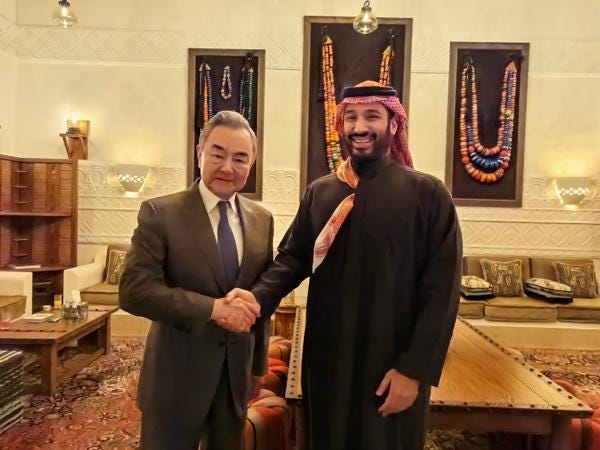
“China calls for deeper Gulf ties, urges free trade agreement.” Semafor, December 15, 2025.
“Wang Yi used a trip to Jordan, Saudi Arabia, and the UAE this week to lobby the Gulf Cooperation Council (GCC) to conclude the talks as a “strong signal defending multilateralism.” China is keen to deepen economic, trade, and investment ties with the GCC, Wang said.”
Go Deeper: “Imports and Influence: China’s Growing Economic Presence in the Gulf.” Carnegie, October 30, 2025.
“French, Saudi and US officials push Hezbollah disarmament plan.” Arab News, December 18, 2025.
“Speaking after the meeting, France’s foreign ministry spokesperson Pascal Confavreux said the talks had agreed to document seriously with evidence the Lebanese army’s efforts to disarm Hezbollah as well as strengthening the existing ceasefire mechanism.”
Go Deeper: “Saudi Arabia and Lebanon: A Love-Hate Relationship.” Washington Institute for Near East Policy, September 12, 2023.
Market, Economy & Domestics
“Saudi Arabia proposes to host WTO meeting in 2028.” Reuters, December 18, 2025.
“The request was on the agenda of a WTO meeting being held in Geneva on December 16-17, and 22 countries welcomed the proposal, but a final decision was not yet made, a WTO spokesperson said on Thursday.”
Go Deeper: “Saudi Arabia’s next horizon: Building human capital beyond Vision 2030.” Atlantic Council, November 20, 2025.
“Qatar bets on cheap power to catch up in Gulf AI race.” Reuters, December 17, 2025.
“The launch of Qai, backed by the country’s $526 billion sovereign wealth fund and a $20 billion joint venture with Brookfield , marks Qatar’s most ambitious move yet into a sector that is reshaping global technology and economics.”
Go Deeper: “Artificial Intelligence in Qatar: Assessing the Potential Economic Impacts.” IMF, March, 2025. [PDF].
UAE: “ADNOC Secures Landmark Structured Financing of up to $11 Billion for Hail and Ghasha Gas Development.” ADNOC, December 18, 2025.
“Hail and Ghasha is part of the larger Ghasha Concession, located offshore Abu Dhabi, which is expected to produce 1.8 billion standard cubic feet per day (bscfd) of gas. It is also the world’s first offshore gas project of its kind that aims to operate with net zero emissions, capturing 1.5 million tonnes per year (mtpa) of carbon dioxide (CO2), equivalent to removing over 300,000 cars off the road every year.”
Go Deeper: “UAE natural gas production: data and insights.” Offshore Technology, July 11, 2024.
“Kuwait To Reportedly Sign Nearly $4B Port Project Contract With Chinese State-Owned Firm.” Middle East Forbes, December 19, 2025.
“Mubarak Al-Kabeer Port was initiated by Kuwait’s Ministry of Public Works to boost the country’s position as a shipping hub and enhance access to the Red Sea, according to infrastructure consulting firm AECOM, which is advising on the project.”
Go Deeper: “Beyond the Arabian Sea: Bridging the gap between Kuwait and China.” KPMG, November, 2024. [PDF].
“India signs deal with Oman as it tries to counter US tariffs by accelerating free trade agreements.” AP, December 18, 2025.
“The deal aims to boost bilateral trade and push India’s exports of engineering goods, textiles, leather, pharmaceuticals and agricultural products. It will provide Indian goods zero-duty market access on 98.08% of Oman’s tariff lines, India’s Trade Ministry said in a statement.”
Go Deeper: “India-Oman joint statement outlines roadmap for deeper cooperation across trade, energy, maritime security and people-to-people ties.” The Economic Times, December 19, 2025.
“Egypt, Qatar’s Al Mana Holding sign $200 million sustainable aviation fuel deal.” Reuters, December 14, 2025.
“The project will be developed in three phases and will span 100,000 square metres in the Integrated Sokhna Zone on Egypt’s Red Sea coast. The first phase will have an estimated annual production capacity of 200,000 tonnes, the cabinet said in a statement.”
“UAE cybersecurity boost: 5,000 Emiratis join private sector to combat threats.” Gulf News, December 20, 2025.
“Dr. Al Kuwaiti stated that the UAE confronts nearly 200,000 cyberattacks daily targeting various vital sectors. He emphasized that the country’s high level of cyber readiness enables it to detect and thwart these attacks before they can impact service continuity or data security.”
Go Deeper: “The power of partnership: How the UAE is securing cyberspace.” World Economic Forum, June 20, 2025.
“Saudi Arabia, India agree visa waiver for diplomatic passports.” Gulf News, December 20, 2025.
“Under the agreement, eligible passport holders from both countries will be able to enter for short stays without the need to obtain visas in advance, cutting administrative procedures and facilitating smoother official travel.”
Go Deeper: “India-Gulf relations are muted—but mobilizing.” Atlantic Council, June 3, 2025.
Bahrain: “Banking sector balance sheet rises to $252.5 billion by end-October 2025.” Alwatan, December 15, 2025.
“The consolidated balance sheet of the banking system — covering both retail and wholesale banks — reached $252.5 billion at the end of October 2025, marking a 1.8% increase compared with the end of October 2024.”
Go Deeper: Bahrain: “Fiscal Year Budget Stats” Ministry of Finance and National Economy, 2025. [PDF].
Kuwait: “The drive to localize leadership positions gets underway.” Aljarida, December 15, 2025.
“In a move signaling the launch of the ‘localization of leadership positions’ drive, four Amiri decrees were issued yesterday at once. One decree promoted Brigadier Abdulwahab Al-Wuhaib to the rank of Major General and appointed him Undersecretary at the Ministry of Interior.”
Go Deeper: “New developments in the leadership positions crisis: posts vacant for five years.” Alqabas, January 2, 2025.
Gulf Opinions
This week, Saudi and Emirati commentators engaged in a pointed debate over Yemen’s unity and the prospect of southern secession. In his latest column, former Al-Arabiya general manager Abdulrahman Al-Rashed argued that Saudi Arabia remains “the only state with a lasting and structural influence on Yemen,” whether unified or fragmented, followed at a secondary level by Oman, grounding his view in Napoleon’s dictum that “geography is the only permanent truth in politics.” He added that “geography and demography” reinforce this reality, noting that more than “two million Yemenis live in the Kingdom,” and concluded that the Southern Transitional Council “cannot advance” its secessionist project “without broad Yemeni acceptance and Saudi backing.” These claims prompted sharp responses from Emirati commentators, most notably Dhahi Khalfan, Lieutenant General of Dubai Police, who argued that while such reasoning may be defensible within international relations, it becomes analytically reductive when transformed into a definitive judgment on the fate of peoples and political projects. Geography, he stressed, is constraining but not a closed political destiny, warning that conditioning any southern project on “the neighbor’s consent” risks reducing sovereignty to a mere geopolitical function. Khalfan further criticized Al-Rashed for conflating leadership failure with the legitimacy of the cause itself, concluding that the article “offers an intelligent reading of geography, but pushes realism so far that it empties politics of meaning,” while overlooking the fact that fragmentation has existed since 1994, not since the emergence of the Southern Transitional Council.
Other Emirati voices echoed this critique. Hani Mas’hour insisted that Al-Rashed’s article is padded with references meant to signal mastery of southern history, describing the comparison between Al-Dhalea and Hadramawt as “a flimsy argument that falls short of Al-Rashed’s established journalistic stature,” and invoking another Napoleonic maxim: “Hesitation and half-measures lead to losing everything in war,” urging a focus on confronting the Houthis while leaving the South to its people to decide its future. In the same vein, Emirati academic Abdulkhaleq Abdullah praised an article by Sheikh Ould Salek, emphasizing that southern Yemenis hold a deep and enduring gratitude for Emirati support, a conviction that “shapes both attitudes and behavior.” On the Saudi side, Khaled Al-Suliman countered that Saudi support cannot be met with “ingratitude,” warning that attempts to dominate other Yemeni regions render opportunistic forces little different from the Houthis, and asserting that “the only safety net Yemen possesses today is Saudi Arabia.” Similarly, Saleh Al-Baidhani, media adviser at the Yemeni Embassy in Riyadh, wrote in Okaz that: “Saudi Arabia remains the country most deeply tied to Yemen’s fate, arguing that history, a 1,300-kilometer shared border, and intertwined security, economic, and social interests make Yemen’s stability a strategic necessity, and that Saudi Arabia has played an indispensable role throughout the conflict in containing crises and preventing collapse.”
More Gulf Opinions
“The collapse of the Assad regime is not merely an internal Syrian event, but a pivotal moment in the region’s history that exposes the limits of power, the failure of governance built on exclusion, the dangers of politicizing identities, and the cost of turning nations into open arenas of conflict. The most important lesson is that genuine stability is not built with tanks, nor are states preserved by postponing explosion, but through early reform, political justice, and inclusive national partnership. Unless these lessons are fully absorbed, tragedies may recur under different names, but with the same pain.”
Abdullnabi Alshoala, Al Bilad, (Bahrain), December 21, 2025.
“Generation Z has grown up in a world of networks rather than ladders, where the internet has leveled the playing field and a teenager on TikTok can wield more influence than the CEO of a major corporation. As a result, this generation favors flattening organizational hierarchies, placing far less value on grand titles or years of experience than on competence and the ability to persuade. The challenge for managers is that position alone no longer guarantees automatic obedience or respect. Added to this is a strong desire for participation: Gen Z employees want a seat at the table and a voice in decision-making from day one. While managers may view this as arrogance or impatience, it is driven by a genuine desire to make an immediate impact.”
Hussain Habib Alsayed, Al Arab, (Qatar), December 20, 2025.
“Al-Burhan fears dismantling his alliance with the Muslim Brotherhood and the organizations aligned with it, foremost among them the Al-Baraa bin Malik Brigade, because these groups supply his army with fighters and shape its war strategy. They are fully aware that any peace in Sudan, or a transition to civilian and democratic rule, would remove them from the political scene altogether. For this reason, they exert pressure to sabotage any move toward peace. When the revolution rose against Bashir’s Brotherhood-backed regime, one of the Sudanese people’s earliest demands was the removal of this group, which had brought disaster upon Sudan and its people.”
Dr. Amal Alhaddabi, Al Bayan, (UAE), December 19, 2025.
“Trump, who repeatedly promised his voters that he would end America’s foreign wars and focus on ‘America First,’ now appears to be recalibrating the compass toward a logic of preemptive war, albeit under a new slogan and justification. Instead of spreading democracy, the pretext this time is combating drug trafficking, a rationale being used to legitimize military moves.”
Khaled bin Salem Al Ghassani, Al Roya, (Oman), December 16, 2025.
Nashra Picks
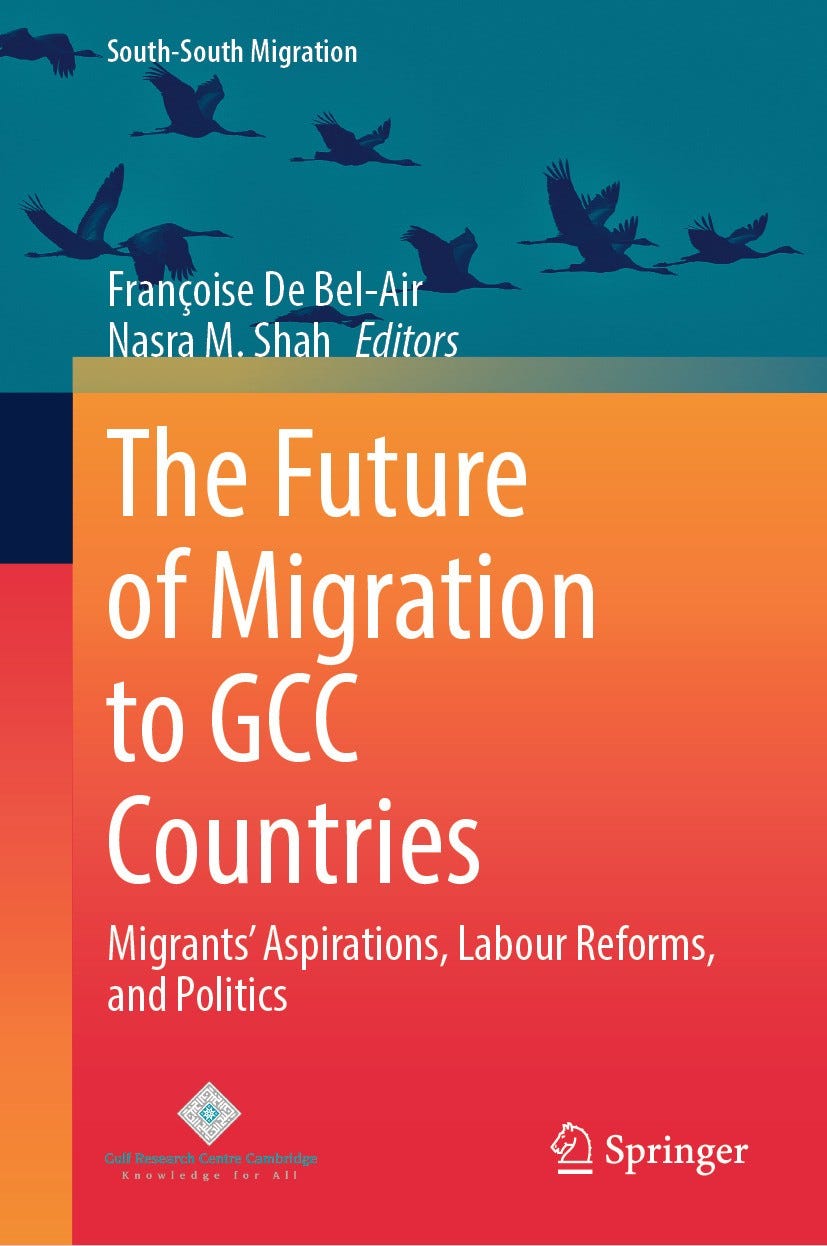
Book: De Bel-Air, Françoise, and Shah, Nasra M., “The Future of Migration to GCC Countries.” Spring, November 22, 2025.
Report: “Kuwait: Staff Concluding Statement of the 2025 Article IV Mission.” IMF, December 18, 2025.
Analysis: “Recasting Syria After Assad: Saudi Arabia’s Bid to Shape a Gulf-Led Regional Order.” John Calabrese, Arab Gulf States Institute in Washington, December 19, 2025.
Analysis: “Why Saudi Arabia Has Become America’s Most Difficult Ally.” Layan Mandani, Medium, December 21, 2025.
Analysis: “GCC: Growth set to strengthen in 2026 as hydrocarbons production picks up.” Daniel Richards, NBD Research, December 18, 2025.
Analysis: “Tracing King Salman Energy Park: Saudi Arabia’s Drive for Localisation of Energy Supply Chain.” Swapnil Sujal, Middle East Political and Economic Institute, December 14, 2025.
Analysis: “GCC Joint Defence Integration and the US Factor.” Mahdi Ghuloom, ORF, December 15, 2025.
Analysis: “From Crude to Compute: Building the GCC AI Stack.” Mohammed Soliman, Middle East Institute, December 15, 2025. [PDF].
Analysis: “Friends in Need: Morocco’s Gen Z Protests and the GCC Response.” Bouchra Lawrence and William Lawrence, Arab Gulf States Institute in Washington, December 18, 2025.
Analysis: “Russia is weakened, but its influence in the Middle East should not be underestimated.” Nikolay Kozhanov, Chatham House, December 11, 2025.
Research: “China’s Partnership Diplomacy and the Formation of Gulf Regional Order.” Zhou Yiqi, Alternatives: Global, Local, Political, December 18, 2025.
Research: “Khaleeji Entrepreneurial Ecosystems: Development Visions, and Precarity in the Neoliberal Gulf.” Spring, November 22, 2025.
Webinar: “The GCC AI Stack: A Roadmap for Gulf Leadership in the Global Technology Race.” The Middle East Institute, December 16, 2025.