

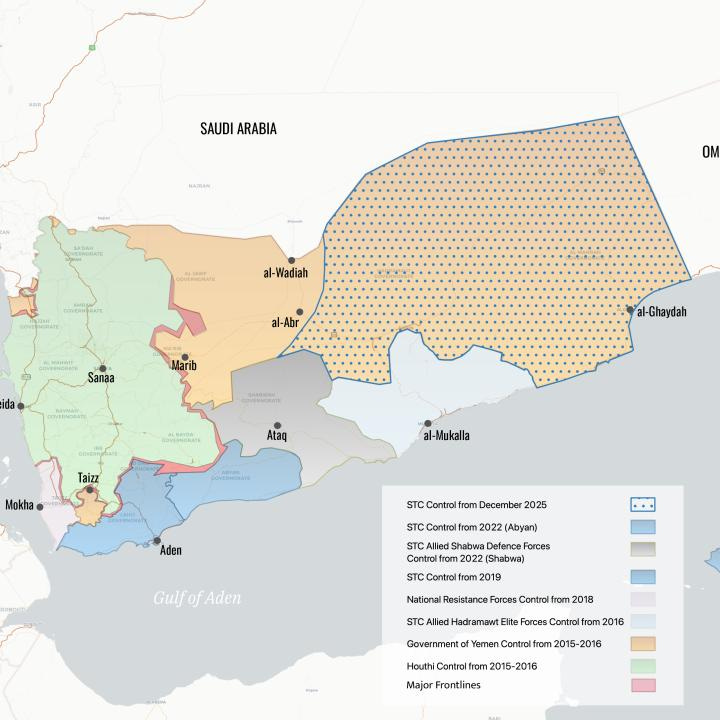
Media Coverage
Geopolitics
“Saudi Arabia demands Yemeni separatists leave seized governorates.” Al Jazeera, December 26, 2025.
“Saudi Arabia’s Ministry of Foreign Affairs issued the demand on Thursday, describing military operations by the Southern Transitional Council (STC) as an “unjustified escalation” after the group took control of the oil-rich Hadramout and al-Mahra governorates earlier in December.”
Go Deeper: “Yemen’s Seismic Shift Has Consequences Beyond Its Borders.” The Washington Institute for Near East Policy, December 22, 2025.
“Saudi Arabia rejects unilateral Israeli recognition of Somaliland.” Alarabiya, December 27, 2025.
“Israel became the first country to formally recognize the self-declared Republic of Somaliland as an independent and sovereign state, with Israeli PM Benjamin Netanyahu claiming this was done “in the spirit of the Abraham Accords.”..”
“For its part, Saudi Arabia expressed its full support for Somalia’s sovereignty, unity, and territorial integrity.”
Go Deeper: “Somaliland: How Trump, Saudi Arabia, Turkey and others reacted to Israeli recognition.” Middle East Eye, December 27, 2025.
Market, Economy & Domestics
“Qatar awards $4B gas deal in push to meet LNG output.” Yahoo Finance, December 24, 2025.
“The engineering, procurement, construction, and installation contract will take five years to complete. Italian energy services company Saipem will take on the majority of the work, worth $3.1 billion, alongside China’s Offshore Oil Engineering Co.”
Go Deeper: “Qatar Plans Major Expansion of Physical LNG Trading Volumes.” Bloomberg, May 20, 2025.
“Oman’s United Solar to receive $30m from Waaree Solar Americas.” Semafor, December 22, 2025.
“When complete, the plant will produce 100,000 tons a year of polysilicon — enough to support 40 gigawatts of solar module production — offering customers an alternative to China, which has a near-monopoly on the market. It is part of a growing trend for Gulf countries to develop renewable energy manufacturing capabilities, with some analysts predicting the region will become a hub for solar panel exports.”
Go Deeper: “Middle East, North Africa solar manufacturing capacity to reach 44 GW by 2029, says WoodMac.” PV Magazine, May 13, 2025.
“Exclusive / Prince Alwaleed nears $400 million deal for Saudi soccer team.” Semafor, December 24, 2025.
“Kingdom Holding Company, Prince Alwaleed’s investment vehicle, has been in talks with Saudi’s Public Investment Fund for several months. The remaining stake in the club is owned by a Saudi non-profit organization that’s mostly funded by Prince Alwaleed.”
“The deal could value the team — currently ranked second in the Saudi Pro League — at about 2 billion riyals ($530 million).”
Go Deeper: “Beyond Football: Saudi Arabia’s Rise Through Soccer and Statecraft.” Gulf International Forum, July 29, 2025.
“Rights groups condemn new record number of executions in Saudi Arabia.” BBC, December 21, 2025.
“At least 347 people have now been put to death this year, up from a total of 345 in 2024, according to the UK-based campaign group Reprieve, which tracks executions in Saudi Arabia and has clients on death row.”
“Kuwait closes the ‘exceptional services’ citizenship file and revokes nationality in cases of fraud and forgery.” Alarabiya, December 25, 2025.
“Kuwait has closed the ‘exceptional services’ citizenship file by completing the revocation of nationality from those who obtained it under this provision, reaching back to the country’s first naturalization case in 1968, according to the Kuwaiti newspaper Al-Rai.”
“Bahrain: Tourism revenues rise 27% since 2022.” Khaleej Online, December 24, 2025.
“It noted that the number of tourists recorded an annual increase ranging between 18% and 20% during the past period, which helped strengthen the sector’s performance and raise its contribution to GDP.”
“The tourism sector’s contribution to GDP reached 6.8%, a relatively high level compared with other GCC countries, reflecting the structural transformation underway in the sector.”
Gulf Opinions
This week, Saudi and Emirati commentators engaged in a wide-ranging debate over the prospects of Southern Yemen and its political future. In Saudi Arabia, commentary largely emphasized restraint, legitimacy, and institutional order. Writing in Asharq Al-Awsat, Yemeni Shura Council member Lutfi Fouad Numan aligned his argument with the message delivered by Saudi Defense Minister Prince Khalid bin Salman, asserting that Yemenis assuming greater responsibility for their own affairs would ease the burden on regional allies and noting that recent Saudi statements carry “signals that the discerning will readily understand.” Indeed, Prince Khalid urged the Southern Transitional Council to prioritize “reason, wisdom, and unity of ranks” by responding to Saudi-Emirati mediation efforts, de-escalating tensions, and transferring military camps to the National Shield Forces and local authorities. Together, these positions reflect a Saudi emphasis on gradual stabilization through recognized frameworks and coordinated diplomacy.
Emirati commentators, however, advanced a different reading of the situation. Hani Mas’hor criticized what he described as a persistent assumption in Yemeni discourse that political outcomes are always “shaped from outside,” arguing instead that the crisis predates 2014 and stems from decades of exclusion, denial of pluralism, and the imposition of a single center over a diverse geography. From this perspective, developments in Hadramawt and Al-Mahrah cannot be reduced to mere “escalation” devoid of historical context. Similarly, Dhahi Khalfan questioned Saudi opposition to southern independence, arguing that rejecting both an independent south and a strong north is an unsustainable position, while warning that calls for unity may ultimately serve Iranian influence. Other Emirati voices, including Mohammed Faisal Al-Dosari, framed the southern project not as secession but as the restoration of a previously recognized state. At the same time, Mohammed Al-Hamadi cautioned against turning political disagreement into conspiracy narratives, stressing that differences must remain “objective and fair to the facts.”
By contrast, Saudi commentators remained firmly anchored in the language of unity and international legitimacy. Abdulrahman Al-Rashed argued that secessionist movements rarely succeed, noting that the international community broadly rejects them because they threaten global stability. Without legitimacy, he warned, the South risks “long years of war, misery, and dangerous fragmentation.” Shaher Al-Nahari echoed this concern, portraying southern fragmentation as a pathway to disorder reminiscent of earlier conflicts in Hodeidah and Sana’a driven by factional ambitions and regional interference. This line of argument culminated in a broader institutional critique articulated by Firas Traboulsi, who stressed that legitimacy is not a procedural formality but a “political safety valve,” concluding that bypassing agreed frameworks only compounds crises rather than resolving them.
More Gulf Opinions
“It appears that the ‘Republic’ of Somaliland—if it truly exercises sovereign decision-making—must navigate a three-dimensional dilemma that could unsettle its very existence: domestically, the challenge of preserving social cohesion; regionally, the need to account for the repercussions of intense geopolitical competition over its strategic ports; and internationally, confronting the reality that breaking diplomatic isolation through a controversial Israeli recognition would further complicate its path toward stability and development.”
Fayez bin Abdullah Al-Shehri, Al Riyadh, (Saudi Arabia), December 29, 2025.
“The essence of the BRICS project does not lie in its summits or final communiqués, but in its attempt to break the dollar’s monopoly over global trade. Conducting transactions in local currencies and building alternative financial systems is not merely an economic step; it is a political declaration of reclaiming sovereign decision-making and freeing itself from the instruments of pressure the West has employed for decades, whether through sanctions or control over international financial institutions.”
Dhari Al-Mir, Al Jarida, (Kuwait), December 28, 2025.
“Freedom of expression in Saudi Arabia is not a matter of legal dispute, as it is guaranteed by law; however, it is not an unrestricted right. Rather, it is a conscious freedom exercised within a clear legal framework that balances the individual right to expression with society’s right to security and stability. In an era of accelerating platforms and increasingly intense discourse, the central message remains that words carry responsibility, and freedom is not measured by the absence of law.”
Mohamed Al Rashid, Al Bilad, (Bahrain), December 27, 2025.
“In today’s world, power is no longer measured solely by the scale of a state economy or influence, but by its ability to project a cultural narrative capable of crossing borders and shaping perceptions. This is where the Doha Dictionary emerges as an instrument of soft power. By documenting the Arabic language historically through a rigorous scholarly methodology, it enhances Arabic capacity to engage more fully with global platforms, universities, research centers, and digital technologies. It also places Arabic on equal footing with major languages that preceded it in large-scale linguistic historiography projects, while breaking the stereotype that confines Arabic to heritage or sacredness alone, without recognizing its dynamism and capacity to interact with modernity.”
Hisah Al Marwani, Al Sharq, (Qatar), December 24, 2025.
“There are strategic plans aimed at control and influence over maritime corridors stretching from Yemen and the Horn of Africa to Sudan and the African continent; this suggests that these wars form a chain of carefully calculated schemes that will ultimately coalesce into a fully integrated strategic project, complete in both structure and mechanisms.”
Awadh bin Saeed, Oman Daily, (Oman), December 23, 2025.
“This concern cannot be separated from a Sudanese memory burdened by the experience of the “Inqaz” regime, which led to a devastating civil war, suffocating international isolation, and the transformation of Sudan into a haven for figures associated with extremism and terrorism. It was this very experience that drove Sudanese civil forces themselves to agree on the necessity of excluding the Muslim Brotherhood from governance and political life.”
Anwar Mohammed Gargash, Al Etihad, (UAE), December 23, 2025.
Nashra Picks
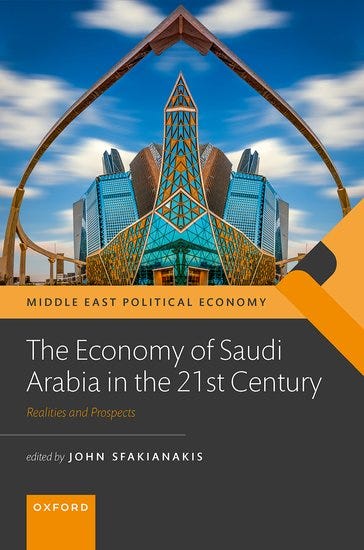
Book: Sfakianakis, John, “The Economy of Saudi Arabia in the 21st Century.” Oxford Press University, June, 2024.
Research: “Strategic Energy Convergence: US Policy and Saudi Arabia’s Transition in Critical Minerals and Civil Nuclear Cooperation.” Umud Shokri, Sakarya University, November, 2025. [PDF].
Research: “Between Brussels and Beijing: Strategic Choices for the GCC Member States in the Era of Fourth Energy Transition.” Nikolay Kozhanov and Saban Kardas, Alternatives: Global, Local, Political, December 23, 2025.
Analysis: “Southern Yemen’s Power Shift: the Houthis and the UAE-Saudi Rivalry.” Burcu Ozcelik, Baraa Shiban and Alaa Zoubi, RUSI, December 15, 2025.
Analysis: “The Gulf’s Return to Lebanon?” Paul Shaya, Arab Gulf States Institute in Washington, December 23, 2025.
Analysis: “Kuwait Turns East: The Rise of Chinese Investment in the Gulf.” Courtney Freer, Gulf International Forum, December 23, 2025.
Analysis: “Gulf Mediation in Focus: Regional Implications of Renewed US-Iran Nuclear Talks.” Layla Ali, Gulf Research Center, December 23, 2025.
Analysis: “The Red Sea Story Behind Saudi Arabia’s Oldest Global Ties.” Saudi Times, December 11, 2025.
Analysis: “GCC Hiring Q3 2025: UAE Drives Growth While KSA Slows and Bahrain, Kuwait Contracts.” Angus Anderson, Finance Middle East, December 6, 2025.
Analysis: “Beijing’s Gulf trade charm offensive meets familiar resistance.” Jonathan Fulton, AGBI, December 18, 2025.
Analysis: “Nowcasting GCC GDP: A Machine Learning Solution for Enhanced Non-Oil GDP Prediction.” IMF, December 19, 2025.
Podcast: “Inside the 5th International Red Sea Film Festival: CEO & Directors Roundtable.” Mo Show Podcast, December 25, 2025.