

Media Coverage
Geopolitics
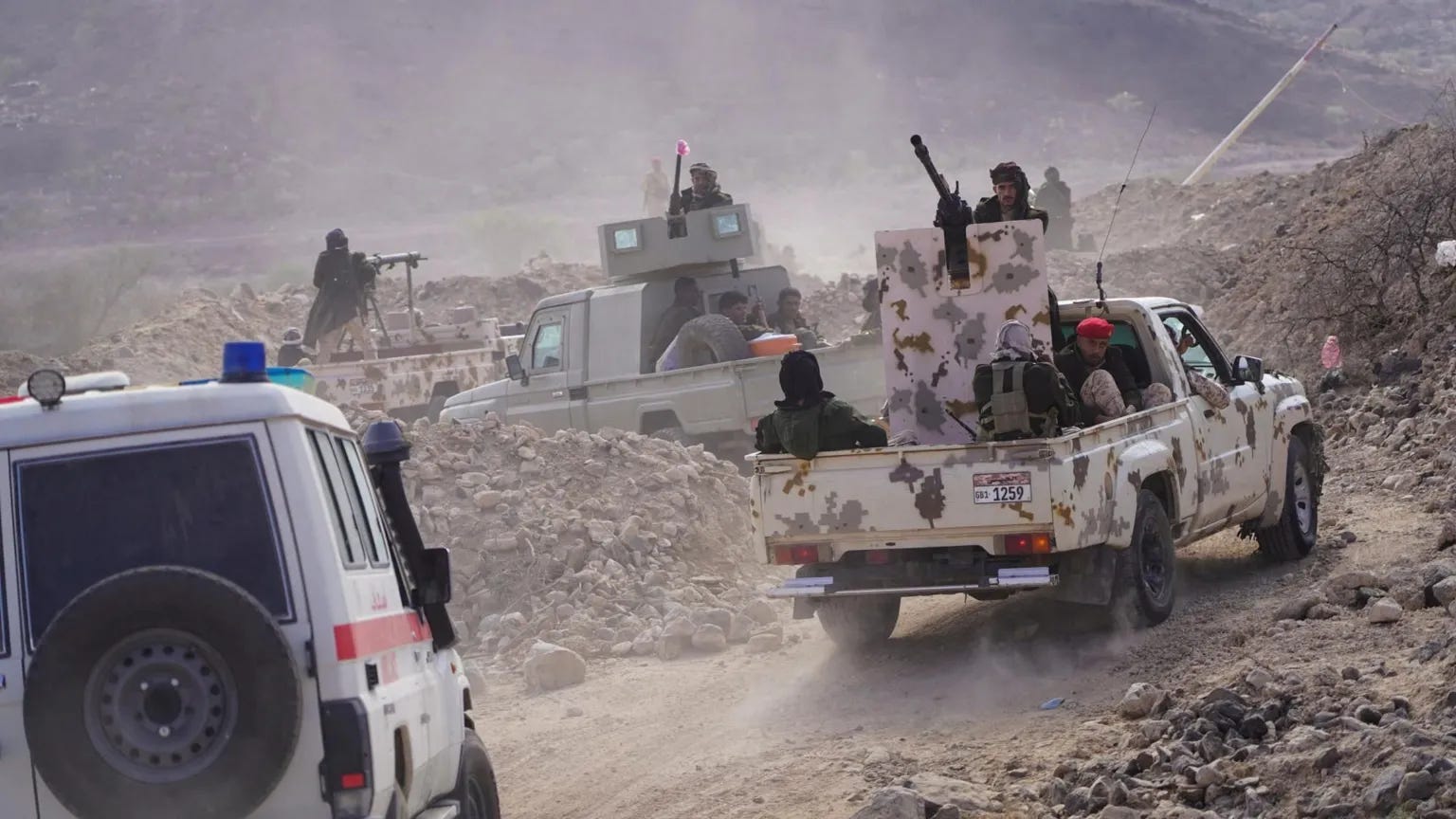
“Saudi Arabia bombs Yemen port city over weapons shipment from UAE for separatists.” AP News, December 30, 2025.
“The bombing followed tensions over the advance of Emirates-backed separatist forces known as the Southern Transitional Council. The council and its allies issued a statement supporting the UAE’s presence, even as others allied with Saudi Arabia demanded that Emirati forces withdraw from Yemen in 24 hours’ time.”
Go Deeper: “How the UAE-Saudi Arabia alliance ruptured.” Financial Times, December 31, 2025.
“UAE says it ends mission of remaining forces in Yemen voluntarily.” Reuters, December 30, 2025.
“The United Arab Emirates’ defence ministry said on Tuesday it has voluntarily ended the mission of its counterterrorism units in Yemen, the only remaining forces it has in the country after ending its military presence in 2019.
It said the decision came after a comprehensive assessment following recent developments, state news agency WAM reported.”
Go Deeper: “Gulf Rivals Saudi Arabia, U.A.E. Come to Blows in Yemen.” WSJ, December 30, 2025.
Market, Economy & Domestics
“Bahrain Unveils Package of Reforms to Fight Fiscal Woes.” Bloomberg, December 29, 2025.
“A new law on corporate tax will apply to local companies, the government said in a statement on Monday, without disclosing detail on the change..”
“Reforms also include plans to raise fuel and natural gas prices, increase dividends from state-owned companies and cut administrative government expenditures by 20%.”
Go Deeper: “IMF Staff Completes 2025 Article IV Mission to The Kingdom of Bahrain.” IMF, November 24, 2025.
“Saudi Stocks’ Worst Year in a Decade Leaves Traders Grim on 2026.” Bloomberg, December 11, 2025.
“The dismal outlook comes on top of this year’s 11% selloff in the Tadawul All Share Index, the biggest drop since 2015. Earnings growth is also expected to be sluggish, with analysts predicting a 2% increase in profit next year, compared with 13% growth for the MSCI benchmark.”
“UAE advances AI strategy with 97% adoption, major infrastructure plans in 2025.” CXO Insight, December 29, 2025.
“The United Arab Emirates reinforced its standing as a global centre for artificial intelligence and digital infrastructure in 2025, recording a world-leading 97 percent utilisation rate of AI tools across government entities and surpassing 450,000 programmers nationwide.”
Go Deeper: “Dubai’s State of Al Report: The Public Sector Version.” Digital Dubai Authority, 2025. [PDF].
“Saudi Arabia finalizes arrangement of $13bln syndicated loan to fund utilities.” Zawya, January 1, 2026.
“Saudi Arabia’s National Debt Management Center said on Wednesday it had finalized the arrangement of a $13 billion, seven-year syndicated loan to help finance power, water and public utilities projects..”
“The transaction is a part of the kingdom’s medium-term debt strategy, which aims to diversify funding sources and meet financing needs over the medium to long term.”
Go Deeper: “Annual Borrowing Plan Report: Fiscal Year 2025.” National Debt Management Center, 2025. [PDF].
“Saudi FDI net inflows in Q3 surge 34% to $6.6bln.” Zawya, January 1, 2026.
“Saudi Arabia’s foreign direct investment (FDI) net inflows for the third quarter of 2025 surged to SAR24.9 billion, up 34.5% over the previous year when its net inflows hit SAR18.5 billion, reported SPA, citing the the General Authority for Statistics (GASTAT) data.”
“This figure also shows a 5.2% rise from the previous quarter, which recorded SAR23.7 billion, according to the FDI Statistics bulletin issued by GASTAT.”
Go Deeper: “Understanding Saudi Foreign Direct Investment Data.” Tim Callen, Arabian Gulf States Institute, February 12, 2025.
“Oman approves 2026 budget with deficit of $1.4bln, state news agency says.” Zawya, January 1, 2026.
“Oman, a small Gulf oil producer, approved on Thursday its 2026 budget with a deficit of 530 million Omani Rials ($1.38 billion), which accounts for 1.3% of national output, the state news agency reported..”
“Oman expects total spending of 11.977 billion rials in 2026, up 1.5% from 2025, the state news agency said.”
Go Deeper: “Final Performance: A Quarterly Bulletin Issued by the Minister of Finance, Second Quarter.” Ministry of Finance, 2025. [PDF].
Qatar: “Ports activity accelerates with 64% rise in cargo movement.” The Peninsula, January 2, 2026.
“With rapid growth in transhipment — accounting for nearly 50 percent of total volumes handled (January to November 2025)— the port solidified Qatar’s status as a vital regional hub for trade and logistics, in line with the Ministry of Transport’s strategic plan.”
Go Deeper: “Qatar Freight And Logistics Market Size & Share Analysis - Growth Trends And Forecast (2026 - 2031).” Mordor Intelligence, 2025.
“Saudi Arabia arrests 116 government officials in anti-corruption crackdown.” Gulf News, January 01, 2026.
“Nazaha questioned 466 people during a nationwide campaign targeting bribery and the abuse of official positions in December 2025.”
Go Deeper: “The Saudi Anticorruption Drive Moves Beyond Frying a Few Big Fish.” Middle East Council on Global Affairs, December 10, 2024.
Gulf Opinions
Following Saudi Arabia’s bombing of Yemen port city of Mukalla on Tuesday, 30 December 2025, after a weapons shipment from the United Arab Emirates reportedly arrived for southern separatists, commentators in both Saudi Arabia and the UAE sharply debated the strike and the broader tension between the two countries. Emirati voices largely condemned the episode. Dr Abdulkhaleq Abdullah argued that such tensions often stem from a “big brother complex,” stressing that while Gulf states respect an elder role, they reject “subordination,” remain committed to “plural centers of influence,” and do not compromise their sovereign decision-making. Hani Mas’hour, warned that the Muslim Brotherhood sought to advance southward “riding on the back of the Saudi tank,” tracing the problem to unilateralism and what he described as dealing with the Houthis through a “logic of surrender.” In Al Etihad, Abdullah Al Hashmi characterized Yemen current leadership as merely “formal legitimacy,” arguing that demands for a different political future in the south reflect the failure of the unity model and the center inability to protect or fairly represent the peripheries. Dr Ali Al Nuaimi, meanwhile, cautioned that disputes between partners should be handled “within the framework, not in public,” warning that public doubt and “friendly fire” erode trust, weaken deterrence, and undermine any effective alliance.
Saudi commentators, by contrast, framed the strike as a defense of Yemen legitimacy and Saudi national security. Dr Abdulghani Al Kindi drew no distinction between Hezbollah, the Rapid Support Forces, the Houthis, and southern separatists, arguing that all risk sliding into a “de facto militia” model. Adhwan Al Ahmari similarly maintained that the Southern Transitional Council does not represent the south as a whole but is one armed faction whose presence in Hadramawt was imposed “by force” and reversed “by force,” driven by access to “oil, maritime, and natural resources,” while Aden functions largely as a “logistical hub” with weaker economic fundamentals. Hamoud Abu Talib went further, arguing that Saudi Arabia now faces “new facts” that cannot be ignored, as weapons shipments from an Emirati port to a faction rebelling against Yemen legitimate authority constitute a “blatant violation” of the coalition mandate and a “direct threat” to Saudi security, making claims of mere “militia smuggling” implausible without official knowledge. Finally, Khaled Al Malik stressed that Saudi Arabia does not deny southern Yemenis their rights, but argued that the problem lies with Aidarous Al Zubaidi, who he said placed “personal interests” above the south, “overturned legitimacy,” and instrumentalized the “southern cause” in ways that undermined gains achieved through the “2014 National Dialogue,” the “2019 Riyadh Agreement,” and the “2022 transfer of power.”
More Gulf Opinions
“The United States has effectively ‘laid its hand’ on the Venezuelan state, at least for the time being, in a striking development at the start of 2026, but Trump did so in the mold of his Republican predecessors Reagan and George H. W. Bush with Noriega, who was also implicated in the Iran arms deal known as ‘Iran-Contra.’ This dramatic episode reveals a new American order in which the sole criterion is direct US interest, with little regard for any other consideration.”
Mishary Dhayidi, Asharq Al-Awsat, (Saudi Arabia), January 4, 2026.
“What are the risks facing the Gulf middle class? The most serious of these risks is that it becomes suspended or gradually erodes when confronted with pressures such as the cost of living and housing rising far faster than income growth, inflation in consumption patterns, weak governance, and blocked channels of fairness in promotion, ownership, and saving. Under such conditions, pressure intensifies when people feel they are working hard without advancing, striking at the very core of ‘what it means to be middle class,’ as this sense of purpose is undermined by feelings of neglect, lack of recognition, and a broader atmosphere of indifference.”
Abdulaziz Alkhater, Al Raya, (Qatar), January 4, 2026.
“The Iranian and Venezuelan experiences, among others, reveal that US interventions are driven by a logic of dominance and colonial-style subordination rather than partnership, and by the manufacture of instability and the so-called discredited concept of “creative chaos,” rather than support for stability. While such policies may temporarily succeed in unsettling targeted states, they often fail to break the will of peoples and instead leave behind deeper crises, with moral rhetoric serving merely as a cover for pressure and disorder that advance narrow interests at the expense of national sovereignty and global stability.”
Khalid bin Salem Al Ghasani, Al Roya, (Oman), January 3, 2026.
“The United Arab Emirates adopts a different approach to media diplomacy, one based on managing the narrative rather than confronting it. The state does not rely on reactive media, nor does it engage in emotional polemics or escalation campaigns; instead, it adheres to a balanced discourse grounded in the presentation of verified information, the rapid and professional release of official data, and engagement with regional and international public opinion in multiple languages, thereby breaking the monopoly of a single narrative and strengthening the presence of the Emirati narrative in the global media space. At the same time, the UAE systematically invests in international media, research centers, and digital diplomacy, recognizing that winning global public opinion increasingly depends on a state’s ability to address international audiences in a rational language that respects the awareness and intelligence of the recipient.”
Ahmed Al Hosani, Al Etihad, (UAE), December 30, 2025.
“The Gulf banking sector, in turn, continued to record strong performance in 2025, with the total assets of Gulf banks estimated at more than $3.7 trillion, alongside continued growth in credit directed to the private sector at rates ranging between 5 percent and 7 percent. Banks also recorded high levels of capital adequacy and liquidity, and achieved solid profits supported by a relatively high interest rate environment.”
Adnan Ahmed Yousef, Akhbar Al Khaleej, (Bahrain), December 29, 2025.
Nashra Picks
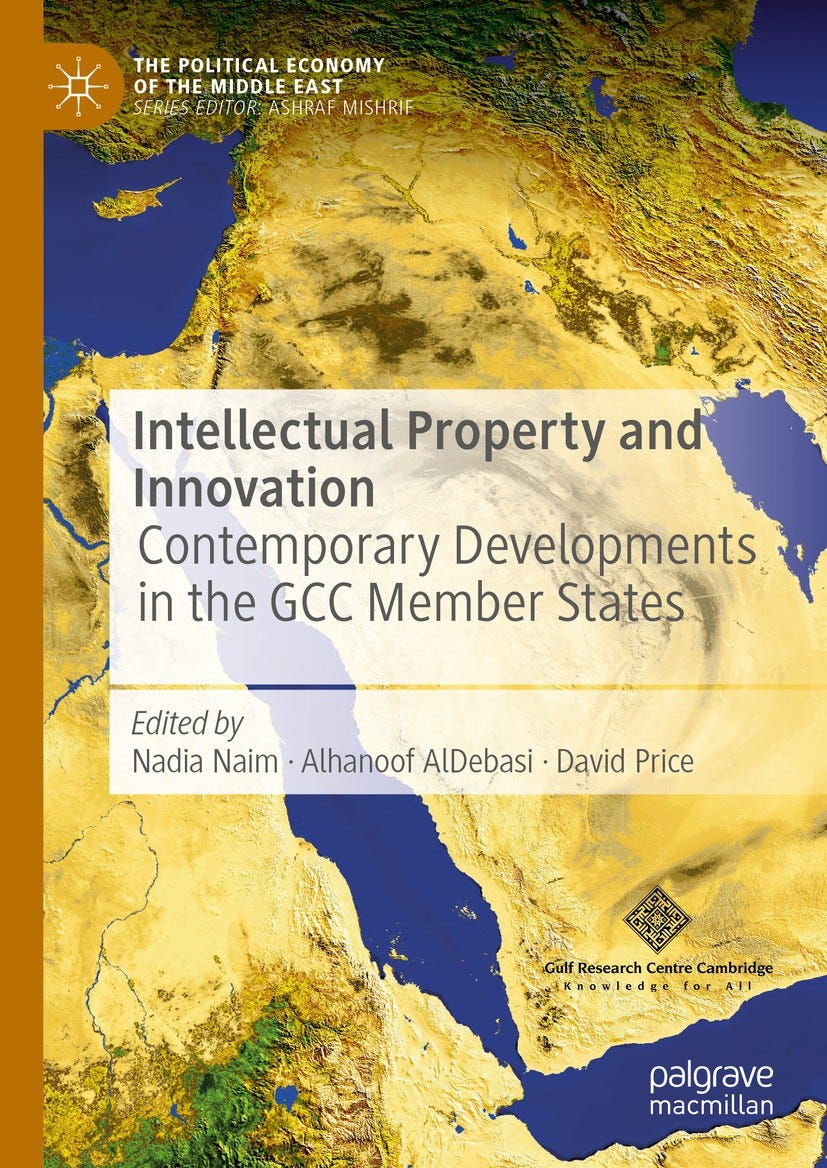
Book: Naim, Nadia., AlDebasi, Alhanoof., and Price, David., “Intellectual Property and Innovation: Contemporary Developments in the GCC Member States.” Springer, 2025.
Research: “A two-way path: State-driven and bottom-up social change in contemporary Arab Gulf monarchies.” Sara Brzuszkiewicz, European View, April 20, 2025. [PDF].
Research: “Assessment of Political Principles in the Constitution of Oman from International Law Perspectives.” Fahad Al Aghbari, Muhamad Sayuti Hassan, and Nurhafilah Musa, Law Reform, March, 2025. [PDF].
Research: “Government Ownership in GCC Countries: Toward Institutional and Governance Development and Reforms.” Julia Barbar, Springer, December 2025. [PDF].
Analysis: “Saudi Arabia’s Path Forward Amid Lower Oil Prices.” Amine Mati and Yuan Rollinson, IMF, December 18, 2025.
Analysis: “From Sputnik to satellites: How China is pulling Egypt and Gulf into its space orbit.” Al-Monitor, December 30, 2025.
Analysis: “Abu Dhabi’s Big Bid on Culture.” Rebecca Anne Proctor, Arab Gulf States Institute in Washington, December 30, 2025.
Analysis: “A New Posture: How Saudi Arabia is Reshaping its Military Readiness.” Gulf International Forum, Leonardo Mazzucco, December 29, 2025.
Analysis: “Understanding the Saudi Reaction to the Escalation in Yemen.” Michael Ratney, CSIS, December 31, 2025.
Analysis: “Foresight For Resilience: The Oman Clean Energy Strategic Outlook.” Dawud Ansari, The Majan Council, December 30, 2025. [PDF].
Analysis: “Mixed signals from the new Q3 2025 labor market data.” Meshal Alkhowaiter, Saudi Labor Pulse, January 01, 2026.
Podcast: “HRH Prince Faisal bin Bandar Al-Saud: Chairman of Saudi Esports Federation.” The Mo Show, December 30, 2025.
Podcast: “How Does Oman View Yemen? And Where Does It Stand Among the Gulf Powers?” Hosts Mohammed Al-Araimi, Yemen Podcast, December 30, 2025.