

Media Coverage
Geopolitics
“Turkey Said to Seek Membership of Saudi-Pakistan Defense Pact.” Bloomberg, January 9, 2026.
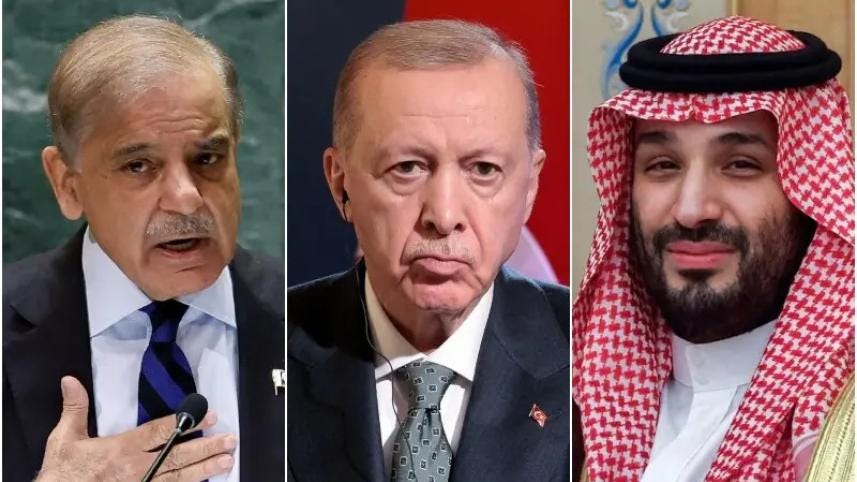
“Should Turkey ink its membership in the alliance, it would underscore the new era in relations with Saudi Arabia as the erstwhile rival leaders of the Sunni Muslim world. After turning the page on years of rancor, the countries are working to develop economic and defense cooperation. They held their first ever naval meeting in Ankara this week, according to the Turkish Defense Ministry.”
Go Deeper: “Turkish-Saudi Convergence in the New Middle East.” AGSI, May 21, 2025.
“Saudi Arabia Moves to Rein In UAE as Yemen Exposes Rivalry.” Bloomberg, January 9, 2026.
“The fallout between the Arab world’s two biggest economies — and key American allies — will have repercussions far beyond Yemen. It could impact efforts to contain Iran and ensure the Gaza ceasefire endures, as well as hit companies using Dubai as a hub to conduct business in Saudi Arabia.”
Go Deeper: “How Saudi-UAE tensions could reshape regional alignments in 2026.” Middle East Eye, January 1, 2026.
“Advisor to Prime Minister and Spokesperson for Ministry of Foreign Affairs: Qatar Engaged with Mediators to Reach Second Phase of Gaza Agreement.” Qatar Ministry of Foreign Affairs, January 6, 2026.
“Contacts are still ongoing to reach the second phase of the agreement.”
“However, there are still obstacles under discussion, in addition to several obstacles on which agreements have been reached.”
Go Deeper: “Qatar’s Adroit Post-October 7 Diplomacy.” Hussein Ibish, Arab Gulf States Institute, January 4, 2026.
“Bahrain begins UN Security Council membership for 2026-27.” MSN, January 3, 2026.
“Ambassador Jamal Fares Al Rowaiei, Permanent Representative of Bahrain to the United Nations in New York, attended a flag-raising ceremony at the UN headquarters to mark the start of the term.”
“It is the second time in Bahrain’s history that the kingdom has served on the Security Council.”
Exclusive-Pakistan, Saudi in talks on JF-17 jets-for-loans deal, sources say.” Al-Monitor, January 7, 2026.
“The first source said the total deal was worth $4 billion, with an additional $2 billion to be spent on equipment over and above the loan conversion. The sources close to the military with knowledge of the matter spoke on condition of anonymity because they were not authorized to speak on the deal.”
Go Deeper: “Why It Took Pakistan So Long To Sell JF-17 Fighters To An Arab Country.” Forbes, December 28, 2025.
Market & Economy
“Saudi Stocks Climb on Hopes for More Market Liberalization.” Bloomberg, January 7, 2026.
“Lifting restrictions on foreign ownership also stands to boost the weight of Saudi equities in MSCI Inc. benchmarks. The kingdom’s $2.3 trillion equity market’s weight in the MSCI Emerging Markets Index currently stands at 2.9%.”
“Minister Sidhu to visit Qatar, Saudi Arabia and UAE to promote Canadian trade.” Global Affairs Canada, January 5, 2026.
“In 2024, Canada-Qatar merchandise trade was valued at $325.4 million, comprising $159.2 million in exports from Canada and $166.2 million in imports.”
“Oman Launches 11th Five-Year Development Plan (2026-2030).” Oman News Agency, January 1, 2026.
“The plan targets an economic growth rate of approximately 4 percent at constant prices.”
“The Eleventh Five-Year Plan necessitates additional investments estimated at RO 15.6 billion, channeled towards pivotal economic and social sectors to accelerate economic growth and realize a target rate of 5 percent.”
Go Deeper: “Ultimate of Oman Ministry of Commerce and Industry Action Plan: Roadmap for the Implementation of the Manufacturing Strategy 2040, “Manufacturing for Well-being” [PDF].
“Saudi Arabia approves annual borrowing plan for 2026.” Arab News, January 4, 2026.
“the Kingdom’s projected funding needs for 2026 are estimated at approximately SR217 billion ($57.8 billion).”
“This is intended to cover an anticipated budget deficit of SR165 billion, as well as principal repayments on debt maturing during the year.”
Go Deeper: Saudi Arabia: “2026 Annual Borrowing Plan.” National Debt Management Center, 2026. [PDF].
“Revenues of Oman’s 2026 Budget Exceed RO 11.4 Billion.” Oman News Agency, January 1, 2026.
“Total public expenditure was estimated at approximately RO 11.977 billion, rising by 1.5 percent from the approved expenditure for 2025. Meanwhile, the estimated budget deficit for 2026 stands at approximately RO 530 million, a decrease of 14.5 percent from the deficit approved in the 2025 budget, constituting 4.6 percent of total revenues and 1.3 percent of the Gross Domestic Product (GDP).”
Kuwait: “Committee reviews progress on major development projects.” Kuwait Times, January 8, 2026.
“Discussions covered Mubarak Al-Kabeer Port, the electricity and power system, renewable energy development and a low-carbon system for waste recycling.”
Go Deeper: “Kuwait: Staff Concluding Statement of the 2025 Article IV Mission.” IMF, December 18, 2025.
Saudi Arabia: “Soudah Development and National Grid sign SAR 1.3 billion agreement to power Soudah Peaks.” Public Investment Fund, January 4, 2026.
“This strategic partnership marks a critical milestone in the development of Soudah Peaks, an ultra-luxury mountain destination rising 3,015 meters above sea level.”
“National Grid will design and construct the integrated electrical network that includes a 380/132 kilovolt central substation with a capacity of 500 megavolt-amperes.”
“OPEC+ Country Members Reaffirm Commitment to Market Stability.” Energy News Beat, January 4, 2026.
“Notably, the countries confirmed their November 2, 2025, agreement to pause planned production increments for February and March 2026, citing seasonal demand factors.”
“This pause affects approximately 1.65 million barrels per day (mb/d), which could be gradually reintroduced—either partially or fully—depending on market developments.”
Domestics
“UAE Raises Minimum Wage for Emiratis in the Private Sector to AED 6,000 from January 2026.” Middle East Briefing, January 5, 2026.
“a further increase in the minimum wage for Emirati employees working in the private sector, raising it to AED 6,000 per month effective January 1, 2026. The move continues the UAE’s phased Emiratization wage strategy and aims to enhance labor market competitiveness while strengthening incentives for citizens to join private sector roles.”
“Bahrain announces electricity and water tariff updates for 2026.” The Daily Tribune, January 4, 2026.
“The rates for the first and second consumption tiers in primary residences will remain unchanged for citizens, with consideration for extended families.”
“For all other non-subsidized categories, electricity rates will increase from 29 fils to 32 fils per kilowatt-hour, effective January 2026.”
“Oman to host second Middle East Space Conference in January 2026.” SatellitePro ME, December 20, 2025.
“Building on the strong momentum of its inaugural edition, MESC 2026 will convene more than 450 senior-ranking decision-makers representing over 190 organisations from more than 20 countries.”
Gulf Opinions
Gulf commentators focused on widening Saudi–UAE differences over Yemen as events accelerated on the ground, particularly after the announcement surrounding the dissolution of the Southern Transitional Council and Aidarous Al Zubaidi refusal to attend the Riyadh dialogue conference, developments that deepened doubts over coordination between Riyadh and Abu Dhabi. From Saudi Arabia, Abdullah Al Otaibi framed Riyadh approach as consistent support for southern rights within a legitimate, Saudi-backed political framework, arguing that the “Riyadh Conference” aimed to support what southerners agree upon “under legitimacy and in coordination with it,” and portraying engagement with the political track as a “wise and courageous” choice. From Saudi Arabia, Turki Al Qoblan linked Yemen, Sudan, and Somalia as interconnected arenas of state fragmentation threatening Arab national security, warning that failure in Yemen would trigger cascading instability because “Arab national security is an integrated system,” while emphasizing that the priority is restoring a unified Yemeni state rather than managing fragmentation. Also from Saudi Arabia, Shaher Al-Nahari argued that the real threat to Arab states, directly accused the UAE. comes from “clear interventions” that empower militias, mercenaries, arms proliferation, and covert alliances, warning that this kind of politics fragments societies and undermines state-building; he stressed that influence should not be pursued through coercion or proxy warfare, and cautioned against turning conflict into a marketplace for “buying blood, ports, waterways, and economies,” because the danger lies in how these practices branch outward and convert internal divisions into lasting tools of control.
From the United Arab Emirates side, Abdullah Majed Al Ali defended Abu Dhabi role as part of a collective Arab responsibility rooted in counterterrorism, aimed at confronting sectarian militias and preventing extremist groups from exploiting post-Houthi chaos, presenting the UAE approach as a comprehensive strategy combining military action with humanitarian aid, diplomacy, and reconstruction. Mohammed Faisal Al Dosari warned that “every rift in the Gulf ranks whets the appetite of extremist organizations and gives them an opportunity to expand, encouraging forces that thrive on chaos and seek to transform division into a permanent reality,” framing Gulf cohesion as a security necessity while arguing that stability depends on balanced regional roles rather than a single center and that the UAE rejects subordination to a “single-axis” logic. Finally, Abdullah Alhashmi urged judging policies by outcomes rather than intentions, stressing that this position “does not mean defending mistakes or claiming infallibility, but a clear call to judge outcomes, not motives,” and pointing to Iraq, Tunisia, Yemen, Syria, and Sudan as cases where upheaval produced state collapse rather than reform, turning manageable disagreements into fragmented agendas that now threaten Gulf cohesion itself.
Other Gulf voices positioned Yemen within a wider strategic rethinking. From Qatar, Ahmed Khalifa revived a long-standing argument for integrating Yemen into the Gulf framework, recalling that “Gulf security cannot be separated from its natural environment in the Arabian Peninsula,” and warning that exclusion deepens demographic and strategic vulnerabilities. From Kuwait, Badr Khalid called for a “Gulf confederation” and a reinforced security–military alliance supported by international powers to confront what he described as a “new Middle East led by Israel,” presenting unified Gulf security as an urgent strategic response. From Oman, Khamis Al Adawai argued that the absence of a unified Gulf strategic and media vision since the post–Cold War order has fragmented Gulf discourse and weakened coordination, making the revival of an integrated Gulf vision toward Yemen a strategic necessity rather than a rhetorical aspiration.
Nashra Picks
Analysis: “Saudi Emirati Tensions and the Struggle for Influence in Southern Yemen.” Arab Center, January 6, 2026.
Analysis: “Wage growth provides some relief as food inflation resumes climb.” Saudi Labor Pulse, January 8, 2026.
Analysis: “How to Make EU-GCC Ties Beneficial for Small States.” Máté Szalai, Trends Research & Advisory, January 2, 2026.
Analysis: “Exporting Fossil Fuels Through Cloud Computing.” Camille Ammoun, Carnegie, January 5, 2026.
Analysis: “The STC Makes its Move in Yemen: What it Means for the Country’s Future.” Alexander Langlois, Gulf International Forum, January 7, 2026.
Analysis: “Saudi Arabia approves 2026 debt plan.” Daniel Richards, Emirates NBD Research, January 5, 2026.
Analysis: “Saudi Arabia kicks off 2026 borrowing.” Edward Bell, Emirates NBD Research, January 6, 2026.
Analysis: “Yemen separatists accuse Saudi Arabia of ‘betrayal’ as pro-Riyadh forces advance.” Adam Lucente, Al-Monitor, January 7, 2026.
Analysis: “Amid Yemen tensions, how can the Gulf states avoid another rift?” Bader Al-Saif, Chatham House, January 8, 2026.
Analysis: “Bahrain’s Difficult Yet Necessary Fiscal Turn.” Mahdi Ghuloom, ORF, January 6, 2026.
Analysis: “A new Gulf order? What December’s Bahrain summit tells us about the future of the GCC.” Arab Business, January 6, 2026.
Analysis: “A Silent Withdrawal: How Bahrain Has Emerged as a New Front in the Growing Saudi Emirati Rift.” Dark Box, January 6, 2026.
Analysis: “U.S.-UAE AI Cooperation: Future Trajectories.” Newlines, January 7, 2026.
Analysis: “The UAE and the Sudan Civil War: Strategy and Regional Consequences.” The Times of Israel, January 5, 2026.
Analysis: “From coalition to confrontation: Saudi-UAE rivalry in Yemen and its regional implications.” Nadwa Al-Dawsari, Middle East Institute, January 05, 2026.
Analysis: “Buckle Your Seatbelts: The U.S. National Security Strategy and the Coming Turbulence in the Gulf.” Patrick Theros, Gulf International Forum, January 8, 2026, English.
Analysis: “Oman, eastern Yemen, and the fragile geometry of neutrality.” Farea Al-Muslimi, Chatham House, January 8, 2026.
Podcast: “The Saudi–UAE Rift: Yemen and the End of an Alliance? | Dr Andreas Krieg.” The Thinking Muslim, January 5, 2026.