

Media Coverage
Geopolitics
“Gulf states pushing to avert U.S.-Iran conflict, official says.” CBS, January 15, 2026.
“The countries involved in the diplomatic push include Saudi Arabia, Qatar, Egypt and Oman, according to the Gulf official. The talks have focused on lowering the temperature in public rhetoric and avoiding military action that these states feared could trigger wider regional instability.”
Go Deeper: “Middle East governments believe US-Iran tension has ‘de-escalated’.” Financial Times, January 15, 2026.
“Saudi Arabia tells Iran its land, airspace won’t be used in strike: Sources.” Alarabiya, January 14, ,2026.
“The message was conveyed as the United States warned it could respond to an Iranian government crackdown on protests, while Tehran has said it would strike US military and shipping assets in the event of a new attack.”
Go Deeper: “Iran’s Gulf Rivals Warn U.S. Against Strike on Tehran.” WSJ, January 13, 2026.
“Saudi Arabia pledges $500 million Yemen development after UAE withdrawal.” Reuters, January 15, 2026.
“Saudi Arabia has announced a slew of development projects across southern Yemen worth about $500 million, many in areas long-held by the United Arab Emirates and allied separatists.”
Go Deeper: “The Saudi–Emirati Drama in Yemen.” Arab Center [D.C], January 13, 2026.
“Somalia cancels all agreements with the UAE, including at major ports.” Middle East Eye, January 12, 2026.
“According to a senior Somali government source and a document seen by Middle East Eye, the move by the Mogadishu government includes all agreements with government agencies, related entities and regional administrations.”
Go Deeper: “Why Somalia drew a line with the UAE.” Aljazeera, January 14, 2026.
“Saudi Arabia in Talks With Egypt, Somalia on Military Coalition.” Bloomberg, January 16, 2026.
“Saudi Arabia is finalizing an agreement on a new military coalition with Somalia and Egypt, part of its bid to curtail the United Arab Emirates’ regional influence.”
“Saudi Arabian officials have pushed the Somali government to curb ties with the UAE. Tensions between the two OPEC+ members have risen after the kingdom ordered the UAE to withdraw its troops from Yemen as it seeks to reduce its rival’s sway.”
Go Deeper: “Saudi Arabia moving towards military coalition with Somalia and Egypt.” Middle East Eye, January 16, 2026.
“US halts immigrant visas for 75 nations, including Kuwait.” Kuwait Times, January 14, 2026.
“The countries include Kuwait, Somalia, Russia, Afghanistan, Brazil, Iran, Iraq, Egypt, Nigeria, Thailand, Yemen and more, according to Fox News.”
Market & Economy
“IMF praises Oman but urges faster diversification.” AGBI, January 16, 2026.
“The IMF’s executive directors joined staff in applauding Oman’s reform agenda, highlighting efforts to deepen the financial sector, bolster the labour market, streamline regulations and advance renewable energy production and digitalisation.”
Go Deeper: “Oman: 2025 Article IV Consultation-Press Release; Staff Report; and Statement by the Executive Director for Oman.” IMF, January 15, 2026.
“Saudi Public Investment Fund plans to spin off mining firm Manara.” Reuters, January 14, 2026.
“Manara, a joint venture between the Saudi Arabian Mining Company, also known as Maaden, and the $925 billion PIF, was established in 2023 to invest in critical minerals abroad. But, although it has bid for assets across Africa and Asia, it has so far completed only one deal: a $2.5 billion 10% stake in Vale Base Metals, which was spun off from Brazilian iron ore giant Vale in 2024.”
Go Deeper: “The Saudi Arabian Mining Sector: Ongoing Investments Propel Long-term Growth.” The U.S.-Saudi Arabian Business Council, 2019.[PDF].
“UAE’s Masdar reaches global clean energy capacity of 65 GW.” Reuters, January 13, 2026.
“United Arab Emirates’ state-owned firm Masdar, has reached global capacity of 65 gigawatts of clean energy as it heads towards its goal of 100 GW by 2030.”
Go Deeper: “Delivering on the UAE Consensus: Tracking progress toward tripling renewable energy capacity and doubling energy efficiency by 2030.” IRENA, 2025. [PDF].
“Qatar joins US-led Pax Silica Alliance to secure semiconductor and critical mineral supply chains.” Arab News, January 13, 2026.
“The alliance was launched last month in Washington with the aim of securing global supply chains for semiconductors, artificial intelligence technology, critical minerals and digital infrastructure.”
Domestics
“Oman hands economic control to crown prince.” SEMAFOR, January 16, 2026.
“Oman’s Sultan Haitham Al-Said has gained plaudits for transforming the country’s economic outlook since taking power six years ago this month. Now his son and anointed successor Theyazin is set to become an increasingly important figure. A cabinet reshuffle saw him promoted from the prosaic position of culture, sports, and youth minister to become deputy prime minister for economic affairs.”
Go Deeper: “What Oman’s Constitutional Change Means for Omanis.” Carnegie, January 14, 2021.
“Abu Dhabi crown prince chairs new sovereign wealth fund.” SEMAFOR, January 13, 2026.
“Bankers will be familiar with the leadership of the fund, which joins an expanding alphabet soup that includes ADIA, ADQ, and Mubadala — together controlling roughly $2 trillion in assets. L’IMAD will be chaired by Abu Dhabi Crown Prince Sheikh Khaled bin Mohamed bin Zayed Al Nahyan, with Mubadala’s Khaldoon Al Mubarak on the board. CEO Jassem Al Zaabi also serves as vice chairman of the UAE Central Bank.”
Go Deeper: “Making Sense of the UAE’s Latest Leadership Appointments.” The Washington Institute, May 12, 2023.
UAE: “Establishing General Secretariat as executive body for ‘National Anti-Money Laundering Committee’.” Emirates News Agency (WAM), January 16, 2026.
“It will also spearhead the implementation of policies aimed at combating money laundering, terrorism financing, and the proliferation of weapons of mass destruction, as well as defined related activities.”
“Eric Trump markets $10B in Saudi real estate projects.” SEMAFOR, January 12, 2026.
“Dar Global CEO Ziad El Chaar said the Diriyah project will include 500 mansions, priced between $6.7 million and $24 million. The company also launched a $1 billion project in Jeddah on Monday.”
Go Deeper: “Why Trump’s Middle East trip should set sights beyond business deals.” Atlantic Council, May 9, 2025.
“Kuwait Cancels Licenses of 516 Companies.” Arab Times, January 11, 2026.
“Article 1 of the decree states that the commercial licenses of 516 companies listed in the attached appendix have been revoked due to their failure to submit financial statements for three consecutive years, in accordance with Paragraph (7) of Article 266 of the Companies Law.”
Gulf Opinions
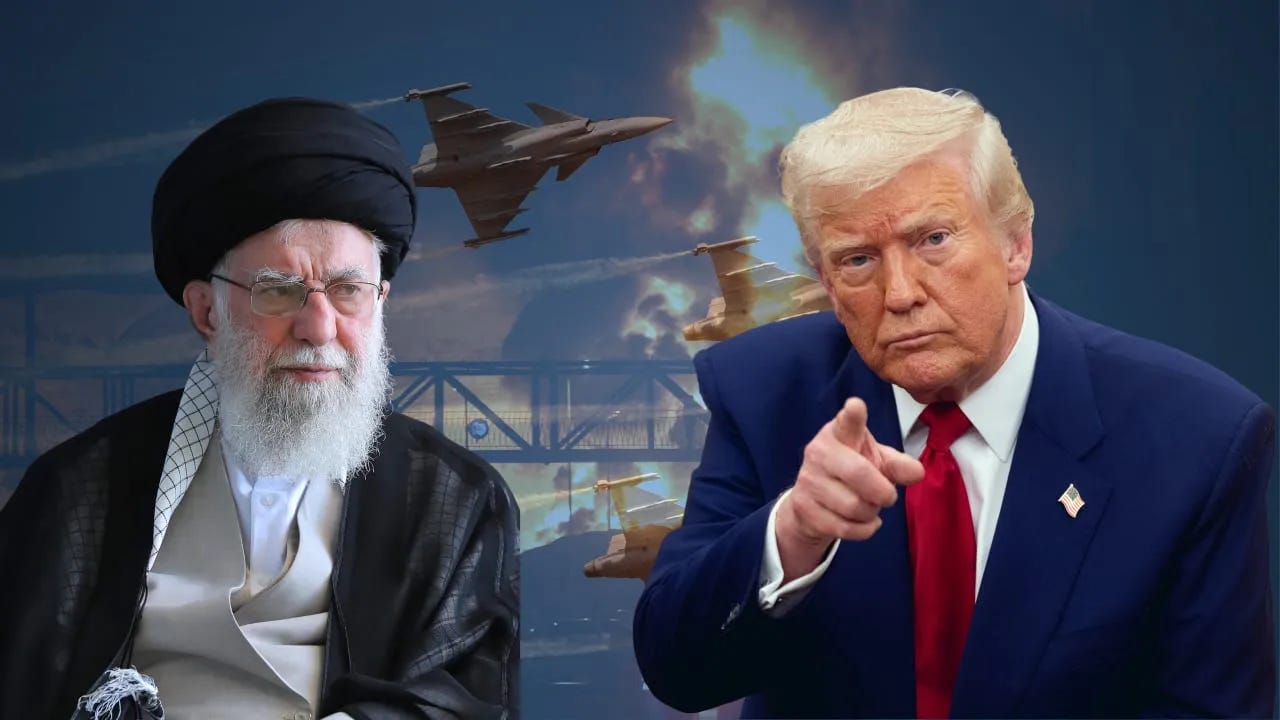
Following unofficial mediation efforts by Gulf states—including Oman, Saudi Arabia, and Qatar—to avert any military action against Iran amid repeated threats by U.S. President Donald Trump, a clear consensus has emerged among Gulf commentators rejecting external interference in Iranian affairs. Saudi columnist Mishary Dhayidi argues that if a U.S. strike is framed merely as “deterrence” or as a symbolic “message,” rather than a decisive transformation of realities, it would likely consolidate the Iranian regime rather than undermine it. Such a move would rally public opinion around the idea that “the homeland” itself is under attack, a sentiment with deep emotional resonance in a society shaped by historical pride and national consciousness. In this reading, military action would once again exhaust the region, adding to a long record of wars that have drained resources, destroyed opportunities, and repeatedly extinguished hopes for stability.
Similar concerns are echoed by Saudi writer Majid bin Nuwaisir, who warns that the collapse of the Iranian regime would not produce a viable alternative but could fracture the country along ethnic and sectarian lines, turning it into a “Middle Eastern Yugoslavia.” Such a scenario, he argues, would export instability beyond Iran’s borders, destabilizing Iraq, Turkey, Pakistan, and the Gulf, while transforming Iran’s military assets into decentralized threats spread across militias, smuggling routes, and maritime choke points. In this context, the Strait of Hormuz would shift from a strategic pressure point into an open arena of chaos, underscoring that war on Iran would endanger regional and global security rather than enhance it. From Kuwait, Dr. Abdullah Al-Shayji offers a more structural reading of U.S. intentions, suggesting that Washington aims to force Iran into concessions far beyond the 2015 nuclear agreement, moving from the permitted 3.67 percent enrichment toward a complete halt—effectively terminating Iran’s nuclear program—while simultaneously responding to pressure from Netanyahu and his far-right government to neutralize Iran’s missile capabilities.
Bahraini commentators extend this critique to the internal Iranian scene. Saad Al Rashid argues that any foreign intervention in Iranian protests would drain them of momentum and ultimately serve the regime, which would reframe popular dissent as “foreign-backed” agitation, thereby reinforcing its legitimacy. Abdulnabi Al Shoala similarly observes that Iran stands at a historic crossroads, facing a choice between undertaking deep reforms that rebuild the social contract on new foundations or persisting with old crisis-management methods that will only intensify tension and instability. From Oman, Murtada bin Hassan bin Ali concludes that even if Washington ultimately steps back from military action—as some of President Trump statements suggest—”this would not end the crisis, but merely entrench ‘a fragile deterrence.’” The Middle East shaped by the Iran question, he argues, will not necessarily be calmer, but fundamentally different, and potentially “more dangerous” during a volatile transitional phase.
Nashra Picks
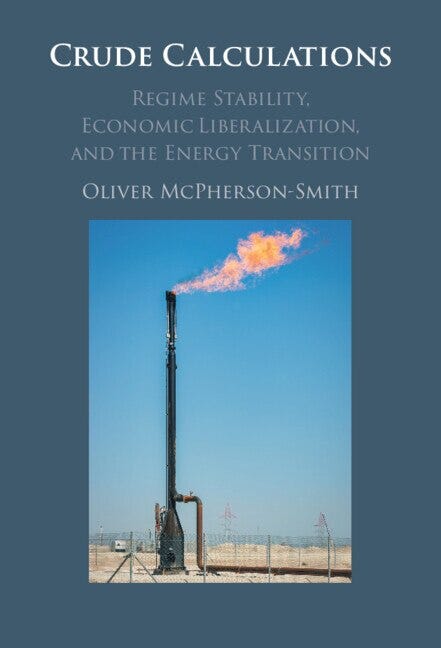
Book: McPherson-Smith, Oliver, “Crude Calculations: Regime Stability, Economic Liberalization, and the Energy Transition.” Cambridge University Press, January 8, 2026.
Analysis: “How Gulf Engagement Could Shape Syria’s Reconstruction.” Nicholas Lyall, Gulf International Forum, January 12, 2026.
Analysis: “The Saudi–Emirati Drama in Yemen.” Nabeel Khoury, Arab Center [D.C], January 13, 2026.
Analysis: “What Ankara Sees in Riyadh — and Why It Still Needs Abu Dhabi.” Gönül Tol, Middle East Institute, January 16, 2026.
Analysis: “Should Saudi Policymakers Be Concerned About Rising Unemployment?” Tim Callen, AGSI, January 16, 2026.
Analysis: “Venezuela, Trump, and Implications for OPEC’s Middle Eastern Core.” Kate Dourian, AGSI, January 13, 2026.
Analysis: “The Emerging ‘Hybrid Professional’: GenAI’s Impact on Skill Demand Changes in the UAE.” Ahmed Dawoud & Ahmed Habashy, ORF, January 12, 2026.
Analysis: “The Ship of Tolerance sails into Jeddah.” Rebecca Anne Proctor, Al-monitor, January 15, 2026.
Analysis: “The Manager-Monarch Who Saved Oman.” Bobby Ghosh, Foreign Affairs, January 12, 2026.
Analysis: “From partners to rivals: What the Saudi-UAE rupture means for Europeans.” Cinzia Bianco, European Council on Foreign Affairs, January 13, 2026.
Podcast: “An Unscripted Conversation with Nada Baeshen & Ahd Kamel.” Mo Show, January 11, 2026.
Podcast: “The Expat Experience in Saudi Arabia - Frankie Hilton & Lily Moffatt | One in Tribe - Ep 30” One in Tribe, January 7, 2026.
Webinar: “Outlook 2026: Prospects and Priorities for U.S.-Gulf Relations in the Year Ahead” AGSI, January 16, 2026.