

Media Coverage
Geopolitics
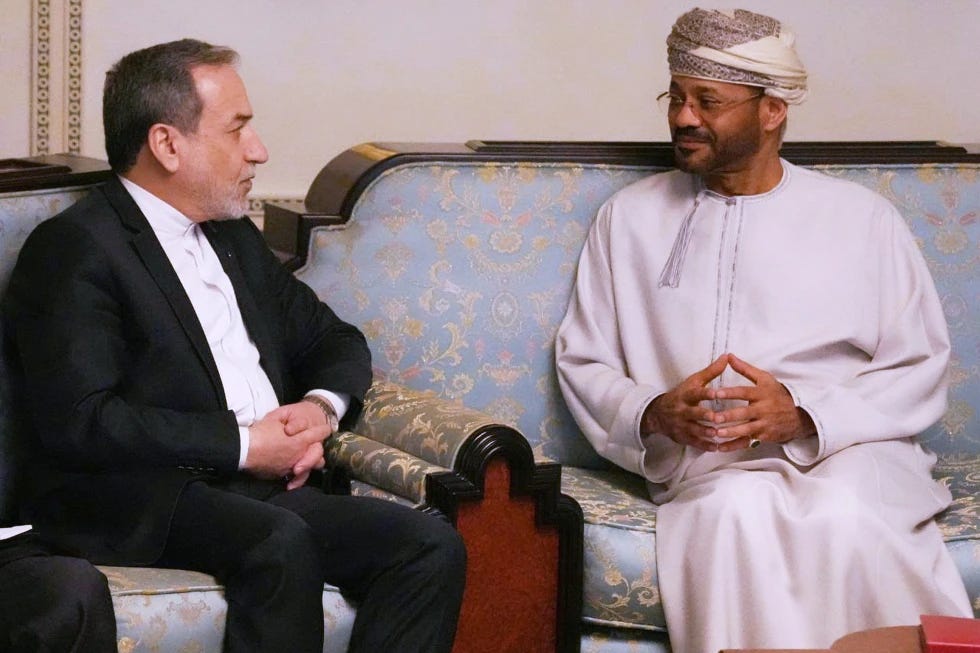
“Iran and US hold indirect talks in Oman. America’s military leader in the Mideast joins the talks.” AP, February 6, 2026.
“The talks had initially been expected to take place in Turkey in a format that would have included regional countries as well, and would have included topics like Tehran’s ballistic missile program — something Iran apparently rejected in favor of focusing only on its nuclear program.”
Go Deeper: “With the US and Iran on a knife-edge, can Oman once again step in to mediate?” Middle East Institute, February 5, 2026.
“Saudi, Iranian FMs underscore need to resolve differences through diplomatic means.” Saudi Gazette, February 5, 2026.
“The foreign ministers discussed regional developments and underscored the need to resolve differences through dialogue and diplomatic means. They also reviewed efforts to maintain security and stability in the region.”
Go Deeper: “Analysis: A decade of Saudi-Iranian relations: from rivalry to re-engagement.” Janatan Sayeh, Long War Journal, April 19, 2025.
“Saudi Arabia may invest in Turkish fighter jet Kaan ‘any moment’, Erdogan says.” Middle East Eye, February 5, 2026.
“‘We are signing significant defence industry cooperation agreements with Saudi Arabia, and we are determined to further strengthen them’” Erdogan told journalists while returning to Turkey following his visits to Egypt and Saudi Arabia this week.”
Go Deeper: “Talk of a Turkish military alliance with Saudi Arabia and Pakistan reflects Ankara’s opportunistic ‘hedging’ strategy.” Chatham House, January 30, 2026.
“Germany’s Merz heads to Saudi, Gulf in quest for new partners.” Zawya, February 4, 2026.
“German Chancellor Friedrich Merz began a tour of Saudi Arabia, Qatar and the United Arab Emirates on Wednesday aiming to forge energy and arms partnerships as Europe’s biggest and richest economy sought to reduce dependence on the U.S. and China.”
Go Deeper: “Merz Promises Gulf Countries Easier Access to Military Goods.” Bloomberg, February 5, 2026.
Market & Economy
“UK Says Trade Deal With Saudis, Other Gulf States ‘Imminent’.” Bloomberg, February 5, 2026.
“The UK’s trade minister said a free-trade agreement with the Gulf Cooperation Council was “imminent,” as the Starmer government looks to build on pacts last year with the European Union, India and the US.”
Go Deeper: “UK chases elusive GCC trade deal that could boost exports, economic links.” Al-Monitor, November 3, 2025.
“Saudi Arabia’s $2 Billion Solar Plan Lifts Turkish Energy Stocks.” Bloomberg, February 4, 2026.
“Saudi companies will initially develop solar projects capable of generating 2,000 megawatts in Turkey’s Sivas and Karaman provinces, followed by 3,000MW of additional wind and solar capacity to be finalized later, according to an intergovernmental agreement signed in Riyadh on Tuesday.”
Go Deeper: “Saudi Arabia to build $2 billion solar farms in Turkey, Turkish energy minister says.” Reuters, February, 3, 2026.
“Kuwait targets 4mln bpd oil production by 2035: Report.” Zawya, February 5, 2026
“Kuwait aims to increase its oil production to 4 million barrels per day (bpd) by 2035 from the current 3 million bpd, according to Nawaf S. Al-Sabah, Deputy Chairman and CEO of Kuwait Petroleum Corporation (KPC).”
“Oil demand is projected to reach 100 million bpd by 2050, Al-Sabah stated, adding that the cost of producing a barrel of oil in Kuwait remains below $10.”
Go Deeper: “Kuwait readies $7 billion pipeline deal as Gulf turns to foreign capital.” Reuters, January 28, 2026.
“Saudi’s MBS Unleashes Months of Reforms to Draw More FDI.” Bloomberg, February 2, 2026.
“The moves have come as Crown Prince Mohammed bin Salman seeks to turn the nation into an investment destination and better compete with nearby Dubai. They also hint at how the Gulf nation is trying to address oil-price volatility and budget deficits that threaten to slow progress on its $2 trillion economic diversification plan.”
Go Deeper: “Wall Street, Saudi Arabia Differ on Kingdom’s Deficit Target.” Bloomberg, December 9, 2025.
Domestics
“Kuwait emir reshuffles Cabinet, replacing 7 ministers.” Middle East Monitor, February 1, 2026.
“The reshuffle also named Sheikh Jarrah Jaber al-Ahmad al-Sabah as foreign minister, Osama Boudi as minister of commerce and industry, Reem al-Fulaij as minister of state for development and sustainability, and Tariq al-Jalahma as minister of state for youth and sports.”
Go Deeper: “Will Kuwait’s Parliamentary Democracy Be Restored, Reformed, or Repudiated?” Carnegie, March 13, 2025.
“Saudi Arabia is lifting the alcohol ban for wealthy foreigners.” BBC, February 05, 2026.
“To be eligible, an expat must either hold a Premium Residency permit, which costs 100,000 Saudi riyals ($27,000; £19,300) a year; or show that he or she earns at least 50,000 riyals per month.”
Gulf Opinions
Omani commentators devoted sustained attention to the “indirect” Iranian–American negotiations hosted in Muscat, emphasizing Oman’s distinctive diplomatic positioning at a moment of heightened regional volatility. Mohammed Rams Al Rawas highlighted the importance of place, portraying Oman as a rare actor capable of “creating the impossible” in the service of peace. As global politics becomes increasingly dominated by threats, coercion, and displays of power, he argued, Oman stands apart through its “quiet, confident” diplomacy, offering a venue where the host “does not interfere” but instead operates as a disciplined and credible honest broker. This approach, he stressed, is not tactical but structural, rooted in a long-standing Omani legacy of neutrality, discretion, and dialogue, built on “the power of silence” and the conviction that wisdom and mediation provide more durable foundations for regional and international security than the “noise of weapons.” Addressing why Tehran requested moving the talks from Istanbul to Muscat, Salem Ahmed Bakhit Safarar pointed to Oman’s pivotal role in facilitating the 2014 negotiations between Iran and the P5+1, which culminated in the 2015 nuclear agreement, alongside the deep trust both negotiating sides place in the Omani mediator and the “strict confidentiality” that has historically surrounded talks in Muscat. At the same time, he cautioned that the negotiating track faces persistent obstruction from external actors, most notably Israel, which he argued continues to work actively to derail any diplomatic breakthrough.
Beyond the question of venue, several commentators reframed the negotiations within a broader strategic context that challenges dominant Western narratives. Khaled bin Salem Al-Ghasani argued that the primary engine of regional war is not Iran but the United States, contending that years of sanctions, political pressure, and coordinated media campaigns amount to a sustained strategy of coercion falsely presented as “deterrence.” From an international politics perspective, Salem bin Hamad Al Hajari maintained that the core confrontation is not between Washington and Tehran, but between Iran and Israel, with the United States acting largely as the political executor of Israeli priorities. He pointed to the June 2025 war as a critical rupture that collapsed long-standing red lines and exposed a fragile deterrence structure, making renewed conflict a matter of “when,” not “if.” In this context, US engagement with Iran appears less driven by concern over a “dangerous state” than by an effort to manage the consequences of Israeli escalation and contain a confrontation Washington itself helped push into the open. Similarly, Khamis bin Obaid Alqutaiti observed that American military deployments and pressure tactics intensified tensions, but Iran’s firm posture and explicit warnings that any attack would trigger a “regional war” forced a temporary retreat toward negotiations, widely viewed as the safer option for all parties. Mohammed bin Salem Al-Batashi concluded that Tehran’s choice of Muscat reflects not only Oman’s regional success in mediation, but also Iran’s strategic self-assurance in selecting a secure venue capable of safeguarding the rights and interests of all sides.
More Gulf Opinions
“Libya currently faces a range of possible scenarios. On one hand, this assassination [Saif al-Islam Gaddafi] could lead to a definitive break with the political era associated with the Gaddafi lineage, potentially reducing international sensitivity surrounding the electoral file. On the other hand, there is a risk that the incident could reignite internal conflict or foster a sense of political despair among factions loyal to the former regime, with resulting security repercussions in areas of strong tribal and local influence.”
Buthaina Khalifa Qasim, Al Bilad, (Bahrain), February 7, 2026.
“It was said that he [Epstein] committed suicide in prison after his arrest, despite widespread doubts about this account; more likely, he was eliminated so that he—and his secrets—would disappear. Such is the logic of corrupt systems when one of their members, or one of their fronts, is exposed: excision and liquidation are the most effective means of preventing further exposure, at least until internal affairs within the system are reorganized.”
Abdullah Alamadi, Al Sharq, (Qatar), February 5, 2026.
“Those tracking the Epstein files now outnumber those following the crimes of the Zionist entity in Gaza, the West Bank, and Lebanon, while public attention has receded from the international system’s onslaught against politically and economically exhausted states such as Sudan, Somalia, Yemen, and others.”
Suad bint Fahd Al Mojil, Al Qabas, (Kuwait), February 5, 2026.
“The choice of Abu Dhabi as the venue for the trilateral talks was neither coincidental nor a gesture of courtesy. Abu Dhabi is not merely a place known for hospitality and gracious hosting, but a conducive environment for achieving the desired objectives.”
“This hosting [of the US-Russia-Ukraine negotiation] is not a passing event, but rather a reflection of a deep-rooted strategy that shapes a distinctive Emirati diplomacy, positioning it at the forefront of the regional and international landscape.”
Ali bin Salem Al Kaabi, Al Etihad, (UAE), February 2, 2026.
“These are not political disputes between regional states, nor a competition for influence as some imagine; this is an existential war, waged through proxy warfare, the support of militias, media campaigns, and dubious alliances, alongside the promotion of questionable doctrines and religions. Its objective is to dismantle Sunni Islam and its historic religious authorities in Mecca and Medina as the world has known them for 1,400 years, and replace them with ‘Islamist Protestantism’; for this reason, crises can at times be useful, as they expose realities and strip away the veneer of complacency and misplaced tolerance.”
Mohammad Al Saaed, Okaz, (Saudi Arabia), February 1, 2026.
Nashra Picks
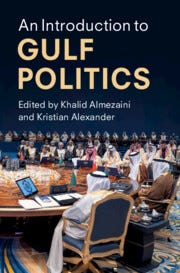
Book: Almezaini, Khalid, and Alexander, Kristian, “An Introduction to Gulf Politics.” Cambridge University Press, June 2026.
Research: “Measuring financial integration in GCC stock markets: Dynamics, risk premia, and the path to enhanced cooperation.” Salem Boubakri and Cyriac Guillaumin, Science Direct, March 2026.
Research: “Private health insurance in Gulf Cooperation Council countries: A scoping review.” Husein Reka, Science Direct, June 2026.
Analysis: “Saudi Arabia’s Break With Interventionism.” Sultan Alamer, Newlines Magazine, February 6, 2026.
Analysis: “Abu Dhabi Builds a New Deal Machine Around Its Crown Prince.” Dinesh Nair, Zainab Fattah, and Alex Dooler, Bloomberg, February 3, 2026.
Analysis: “Caught in the Gulf crossfire: Pakistan navigates Saudi-UAE rivalry.” Sabena Siddiqui, Al-Monitor, February 1, 2026.
Analysis: “UAE: Greenfield FDI surged 78% y/y to reach a record USD 33.2bn in 2025.” Mayed Alrashdi, NBD Research, February 4, 2026.
Analysis: “Of Course the UAE Is Not Preparing To Take Over Gaza.” Hussein Ibish, AGSI, February 5, 2026.
Analysis: “Trump’s Energy Agenda: Gains and Risks for the Gulf.” Masha Kotkin, ORF, January 29, 2026.
Analysis: “The Cost of War on the Region: A Gulf Reading of a Scenario of an Attack on Iran.” Ebtesam AlKetbi, Emirates Policy Center, January 29, 2026.
Analysis: “Merz courts Gulf as Germany seeks energy alternatives to US, China.” Beatrice Farhat, Al-Monitor, February 5, 2026.
Analysis: “MEI Perspectives Series 53: How Gulf States Quietly Developed Durable Soft Power in Asia.” Joshua Snider, Middle East Institute (NUS), January 28, 2026.
Analysis: “The Saudi-UAE Rift: Taking the Measure of the Gulf That Separates and Unites Them.” William Roebuck, AGSI, February 4, 2026.
Analysis: ”Normalization is slipping away.” Daniel Benaim, Middle East Institute, February 4, 2026.
Analysis: “Gulf Maritime Security: Balancing Partnership and Flexibility.” Leonardo Mazzucco, AGSI, February 4, 2026.
Analysis: “In Saudi Arabia, Erdogan fosters security alignment, $30B trade push.” Ezgi Akin, Al-Monitor, February 4, 2026.
Analysis: “Yemen Is Not a Gulf Rivalry—It Is a Test of Whether Extremism Can Be Contained.” Ahmed Charai, The Jerusalem Strategic Tribune, February 5, 2026.
Analysis: “With the US and Iran on a knife-edge, can Oman once again step in to mediate?” Alex Vatanka, Middle East Institute, February 5, 2026.
Analysis: “Kuwait to open offshore oil, gas fields to foreign firms: What to know.” Jack Dutton, Al-Monitor, February 3, 2026.
Podcast: “What Does Saudi Arabia Want from Yemen?” Malek Al-Roqi, Yemen Podcast, January 22, 2026. [Eng subtitle].
Interview: “The Smart Interviewer: How to Lead the Conversation and Build Rapport,” Dawood Al-Shiryan, Abdullah Al-Mudaifer, Ali Al-Alyani, and Rachid Allali, Saudi Media Forum, February 3, 2026. [Eng subtitle].