

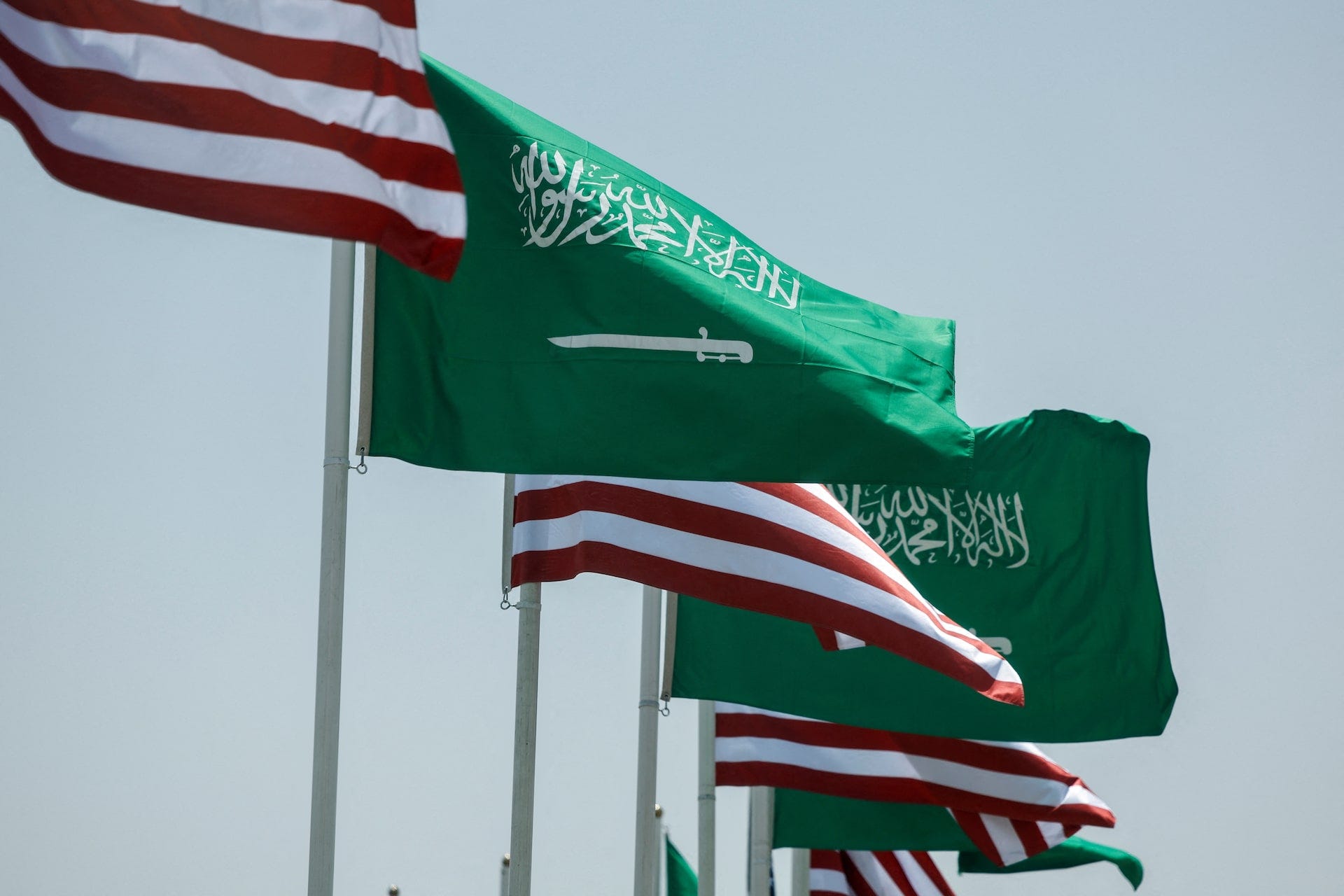
Media Coverage
Geopolitics
“US removing guardrails from proposed Saudi nuclear deal, document says.” Reuters, February 19, 2026.
“President Donald Trump has told Congress he is pursuing a civil nuclear pact with Saudi Arabia that does not include non-proliferation safeguards the U.S. has long said would ensure the kingdom does not develop nuclear weapons, according to a copy of the document sent to Congress and reviewed by Reuters.”
“Saudi Crown Prince and US senator Lindsey Graham discuss Iran tensions.” The National, February 20, 2026.
“Mr Graham also spoke of another regional matter, after several weeks of intense criticism of the UAE through Saudi social media and TV channels. He urged the countries to put aside their differences and focus on the “big prize” of replacing Iran’s regime.”
“UK Renews Push for Saudi Arabia to Invest in Fighter Jet Program.” Bloomberg, February 19, 2026.
“Britain’s fresh diplomatic push comes as manufacturers and allies grow frustrated with the Labour administration’s delay in publishing a plan to allocate fresh defense funding. Though GCAP is expected to be handed billions of pounds in the plan, the delay has led to uncertainty around its ability to finance key contracts.”
“Qatar PM arrives in Venezuela on first trip since Maduro’s ouster: What to know.” Al-Monitor, February 17, 2026.
“The arrangement with Qatar had drawn criticism from Democrats, and Rep. Gregory Meeks, the ranking member of the House Foreign Affairs Committee, wrote a letter to Secretary of State Marco Rubio on Friday warning that the ‘offshore account could enable corruption.’”
Market & Economy
“First Europe-Gulf Forum to take place in May.” The National, February 12, 2026.
“The forum comes on the heels of the launch of the Alliance for Europe-Gulf Geopolitics and Investments Summit in September at the 80th UN General Assembly in New York by US think tank the Atlantic Council and Greek media company the Antenna Group.”
“Saudi Arabia’s Humain Invests $3 Billion Into Musk’s xAI.” Bloomberg, February 18, 2026.
“The deal strengthens Musk’s relationship with Saudi Arabia, which has made AI a central plank of its efforts to diversify its economy away from oil. Humain was formed in 2025, with backing from the country’s trillion-dollar sovereign wealth fund, Public Investment Fund, and has been on a dealmaking spree to build up the infrastructure and compute capacity required to train and run AI models.”
Go Deeper: “Elon Musk’s xAI Gets $3 Billion Investment From Saudi-Backed A.I. Firm.” The New York Times, February 18, 2026.
“UAE economy to grow over 5% in 2026, says minister.” Zawya, February 12, 2026.
“Al Marri pointed out that the number of companies registered in the national economic register has risen to more than 1.45 million from about 650,000 five years ago, underscoring the UAE’s attractiveness to global investors.”
Go Deeper: “United Arab Emirates and the IM.” IMF, 2026.
“Kuwait moves toward ‘Freelance Visa’ system to regulate labor market.” Zawya, February 20, 2026
“According to preliminary guidelines, the first phase of the proposed system would focus on simple professions. Annual fees are expected to range between KD 750 and KD 1,000, subject to renewal and compliance with regulatory requirements. These include registering a verified residential address, providing an approved email account, submitting clear personal data and meeting additional conditions to be specified by the competent authorities.”
“Bahrain Bourse Unveils Capital Market Development Plan (2026-2028).” Bahrain Bourse, February 9, 2026.
“A comprehensive Capital Market Development Plan aimed at elevating the market, and designed to diversify market offerings, deepen liquidity, and streamline market operations.”
Go Deeper: “Capital Market Development Plan 2026-2028 Elevating the Market.” Bahrain Bourse, 9, February 2026. [PDF].
“MBS’s $100 Billion Quest Opens Mecca’s Property Market to Global Money.” Bloomberg, February 13, 2026.
“Saudi Arabia is opening Mecca’s doors to foreign investment. The move could unlock billions as Crown Prince Mohammed bin Salman looks to diversify the nation’s economy, Zainab Fattah reports.”
Go Deeper: “MBS’s $100 Billion Quest Shored Up by Mecca Boom as Neom Slows.” Bloomberg, February 13, 2026.
“Bahrain launches National Aviation Strategy 2026–2027 to reach 100 destinations, deliver $1.5 billion GDP boost.” Economy Middle East, February 16, 2026.
“This specific collaboration is projected to contribute as much as $1.5 billion to the Gross Domestic Product of Bahrain and is expected to generate 1,200 direct employment opportunities within a five-year period.”
Gulf Opinions
This week, Gulf commentators concentrated on Iran and President Donald Trump warning that the United States could bomb Iran if no agreement is reached between the two sides. Kuwaiti commentator Dana Al Enezy argues that what is often presented as a US–Iran confrontation is, in reality, a direct struggle between Iran and Israel, with Washington acting primarily as a strategic supporter rather than the principal combatant. She stresses that the Gulf states are inevitably exposed to the consequences through “energy market stability” and “maritime security,” yet ultimately have no interest in being drawn into a confrontation that does not serve their stability priorities. Saudi columnist Abdulrahman Al-Rashed approaches the issue from a historical angle, arguing that major wars frequently erupt from a “deceptive sense of security” and repeated miscalculations, recalling episodes from the 1967 war to Saddam’s belief that “America will not dare.” He suggests Iran risks repeating such errors if it assumes that limited nuclear understandings or investment promises can shield it from confrontation, particularly when Israel views Iran ballistic capabilities as an existential matter. In his view, convincing oneself that war is “impossible” is what produces destructive strategic mistakes, and while all options are costly, war remains “the worst choice.” Saudi writer Hassan Al Mostafa also highlights the dual track shaping the current moment, noting the simultaneous emphasis on “diplomacy” and “deterrence,” as Trump describes talks as “ongoing” while referencing major naval deployments, creating a negotiation climate in which dialogue and overt threat operate side by side and both parties signal that the cost of failure would be high.
From Bahrain, Fahad Al-Mudahki directs attention to Iran internal conditions, arguing that responsibility lies primarily with the Iranian regime, whose economic mismanagement has fueled protests and weakened domestic stability. He maintains that even if direct confrontation with Washington is avoided and unrest temporarily subsides, the continued economic downturn is likely to intensify medium- and long-term public anger, leaving the system either forced to restructure or merely postponing a deeper reckoning. In Oman, Ismail bin Shihab Al-Balushi offers a contrasting reading, suggesting that Washington is unlikely to initiate a full-scale war not because it lacks military capacity, but because it recognizes that the “cost of confrontation” could spiral beyond control, despite its insistence on “zero nuclear” and “zero enrichment.” Meanwhile, UAE commentator Al Badr Al-Shatiri presents a more critical view of US behavior, echoing Stephen Walt’s description in Foreign Affairs of a “predatory state” that seeks maximum advantage from allies and adversaries alike and treats “what is mine as mine, and what is yours as negotiable.” He points to the record of military actions and continued naval deployments as evidence that the United States is prepared to escalate further should Iran fail to comply, reinforcing the sense that the region remains suspended between negotiation and the persistent shadow of force.
More Gulf Opinions
“Fundamental dilemma clearly stands before us: the problem is not in choosing a political or economic model, but in the absence of the institutional and cultural framework that allows any model to function successfully. Some Arab states experienced economic openness without oversight institutions, resulting in monopolies and widespread corruption, while others imposed full government control over the economy, leading to bureaucracy, stagnation, and also corruption.”
Mohammed Al Rumaihi [Kuwait], Asharq Al-Awsat (Saudi Arabia), February 21, 2026.
“The new power actors are no longer merely secondary participants; they have become central architects of information disruption, leveraging direct access to mass audiences, advanced data analytics capabilities, and organizational flexibility that surpasses traditional institutions. They are redefining the concept of ‘power’ in the digital age, where influence extends to shaping perceptions and manufacturing beliefs.”
Sameera Rajab, Akhbar Alkhaleej, (Bahrain), February 21, 2026.
“That is why the many framings of this rift get it wrong. Riyadh’s concern is not where a consulting firm places its regional office, nor is it a desire to ‘downsize’ the UAE in regional politics. The issue is whether a close partner is widening security risks on Saudi Arabia’s periphery while still benefiting from the optics of Gulf unity.”
Ali Al Shihabi, Arab News, (Saudi Arabia), February 20, 2026.
“If Islamic countries today suffer from political and economic weakness, the logical starting point lies in internal reform through strengthening transparency, combating corruption, investing in education, and building strong institutions. Only then can any reform project — whether grounded in Islamic reference or framed in humanistic terms — move from a slogan to an inspiring experience that serves all humanity.”
Mohammed Al Bahzad, Al Raya, (Qatar), February 20, 2026.
“The Board of Peace will ultimately share the fate of the League of Nations, which was formed after World War I and later collapsed, as the countries that fought the first war were already inclined toward a second and merely awaited a spark. Hitler Nazi project provided that spark, leading to the outbreak of World War II, during which the United States used atomic bombs on Hiroshima and Nagasaki, dozens of European cities were destroyed, and more than 50 million people lost their lives.”
Awad bin Saeed, Oman Daily, (Oman), February 17, 2026.
“Designing Arab alliances today must rest on three pillars: a strong economy that reduces internal vulnerability, cohesive security that protects borders and institutions, and a political vision that rejects ideological rigidity and affirms the nation-state. This is the distinction between a state-building project and a project of chaos, and when major Arab capitals converge around this understanding, they are not merely managing a crisis but shaping a new phase. Recent years have shown that a vacuum is more dangerous than disagreement, and that division produces crises greater than any direct confrontation. The current moment therefore demands high rationality and prioritizing supreme interests over narrow calculations, as the region cannot endure another cycle of attrition or further failed experiments.”
Abdullah Alhashmi, Al Etihad, (UAE), February 13, 2026.
Nashra Picks
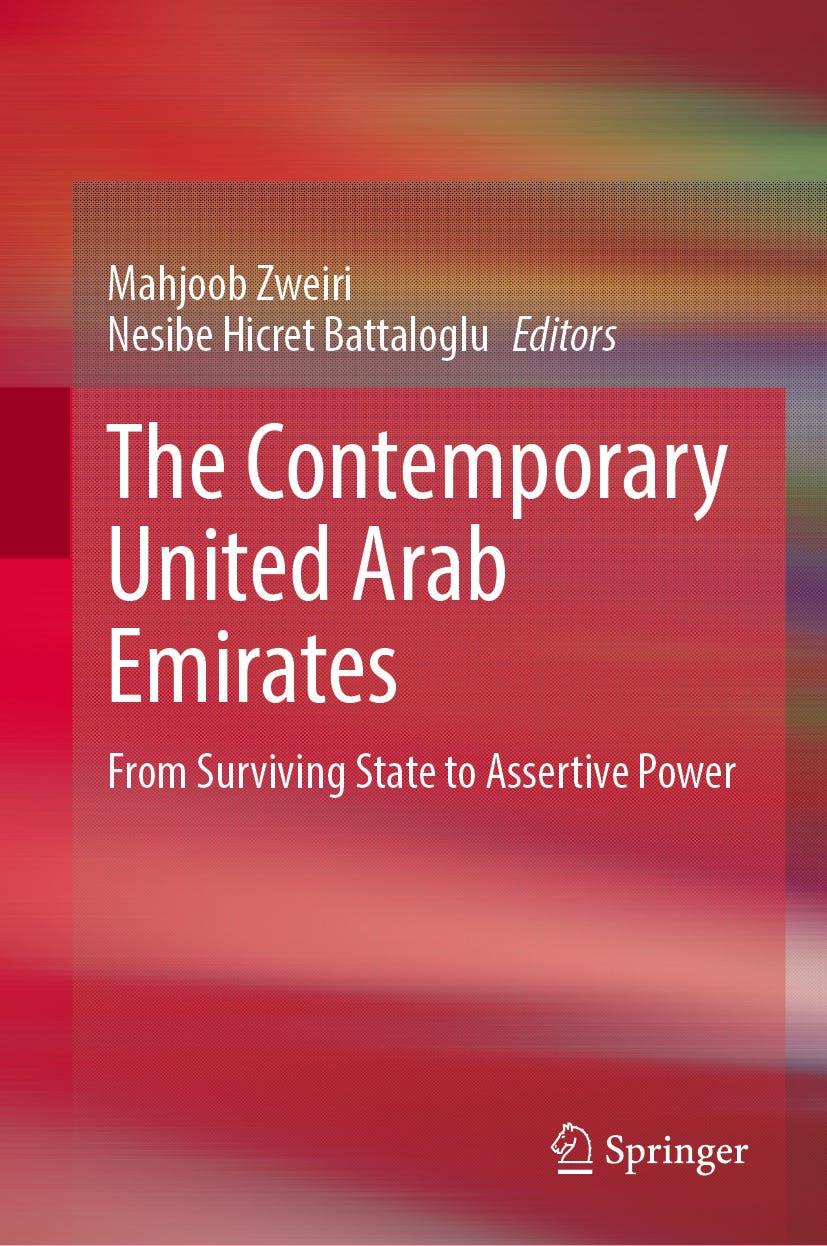
Book: Zweiri, Mahjoob, and Battaloglu, Nesibe Hicret, “The Contemporary United Arab Emirates: From Surviving State to Assertive Power” Springer, April 2026.
Analysis: “The Saudi–Iranian Détente: A Strategic Imperative.” Shahram Akbarzadeh, Middle East Council on Global Affairs, February 19, 2026.
Analysis: “The Saudi-Turkish Pragmatic Realignment.” John Calabrese, Arab Gulf States Institute, February 18, 2026.
Analysis: “Six Flags. Formula One. Aquarabia. Saudi Arabia Bets $32 Billion On Fun.” Christine Burke, Bloomberg, February 20, 2026.
Analysis: “Oman Sets Its Economic Compass for the Year Ahead.” Robert Mogielnicki, Arab Gulf States Institute, February 20, 2026.
Analysis: “The GCC’s Calculus: Financing and Securing Gaza in 2026.” Aziz Alghashian, Gulf International Forum, January 21, 2026.
Analysis: “Why are Middle Eastern governments lobbying against a US attack on Iran?” Galip Dalay, Chatham House, February 19, 2026.
Analysis: “IMF Staff Completes 2026 Article IV Mission to Qatar.” IMF, February 12, 2026.
Analysis: “Constraint and Competition: Saudi Arabia’s Regional Policy in a Shifting Middle East.” Arab Center [DC], February 17, 2026.
Analysis: “The UAE’s Pitch for Cricket.” Raphaël Le Magoariec, Arab Gulf States Institute, February 19, 2026.
Analysis: “Bridging the Gulf: Energy Policy and Climate Governance in the GCC.” Justin Dargin, Middle East Council on Global Affairs, February 9, 2026.
Podcast: “Where is the Emirati–Kuwaiti Partnership Headed?” Hosts Matar Al Neyadi, Arab Cast, February 16, 2026.
Interview: “KDIPA and Goldman Sachs on Gulf Investments.” Interviewee Sobeeh Almukhaizim, Anthony Gutman, and Goldman Sachs, Bloomberg, January 20, 2026.
Webinar: “Global Energy Dynamics 2026: Oil, Politics, and Power Plays From Washington to the Gulf.” Speakers Aldo R. Flores-Quiroga, Carole Nakhle, Harry Tchilinguirian, BNP Paribas, and Kate Dourian, Arab Gulf States Institute, February 19, 2026.