

Oil, Strait of Hormuz, and Stock Markets
Oil Price Update
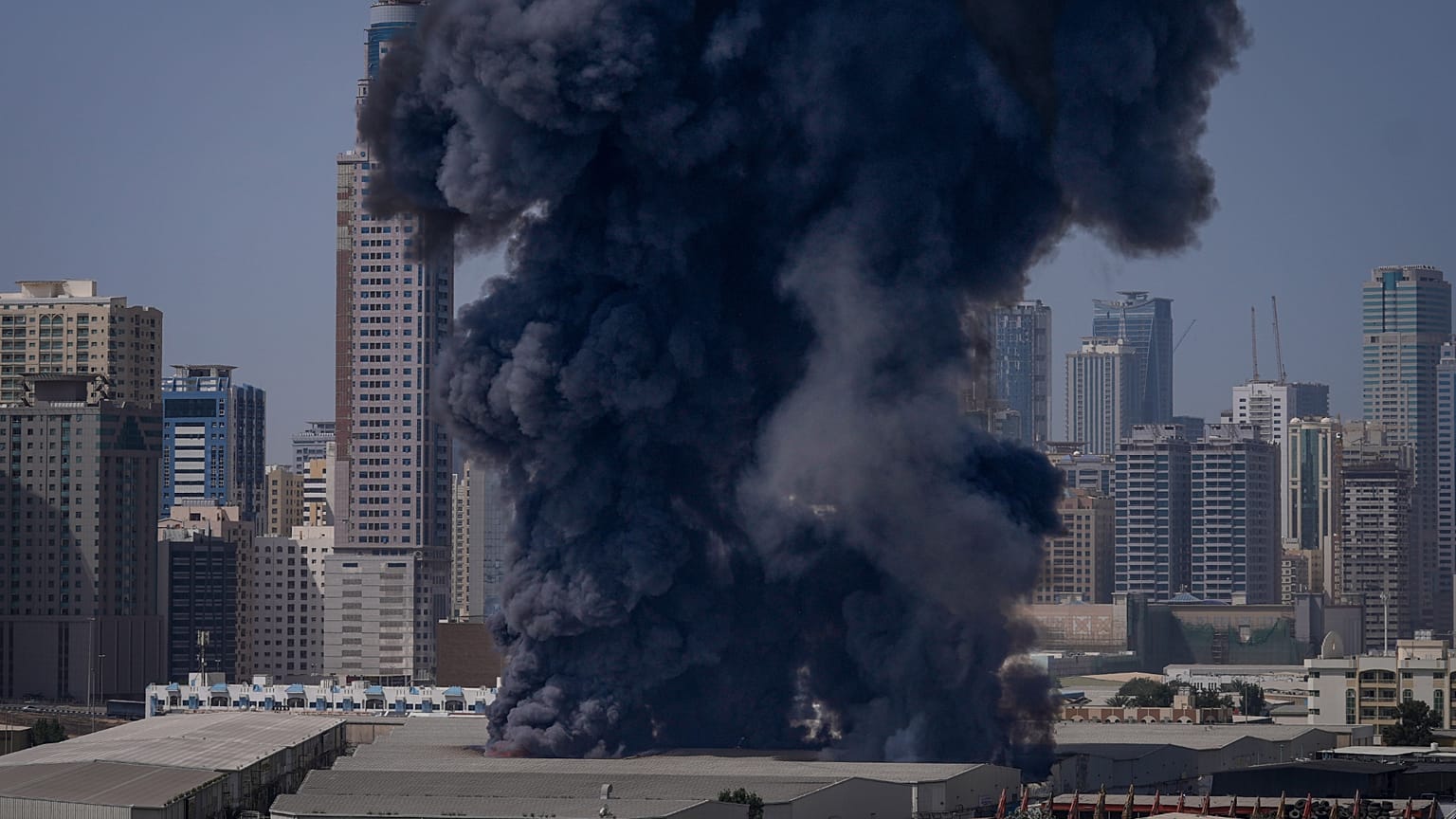
As of the market close on March 6, 2026, West Texas Intermediate (WTI) crude oil settled at $90.90 per barrel. This represents a staggering 35.8% increase from the pre-war price of $66.96 on February 27. The weekly surge peaked following the direct drone attempt on the Shaybah oil field and the total closure of the Strait of Hormuz.
Source: Investing.com, March 8, 2026.
Strait of Hormuz Status
UKMTO reports a total collapse in transit activity over the last seven days. Since March 1, daily commercial crossings have dropped from a baseline of ~100 to just 2 recorded today. The area is classified as “critically dangerous” following 15 confirmed maritime strikes this week.
Source: UKMTO, March 8, 2026.
Stock Markets Performance
Defense Summary
Media Coverage
“Arab League to hold emergency meeting over Iranian attacks.” Al Arabiya, March 07, 2026.
“Iran to halt strikes on neighbours unless attacks from there: Pezeshkian.” Al Jazeera, March 07, 2026.
“Pakistan, Saudi Discuss Security Measures as Iran Strikes Region.” Bloomberg, March 07, 2026.
“UAE ‘not an easy target’, President warns enemies against misjudging strength.” Gulf News, March 07, 2026.
“US to reinsure maritime losses in Gulf up to about $20 billion.” Reuters, March 07, 2026.
“Emirates to Resume Flights After Brief Halt on Missile Threats.” Bloomberg, March 07, 2026.
“Ukraine’s interceptor drone makers look at exports to the Gulf as Iran war flares.” Reuters, March 07, 2026.
“`UAE and Kuwait Start Oil Output Cuts After Hormuz Blockage.” Bloomberg, March 07, 2026.
“Exclusive: Saudi has told Iran not to attack it, warns of possible retaliation, sources say.” Reuters, March 07, 2026.
Gulf Opinions
This week, Gulf commentators devoted significant attention to the war involving Iran, with many voices across the region condemning the recent Iranian attacks on Gulf states and warning about the wider regional consequences of the conflict. Bahrain commentator Abdulnabi Alshoala warns that targeting Gulf Cooperation Council states will only widen the confrontation and further destabilize the region, deepening mistrust toward Iran among Gulf societies and threatening what remains of prospects for coexistence. From Kuwait, Abdullah Al Shyji cautions Gulf countries “not to be dragged into a war that is not theirs,” arguing that the US–Israeli war against Iran represents a war of choice that risks pushing the region toward dangerous escalation. While condemning Iranian attacks on Gulf territory and affirming the right of self-defense, he emphasizes that Gulf states should prioritize unity, restraint, and diplomacy in order to avoid a prolonged regional conflict.
Similarly, UAE commentator Salem Alnuaimi argues that the Gulf has been drawn into the conflict not by choice but through Iranian missile and drone strikes targeting its infrastructure, energy routes, airports, and ports, effectively turning the region into a direct battlefield. In his view, the moment represents a serious test of Gulf and broader Arab solidarity, raising questions about whether the Gulf Cooperation Council will remain merely a framework for coordination or evolve into a mechanism capable of collective deterrence and protection of sovereignty. Another UAE voice, Mohammed Khalifa, points to what he sees as a notable aspect of the Emirati position: despite repeated Iranian attacks, particularly against Emirati interests, the UAE continues to maintain neutrality and avoids direct involvement in the war. From Qatar, Ahmed Ali stresses that no country has worked harder than Doha to help reduce Iran international isolation and encourage its integration into the regional environment, yet Tehran has continued to target Gulf capitals, including Doha, and maintain hostile relations with its neighbors.
Several Saudi commentators focused on the military and political trajectory of the conflict. Abdulrahman Al Rashed argues that even after only a short period of fighting, the balance of power has already begun eroding capabilities that Tehran had previously refused to negotiate away. While he does not describe the situation as a decisive victory, he suggests the confrontation has succeeded in containing parts of the Iranian threat, although the regime itself remains cohesive and the question of what comes next in Tehran remains uncertain. Hassan Al Mustafa approaches the issue from another angle, arguing that Iranian official rhetoric toward Gulf states sharply contradicts its actions on the ground. While Iranian leaders speak publicly of cooperation and good neighborly relations, he notes that missiles and drones continue to target Gulf territory. Al Mustafa outlines several possible explanations for this contradiction, including dual messaging between diplomacy and military escalation, the growing influence of the Revolutionary Guard over foreign policy, the marginalization of moderate factions, disruption in command structures following the killing of senior figures, and the use of proxies and covert attacks to maintain pressure while preserving deniability.
From Oman, Ibrahim bin Salim Al Siyabi reflects on the broader international context, arguing that repeated strikes on sovereign states without clear international authorization reveal a deeper shift in the global order. In his view, the erosion of legal norms and the increasing reliance on force, assassinations, and regime-change rhetoric suggest that international relations are moving away from rules toward power politics. In such an environment, he warns that fragmented regions may become vulnerable to external pressure unless they strengthen cooperation and collective resilience. Echoing the uncertainty surrounding the conflict, Omani commentator Khaled Al Ghasani concludes that the world is watching with growing concern, questioning whether the war will remain contained or expand into a political and economic earthquake capable of “reshaping both the region and the wider international system.”
More Gulf Opinions on Iran War
“Information indicates that wars fought on a religious basis account for no more than 7 percent of all wars throughout history. Most modern conflicts combine politics, nationalism, and economics, and may sometimes employ the religious factor indirectly without openly declaring it. Yet today we face a striking paradox in the third millennium, separated by centuries from the last wars that drew their causes and fuel primarily from religious motivations.”
Hamood Abu Talib, Okaz, (Saudi Arabia), March 8, 2026.
“From here emerges the need for a gradual transition from the traditional coordination model to a more integrated model based on building an institutional framework capable of achieving greater collective effectiveness without undermining the national sovereignty of member states. This could be achieved by adopting a hybrid federal model that combines certain characteristics of both federal and confederal unions, allowing the development of joint Gulf cooperation while preserving the independence and sovereignty of the states.
Modhi Mubarak Al Buainain, Al Sharq, (Qatar), March 7, 2026.
“Paradoxically—and somewhat naively—it has become evident how superficial the current American leadership is and how little it understands these matters. The extremist Christian Zionism represented today by influential figures in Washington and Tel Aviv speaks of an ideological war against Muslims, framed as a divine mandate to fulfill alleged Talmudic promises regarding the return of Christ. What Mike Huckabee, the US ambassador to Israel, stated in this regard can in fact be seen as an acknowledgment that a religiously framed war is being pursued to realize the goals of a “Greater Israel” stretching from the Euphrates to the Nile, in preparation for fulfilling the promises of the Torah and the Gospel.”
Mohammed Awadh Al Mashikhi, Al Roya, (Oman), March 7, 2026.
“Iran faces three possible scenarios. The first is openness: engaging in serious negotiations with the West and building good-neighborly relations with the Gulf states in order to save Iran from collapse. The second is hardline consolidation, in which the Revolutionary Guard and the conservative hardline current impose their control and appoint a radical successor, further increasing the suffering of the Iranian people. The third is chaos, where Iran could slide into a civil war that would affect neighboring countries, trigger waves of refugees, and lead to the fragmentation of the so-called axis of resistance into rival factions.
Ahmed Al Dawas, Al Seyassah, (Kuwait), March 5, 2026.
“Thank you [Iran] for reminding us that we in the Gulf Cooperation Council are one, that everyone asks about everyone, and that all are convinced our six states are our fortress and our stronghold, and that your regime will never gain our trust no matter how much we extend it. The second thanks is that you awakened your sleeping cells within our Gulf states, exposing yourself to those who once thought you were the sleeping princess. Thank you for revealing a dark layer that spared not even the Gulf states that once supported you and acted as mediators, rushing to your aid in times of hardship—only for you to plant a dagger in their side, bomb them just as you bomb those you openly declared enemies.”
Sawsan Al Sha’er, Al Watan, (Bahrain), March 4, 2026.
Nashra Picks
Analysis: “From Passive to Active Defense: Gulf Countries’ Options in Responding to Iran’s Aggression.” Emirates Policy Center, March 6, 2026.
Analysis: “Avoiding War with Iran Is the Gulf’s Only Winning Move.” Alanoud Al Thani, Middle East Council, March 7, 2026.
Analysis: “Iran’s Regional Gamble and Its Implications for the Future of Gulf Security.” Khalid Al-Jaber, Middle East Council, March 2, 2026.
Analysis: “Iran War Tests Qatari Mediation and Diplomacy.” Arab Gulf States Institute, March 6, 2026.
Analysis: “Caught in the Crosshairs, Gulf Arab Countries Remain Crucial to Peace.” Arab Gulf States Institute, March 4, 2026.
Analysis: “Iran Is Pushing Its Neighbors Toward the United States.” Carnegie, March 4, 2026.
Analysis: “What a Middle East oil and LNG crisis means for China and East Asia.” Atlantic Council, Joseph Webster, Reid I’Anson, and Kevin Li, March 5, 2026.
Interview: “Q&A: Sheikh Nawaf al-Sabah ’94 Describes Iran’s Attacks on Kuwait.” Princeton, March 6, 2026.
Podcast: “Between Tehran and Washington: Where Do the Gulf States Stand?” with Bader Al-Saif, Bedoon Waraq podcast, March 5, 2026. [Eng Subtitle].
Podcast: “How the Gulf Countries Are Responding to Iran’s Attacks.” Foreign Policy, March 5, 2026. [Eng].
Webinar: “Fight or Flight? The Gulf States Weigh their Options.” Middle East Institute, March 4, 2026. [Eng].
Webinar: “The Repercussions of the War on Iran and Regional Transformations.” with Rashid Al Muhannadi, Haider Saeed, and Shafiq Shqair, Middle East Council, March 5, 2026. [English subtitles].
Webinar: “After the Shock: Implications of the U.S.–Israeli Strikes and Iran’s Leadership Transition.” Arab Gulf States Institute, March 3, 2026.