

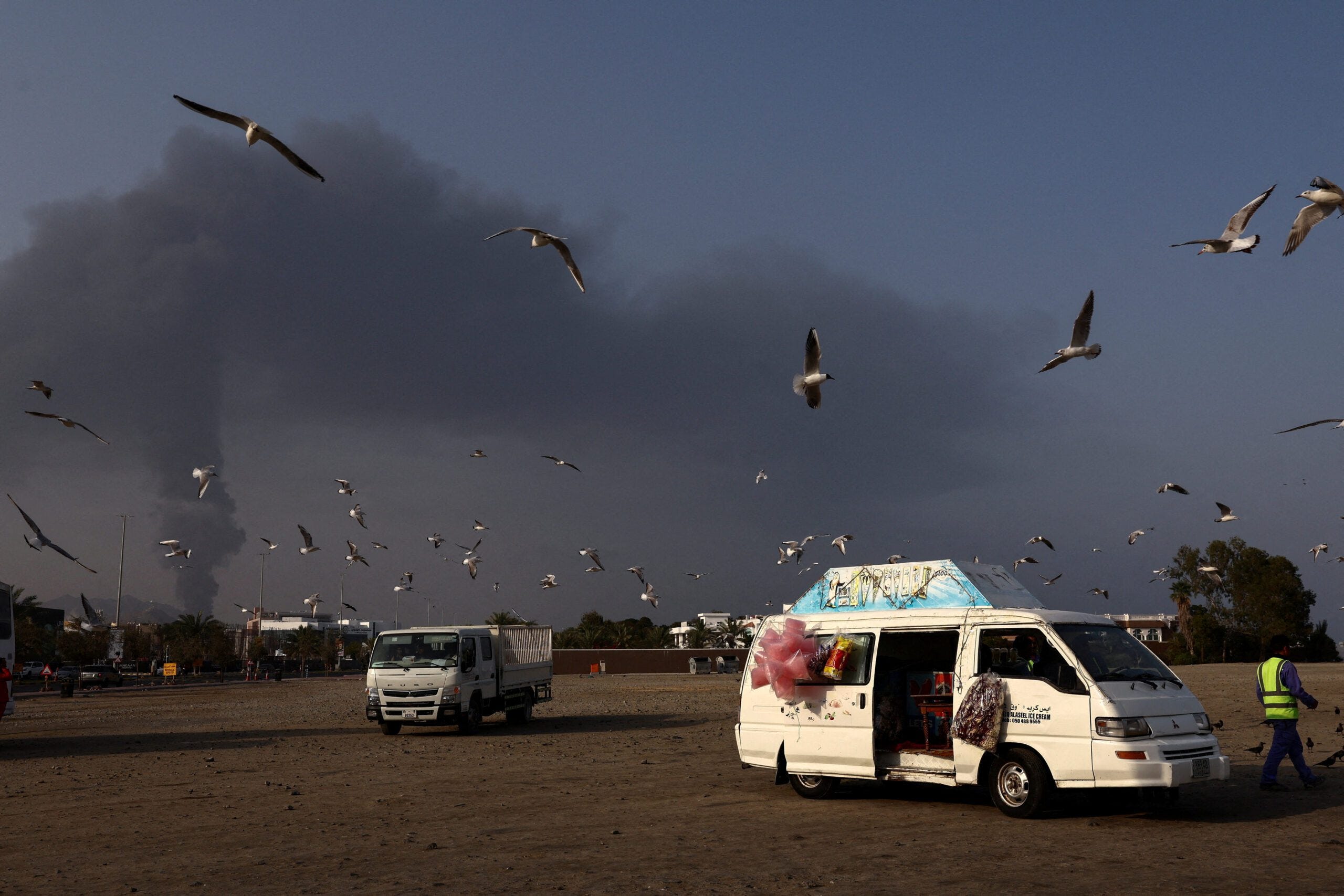
Five weeks of war have reshaped how Gulf publics think, debate, and disagree. The conversation is richer than most outside coverage suggests. This week's digest brings together the sharpest Gulf commentary on the conflict, curated reading and listening for those who want to go deeper, and the perspectives that aren't making it into the international press.
If you find it useful, share it with someone who should be reading it.
Public Debates
The question of who is “winning” the current confrontation between Iran, the United States, and Israel has evolved into a broader intellectual divide across Gulf commentary—reflecting not only battlefield interpretations, but deeper disagreements over power, narrative, and long-term consequences. While some argue that Washington has achieved strategic gains, others insist that Iran has imposed new constraints on the region. Between these views, a third position emerges: the outcome remains unclear, but the Gulf is bearing the heaviest cost.
A balanced reading begins with Hamad bin Jassim Al Thani from Qatar, who frames the situation in terms of risk rather than victory. He warns that escalation may persist because “there are parties that want this war to continue… knowing its consequences will not directly affect them,” pointing to Israel, whose ports “remain open to the Mediterranean and the Red Sea.” By contrast, the Gulf faces systemic exposure: “the continued choking of the Strait of Hormuz could lead to serious economic repercussions… not only for the region, but for the global economy.” His key question—“who benefits from this collapse?”—captures the ambiguity, especially as he suggests that “the United States is not the real beneficiary.”
This uncertainty is reinforced by Bahraini writer Jaffar Salman, who focuses on messaging rather than outcomes. He argues that Donald Trump delivers multiple narratives simultaneously: “to Europe, readiness to stop the war… to the Gulf, Iran, and Israel, continued escalation… to the American public, victory.” In this view, rhetoric itself becomes a strategic tool.
One major camp argues that Iran holds the upper hand—not through decisive military superiority, but through its ability to impose costs. Kuwaiti thinker Abdullah Alnefisi states that “Trump is looking for an exit… he fell into an Israeli trap.” Qatari analyst Mohammed Alahmari similarly argues that Washington has effectively “ceded” leverage over the Strait of Hormuz, describing it as “the real nuclear bomb of Iran.”
This view is reinforced by battlefield persistence. Saudi writer Khaled Almalik notes that despite repeated U.S. claims of victory, “Iran continues to attack Israel, American forces, and Gulf states,” raising doubts about whether its capabilities have truly been neutralized. Even if U.S. claims were accurate, he warns of a strategic vacuum that could enable Israeli expansion under full Western backing.
Economically, Iran’s leverage appears clearer. Saudi economist Hebshi Alshimary notes that roughly “20 million barrels of oil per day” pass through the Strait of Hormuz, making disruptions globally consequential. The crisis has exposed fragility: some Gulf producers cut output due to storage limits, while shipping costs surged sharply. Iran, in effect, has weaponized geography into economic pressure.
Omani perspectives extend this argument further. Abbas Alzadjali argues that Iran’s asymmetric responses have disrupted energy markets and imposed insecurity across the Gulf, raising questions about whether the war reflects strategic necessity or “overconfidence in military power.” Meanwhile, Asim Al-Shidi contends that the U.S.-led security model has lost “legitimacy,” now seen as aligned with Israeli dominance rather than regional balance.
Yet another camp insists that the United States has achieved meaningful gains. Kuwaiti writer Saad bin Tiflah Alajmi argues that U.S.-Israeli actions disrupted Iran’s plans, “confusing the timing” of a premeditated attack on Israel, noting that “85 percent of Iranian drones and missiles” were instead directed toward the Gulf and Jordan.
Emirati analyst Salah Al-Ghul emphasizes Iran’s growing isolation, arguing that continued attacks have deepened its marginalization and that any settlement must include “clear guarantees to prevent repeated aggression” across missiles, maritime pressure, and proxy networks.
From Kuwait, Muhammad Nasser Al-Atwan argues that Iranian targeting patterns reveal weakness: rather than striking fortified U.S. bases, Iran focuses on civilian infrastructure, suggesting a strategy of “economic coercion and psychological warfare” against Gulf societies.
Finally, U.S. advantage also appears in narrative control. Omani writer Mubarak Al-Hamdani notes that a single U.S. statement can move global markets within minutes, highlighting a broader “struggle over strategic narratives” and who controls them.
Taken together, these perspectives suggest that framing the conflict as a simple U.S. or Iranian victory misses the larger picture. Iran has imposed asymmetric costs, particularly through energy disruption, while the United States retains structural advantages in military, financial, and narrative domains. The most consistent conclusion across Gulf commentary is not who has won, but who is absorbing the consequences: a region caught between escalation, uncertainty, and a shifting balance of power.
